Helen of Troy (HELE) — supplier footprint, contracts and what investors should price in
Helen of Troy designs, imports and distributes consumer household and personal-care products and monetizes primarily through product sales to retail channels and by licensing branded trademarks for royalty income. The company sources most finished goods from third‑party manufacturers (largely in Asia), funds working capital and M&A from a large credit facility, and uses a mix of long‑term leases and short‑term hedging to stabilize costs. For investors, the core economics rest on outsourced manufacturing scale, trademark licensing royalties, and the company’s ability to manage global logistics and interest‑rate exposure. Learn more at https://nullexposure.com/.
Snapshot: how HELE contracts with the market
Helen of Troy runs a hybrid procurement and finance model: operational manufacturing is outsourced and highly concentrated, while financing and occupancy are managed through multi‑year credit and lease commitments. Key characteristics:
- Contracting posture: A mix of long‑term obligations (multi‑year trademark licenses, 7–20 year leases, term loans maturing in 2029) and short‑term tactical instruments (12–24 month FX forward contracts, short leases and leasebacks). This creates predictable fixed costs alongside working‑capital volatility. (Company filing, FY2025 Form 10‑K filed Feb 28, 2025.)
- Concentration: Finished goods manufacturing is concentrated geographically — about 79% of finished goods purchased were manufactured in Asia in FY2025, with 63% manufactured in China. That concentration drives tariff and logistics exposure and raises single‑point supply risk. (FY2025 Form 10‑K.)
- Criticality: Third‑party manufacturers are mission‑critical — distributors and retailers depend on timely shipments and inventory; any interruption in Asian manufacturing or container capacity will directly hit sales and margins. (FY2025 Form 10‑K.)
- Maturity: Supplier relationships range from mature co‑development ties with established manufacturers to active short‑term logistics vendors and recent real‑estate lease arrangements tied to corporate moves. Several relationships are actively managed and audited for compliance. (FY2025 Form 10‑K.)
The relationships on record — what the filings and press reveal
Below are the supplier/partner relationships surfaced in public reporting and local media; each entry is grounded in the source material.
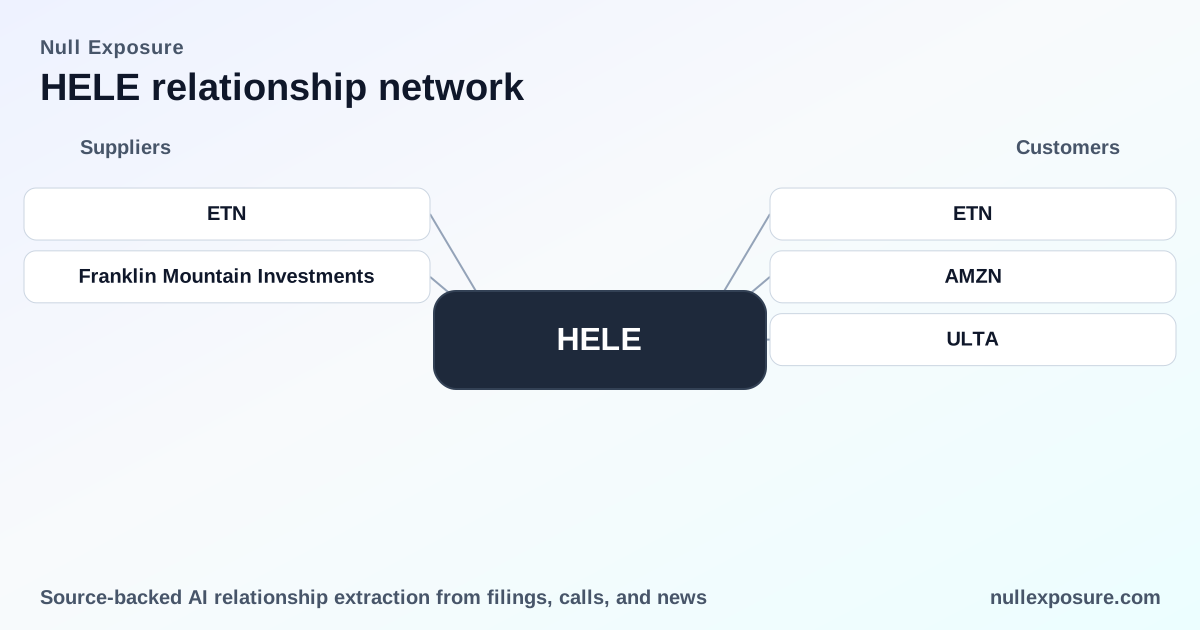
Eaton — Helen of Troy is leasing back a West Side office building from Eaton for up to 18 months, largely rent‑free as part of a relocation and facility sale/leaseback arrangement. This leaseback was disclosed in local reporting on the company’s headquarters move. (El Paso Times, March 1, 2024 — coverage of the headquarters relocation and leaseback.)
Franklin Mountain Investments — Franklin Mountain Investments (the vehicle managing owner Foster’s real estate holdings) is the landlord/developer for the One San Jacinto Plaza space where Helen of Troy will occupy the third floor and most of the fourth floor under a 10‑year lease for 54,000 square feet, with Helen of Troy undertaking renovations. (El Paso Times, March 1, 2024 — article describing the downtown lease and renovation.)
What the constraint signals say about HELE’s operational risk
The company’s published constraints and disclosures provide investor‑grade signals that flesh out the above relationships without attributing specific constraints to either landlord unless explicitly named:
- Long‑term commitments dominate the liability profile. The firm carries long‑term debt obligations concentrated toward fiscal 2027–2029 and records leases with remaining terms up to 20 years; long‑dated license and royalty commitments (minimum royalties in the low‑single‑digit millions annually) further lock in fixed outflows. These factors make operating leverage sensitive to sales downturns. (FY2025 Form 10‑K.)
- Licensing is a structural revenue lever and cost center. Helen of Troy is both a licensee and a licensor in different arrangements: it pays minimum royalties under several trademark licenses (future minimum annual royalties ~ $6.3M and declining over the next five years) while also licensing trademarks to third parties for royalty income. Loss of key licenses would alter both revenue and cost structure. (FY2025 Form 10‑K.)
- APAC manufacturing concentration is the single largest supply‑chain signal. With roughly 79% of finished goods from Asia and 63% from China, production lead times are long and subject to tariffs, freight inflation, and geopolitical risk; the company is explicitly pursuing diversification outside China to mitigate tariff risk. (FY2025 Form 10‑K.)
- Counterparty mix includes governments and very large financial institutions. Treasury bills and large bank credit facilities are part of the liquidity and hedging strategy; derivatives exposure is managed with major financial counterparties. This reduces counterparty credit risk but ties the company to global liquidity cycles and SOFR movements. (FY2025 Form 10‑K.)
- Spend scale is meaningful. Multiple signals point to >$100M contracting bands — a $1.5B aggregate credit facility commitment, material acquisition cash payments (e.g., $229.4M initial cash for Olive & June), and a $500M repurchase authorization — which all underscore scale in procurement and financing. (FY2025 Form 10‑K.)
If you want a consolidated supplier profile or a tailored counterparty risk brief for HELE, visit https://nullexposure.com/ for our full services.
Operational implications for investors and procurement teams
Assessing HELE requires focusing on four investment levers:
- Supply resilience — The manufacturing concentration in China and broader APAC means slower replenishment, elevated inventory needs, and tariff exposure; monitor throughput at 3PL partners and the firm’s success in sourcing outside China.
- Cash flow and covenant risk — Large term loans and a sizable credit facility mean solvency outcomes are tied to covenant compliance; interest‑rate swaps hedge variable rates but residual exposure remains until 2029 maturities are addressed.
- Brand/licensing durability — Minimum royalties are non‑negligible and some trademarks are indispensable to market positioning; licensing churn would compress margins and require reallocation of marketing spend.
- Lease and occupancy flexibility — Recent sale/leaseback and an 18‑month leaseback arrangement, plus the 10‑year downtown lease, show management using real‑estate as a balance‑sheet lever; watch for future lease refinancings and short‑term lease obligations that affect SG&A.
Mid‑article action: For a vendor concentration heatmap or covenant stress test tailored to HELE, engage with our research at https://nullexposure.com/.
A concise due‑diligence checklist for underwriting HELE relationships
- Confirm top three manufacturers and their contingency plans for container or factory shutdowns.
- Validate royalty schedules and termination rights on key licensed trademarks.
- Stress test the credit agreement covenants against downside sales scenarios through FY2029.
- Review 3PL contracts and insurance coverage for weather‑related disruptions (inventory storage incidents were recorded historically). (FY2025 Form 10‑K.)
Bottom line — what to price in now
Price Helen of Troy as a consumer‑product consolidator with material supply‑chain concentration and sizeable financing commitments. Upside derives from successful diversification of manufacturing out of China, stable royalty income and margin recovery; downside comes from tariff shocks, freight disruption and leverage pressure through 2027–2029 maturities. Leaseback and real‑estate moves are tactical balance‑sheet actions that improve near‑term liquidity but do not eliminate structural supply and licensing risk. For deeper counterparty analysis and bespoke supplier scoring, start here: https://nullexposure.com/.
Sources: El Paso Times (coverage of Helen of Troy’s headquarters move, March 1, 2024) and Helen of Troy FY2025 Form 10‑K and related filings (period ending Feb 28, 2025).