HEMI: Hartford’s Equity-Premium Income ETF — supplier relationships and what they mean for investors
Hartford Funds launched the Hartford Equity Premium Income ETF (HEMI) as an actively managed equity vehicle that monetizes through management fees while delivering income via a systematic short-call overlay. The fund generates distributable income by selling out‑of‑the‑money call options on broad S&P 500 exposures (either the index itself or SPY) and packages that income into an ETF wrapper to attract yield‑seeking assets. For investors and operating partners, the relevant questions are counterparty structure, operational concentration, and how critical each supplier is to the overlay strategy and distribution model. Learn more at the NullExposure homepage: https://nullexposure.com/
Quick read: how HEMI operates and why suppliers matter
HEMI’s core operating model is straightforward: equity exposure plus systematic option writing, executed at scale through an ETF structure. Hartford Funds captures fees for portfolio management and ETF operations; the option-writing component captures option premium but also introduces dependency on trading counterparties, execution platforms, and index/ETF liquidity. Supplier relationships therefore drive both cost and execution risk, and they define the fund’s operational profile for distributors and institutional counterparties.
Visit NullExposure for deeper supplier intelligence: https://nullexposure.com/
Supplier relationships — a close read of disclosed partners
Below are the supplier relationships disclosed in public coverage and their practical implications for investors and operators.
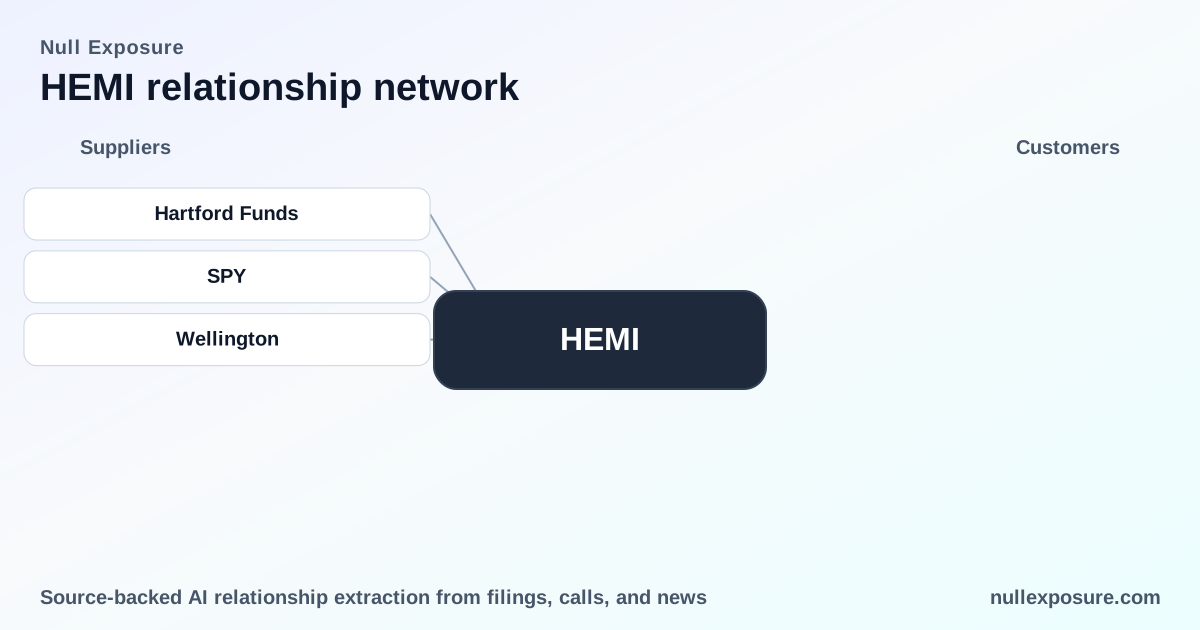
Hartford Funds — the issuer and manager
Hartford Funds is the issuer and active manager of HEMI, designing the strategy that pairs U.S. equity exposure with a systematic short S&P 500 call-writing overlay. According to a Benzinga article published March 10, 2026, Hartford Funds launched the Hartford Equity Premium Income ETF and positions Hartford as the fund’s manager (https://www.benzinga.com/etfs/new-etfs/25/12/49547862/sp-500-power-meets-income-edge-in-hartfords-latest-etf). Hartford’s role is the primary control point for strategy design, distribution, and fee collection.
SPDR S&P 500 ETF Trust (SPY) — execution and hedging reference
HEMI uses a systematic approach that sells out‑of‑the‑money call options on either the SPDR S&P 500 ETF Trust (SPY) or the S&P 500 Index to generate option premiums; SPY therefore functions as a practical execution vehicle and liquidity anchor for the overlay. The same Benzinga piece (Mar 10, 2026) describes the use of SPY or the index as the derivatives reference (https://www.benzinga.com/etfs/new-etfs/25/12/49547862/sp-500-power-meets-income-edge-in-hartfords-latest-etf). SPY’s liquidity and option market depth are critical to predictable premium capture and low slippage.
Wellington — distribution partnership and advisor outreach
Wellington (represented by Christina Kopec Rooney) is cited for a long‑standing partnership with Hartford and a shared focus on developing ETF solutions for advisors, indicating a distribution and advisor‑relationship role for the product’s market rollout. Benzinga’s coverage (Mar 10, 2026) highlights Wellington’s involvement in tailoring ETF-based solutions for advisors (https://www.benzinga.com/etfs/new-etfs/25/12/49547862/sp-500-power-meets-income-edge-in-hartfords-latest-etf). Such distribution partners influence adoption among wealth channels and shape asset inflows.
Operational and business-model constraints investors should treat as company-level signals
With no explicit constraints disclosed in the coverage, evaluate these company-level characteristics as structural signals:
- Contracting posture: HEMI’s model implies a balance of internal management (Hartford-led strategy execution) and external execution via liquid derivatives markets and market-makers. Expect standard issuer-counterparty arrangements rather than exclusive vendor lock‑ins.
- Concentration: The strategy centers on a small set of execution anchors (SPY and S&P 500 options markets) and distribution partners, creating concentration risk in liquidity and advisor reach. Concentration simplifies operations but raises dependence on a few counterparties and channels.
- Criticality: The option-overlay capability is mission-critical to HEMI’s value proposition; any interruption to execution (platform outages, option-market stress, or reduced SPY liquidity) reduces distributable income and damages competitive positioning.
- Maturity: HEMI is a newly launched ETF under Hartford’s product umbrella, placing it in an early commercial maturity stage where distribution traction and initial AUM accumulation determine medium-term viability.
What investors and operators should focus on now
Focus attention on these practical risk and execution vectors:
- Liquidity and execution: SPY option market depth and dealer capacity are the most important operational levers for premium capture.
- Distribution momentum: Partner relationships like Wellington drive advisor adoption and initial AUM scale; monitor placement statistics and institutional uptake.
- Governance and tilts: Understand how Hartford controls the overlay sleeve, option strike selection, and risk limits to evaluate downside exposures.
Key risk and opportunity highlights:
- Execution dependency on SPY/options markets — impacts realized yield and cost.
- Concentration of distribution channels can accelerate scale if successful, or constrain asset flow if uptake lags.
- Fee capture and product differentiation derive from Hartford’s ability to deliver consistent income relative to peers.
For a deeper vendor and counterparty assessment, see NullExposure’s supplier intelligence hub: https://nullexposure.com/
Final takeaways and next steps
HEMI is a clear, fee‑based product strategy: Hartford packages U.S. equity exposure with a systematic option-writing overlay to produce income that attracts yield-seeking investors. The fund’s economic performance and operational risk hinge on execution via SPY/options markets and distribution partnerships such as Wellington. Investors should prioritize monitoring execution quality, counterparty resilience, and early distribution metrics as HEMI scales.
To continue analysis on HEMI’s supplier exposure and broader market implications, visit NullExposure for ongoing updates and relationship intelligence: https://nullexposure.com/