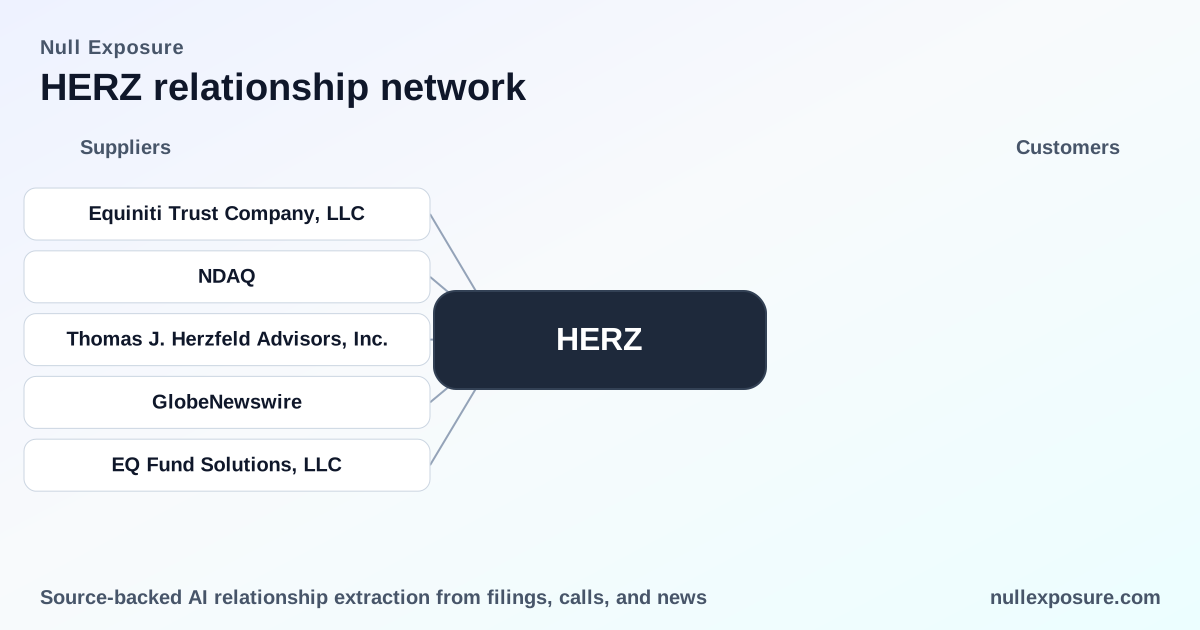
HERZ: Supplier relationships that drive corporate actions and investor access
Herzfeld Credit Income Fund, Inc. (HERZ) is a Nasdaq-listed closed-end fund that monetizes through investment management returns distributed to shareholders and through strategic share-level actions (reverse splits, tender offers) that affect free float and trading characteristics. The Fund outsources core operational services—transfer agency, depositary and information distribution—while its investment exposure and corporate actions are driven by Thomas J. Herzfeld Advisors, Inc., the named SEC-registered investment manager. For investors and operators evaluating supplier risk, the relevant facts are straightforward: the manager controls strategy; third parties execute corporate action mechanics; and exchange and vendor relationships shape liquidity and recordkeeping.
If you evaluate counterparties for capital or operational exposure, start here: https://nullexposure.com/
Why these supplier links matter for investors
Corporate actions such as a reverse stock split and a cash tender offer are governance decisions that change shareholder economics and trading liquidity. Execution relies on a small universe of specialized suppliers: transfer agents and information agents handle the mechanical steps and disclosures; the investment manager proposes and implements strategy; the exchange provides the trading venue. Understanding each relationship clarifies operational concentration, legal routing for disclosures, and potential single points of failure when capital allocation decisions are executed.
- Operational concentration is material. The Fund relies on a few named service providers for discrete but critical functions.
- Managerial control is centralized. Thomas J. Herzfeld Advisors initiates strategic choices (distributions, reverse split, tender offer).
- Market access and registry are distinct risks. Nasdaq is the trading layer; Equiniti and EQ Fund Solutions process investor records and tender logistics.
Explore a structured supplier risk view at https://nullexposure.com/ to compare counterparties and action history.
The relationships—who does what (plain-English summaries)
Thomas J. Herzfeld Advisors, Inc.
The Fund’s investment manager, Thomas J. Herzfeld Advisors, Inc., is an SEC-registered advisor that both runs the Fund’s investment program and recommended the Board-approved reverse stock split; public filings and press releases also describe the manager as the source of forward-looking commentary on the Fund. According to company filings and press releases in FY2025–FY2026, TJHA is the named manager and strategic decision agent for HERZ (Manila Times/GlobeNewswire/QuiverQuant, Oct 2025–Feb 2026).
Equiniti Trust Company, LLC
Equiniti serves as the Fund’s transfer agent and depositary for corporate actions: shareholders of record receive post-split ownership information through Equiniti and the depositary role was referenced in tender-offer results. The transfer-agent role was explicitly cited in press materials around the Fund’s reverse split and tender documentation (Manila Times / Globe and Mail, Jan–Feb 2026).
EQ Fund Solutions, LLC
EQ Fund Solutions acted as the information agent for the Fund’s cash tender offer, responsible for distributing tender materials and investor communications tied to that offer. The information-agent designation for the tender was disclosed in the Fund’s Oct 2025 communications (Manila Times, Oct 17, 2025).
Nasdaq Capital Market
HERZ continues to trade on the Nasdaq Capital Market under the ticker “HERZ”; the exchange processed the reverse split mechanics and the Fund retained its listing while issuing a new CUSIP effective February 6, 2026. Exchange-level details and the post-split CUSIP change were published with the reverse-split announcement (Globe and Mail/QuiverQuant, Feb 2026).
GlobeNewswire (press distribution)
GlobeNewswire functioned as a distribution channel for the Fund’s press releases, which were then republished or summarized by outlets such as The Manila Times and QuiverQuant; one distribution carried the standard press-release disclaimer noted in downstream feeds. Press-distribution via GlobeNewswire is referenced in the Fund’s corporate action communications (QuiverQuant / The Manila Times / Globe and Mail, Oct 2025–Feb 2026).
What this supplier map says about HERZ’s operating model
- Contracting posture: HERZ exhibits a classic closed-end fund posture—strategy is retained by a single named investment manager while execution and investor communications are outsourced to specialist vendors. That allocation concentrates strategic risk with the manager and operational risk with named vendors.
- Concentration and single points of failure: The Fund uses a small number of third parties (Equiniti, EQ Fund Solutions, GlobeNewswire) for transfer, tender logistics, and distribution; these are single providers for their functions and therefore critical to corporate-action execution and shareholder communications.
- Criticality of the manager: Thomas J. Herzfeld Advisors is both the strategic engine and public voice; its recommendations drive Board approvals of actions that directly affect shareholder value and liquidity.
- Maturity signal: Public materials state the manager was founded in 1984 and is SEC-registered, indicating long-tenured advisory continuity rather than an ad hoc or newly created operational structure (Manila Times press background, FY2025–FY2026).
Investor implications — what to watch next
- Execution risk on corporate actions: with single-source transfer and information agents, operational delays or miscommunications could meaningfully affect tender results or post-split recordkeeping. Monitor Equiniti and EQ Fund Solutions notices around future actions.
- Liquidity and float management: the reverse split and tender offer are explicit tools the manager used to alter trading dynamics; investors should track subsequent volume and NAV disclosure cadence reported by the manager.
- Disclosure chain: press distribution through GlobeNewswire and downstream summarizers means investors should read primary filings and depositary notices as published by the transfer agent for authoritative information.
If you need a comparative study of counterparties or a supplier-risk scorecard for HERZ and peer funds, start a tailored review at https://nullexposure.com/.
Actionable takeaways
- Primary risk sits with the manager for strategy and with the transfer/information agents for execution. Both elements deserve active monitoring.
- Corporate actions in FY2025–FY2026 (tender offer, reverse split) were implemented via the named suppliers listed above; investors should view these events as deliberate liquidity-management moves from the manager.
- Operational concentration is non-trivial: single-provider relationships are efficient but create dependency that should be considered in valuation and stewardship decisions.
For operators and investors focused on counterparty risk, supplier performance history, or governance impacts from corporate actions, explore NullExposure’s supplier-analysis tools and reports at https://nullexposure.com/ — they provide a practical next step to quantify and monitor these exact relationships.