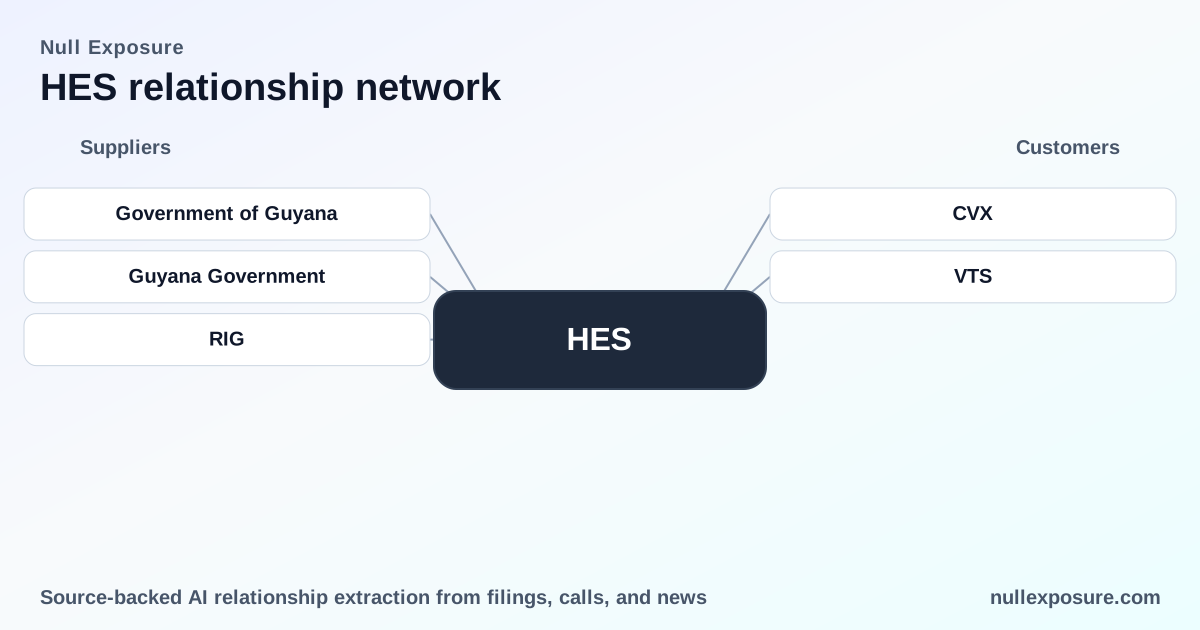
Hess (HES) supplier relationships: what strategic counterparties reveal about execution risk and capital allocation
Hess Corporation is an upstream energy operator that generates cash by producing and selling crude oil and natural gas and by developing deepwater assets; it funds exploration and development while selectively contracting third-party services and environmental offsets to support operations and corporate strategy. Supplier engagements range from multi-year drilling contracts to long-dated carbon-credit purchase commitments, and these counterparties directly shape Hess’s operational cadence, capital allocation, and reputational exposure. For more context on counterparty visibility and supplier risk, visit https://nullexposure.com/.
Why these supplier interactions matter to investors
Hess runs a capital-intensive upstream business where vendor selection and contract tenor translate into measurable operational risk. Long-duration purchase agreements lock in obligations that affect free cash flow and strategic flexibility, while day-rate or extension deals with drilling contractors determine near-term production capability in key basins. Investor focus should be on counterparty quality, contract length and enforceability, and whether supplier engagements improve or constrain Hess’s ability to deliver production and returns.
Operating model signals investors should watch
- Contracting posture — long commitments: The available information shows Hess uses extended contracts and purchase agreements rather than purely spot transactions, indicating a preference for securing capacity and offsets through multi-year deals. This reduces short-term price volatility for inputs but increases fixed obligations across cycles.
- Concentration — targeted counterparties: Engagements with sovereign counterparties and major offshore drilling firms highlight concentration in a small set of mission-critical suppliers; this raises single-point dependency risk for both operations and reputation.
- Criticality — operations and ESG are both operational: Supplier relationships support both core production (drillship capacity) and corporate environmental commitments (carbon-credit purchases), so a disruption would affect production and public positioning simultaneously.
- Maturity — predictable counterparties: Hess is contracting with established counterparties rather than nascent firms, suggesting suppliers are operationally mature and creditworthy, but the company remains exposed to country and industry operating risks (sovereign control, vessel availability).
Supplier relationships — the counterparties to know
Government of Guyana
Hess entered a REDD+ carbon credit purchase agreement with the Government of Guyana committing to buy a minimum of US$750 million of high-quality carbon credits between 2022 and 2032. According to coverage from Demerara Waves and local media reporting in December 2022 and follow-ons in 2023, the deal is a direct sovereign sale structured as a long-term purchase of offsets (Demerara Waves, Dec 2, 2022; NewssourceGY, Dec 2022 / Jan 2023). https://demerarawaves.com/2022/12/02/govt-hess-sign-us750-million-carbon-credit-deal/
Transocean (Deepwater Asgard drillship)
Hess extended a contract for Transocean’s Deepwater Asgard drillship to continue operations in the U.S. Gulf of Mexico, preserving access to a large, capable deepwater rig for Hess’s drilling program. Offshore Energy and Ocean Energy Resources reported a contract extension in 2024 that keeps the vessel working for Hess in the GOM, illustrating the company’s reliance on third-party drillship capacity for deepwater execution (OEDigital, July 2024; Ocean-Energy-Resources, July 2024). https://www.oedigital.com/news/512647-transocean-s-drillship-to-stay-in-gulf-of-mexico-under-195m-contract-extension
What each relationship implies for valuation and risk
- Guyana carbon-credit deal: The US$750 million, decade-long commitment is a material non-production cash outflow pathway that shifts capital to an ESG outcome rather than reservoir development. For investors, this reduces near-term optionality for capital redeployment and increases Hess’s reputational visibility in Guyana; political or administrative changes in Guyana could affect delivery or social distribution of proceeds, which is relevant to social-license risk and investor ESG assessments.
- Transocean rig extension: Retaining a proven drillship removes a key execution risk for planned wells in the Gulf, supporting production targets and cash generation. The extension is a classic opex/capex trade-off: paying for guaranteed vessel availability stabilizes drilling schedules but creates fixed contractual exposure to day rates and extension clauses.
Risk checklist for managers and investors
- Confirm contractual terms: termination rights, force majeure, and pricing escalation in both the carbon and rig contracts will determine Hess’s flexibility if market conditions change.
- Assess sovereign and social risk in Guyana: investor outcomes depend on whether proceeds are delivered as structured and whether local stakeholders accept the arrangement, both of which affect reputational and regulatory risk.
- Monitor fleet availability and day rates: the broader offshore market will affect replacement costs if Hess needs to re-contract rig capacity, which impacts forecasted unit development costs.
- Track public disclosures and payment milestones: payments or initial disbursements tied to the Guyana agreement were reported in early follow-up pieces, providing visibility into execution status (NewsSourceGY coverage, Jan 2023).
For a direct line to more counterparty intelligence and to map supplier concentration against financial exposure, consult NullExposure’s research hub at https://nullexposure.com/.
Tactical investor actions and monitoring cadence
- Prioritize obtaining the full contract texts or detailed summaries through filings or company investor communications to quantify covenants and contingent liabilities.
- Build scenario models that treat the US$750 million carbon commitment as a staged liability against free cash flow over 2022–2032 rather than a one-off charge.
- Stress test production models for rig availability disruptions; quantify the cost to replace Deepwater Asgard capacity if required.
Bottom line: what to watch next
Hess’s supplier picture is dominated by long-duration commitments that lock in both operational capability and ESG-related cashflows. That structure reduces short-term execution uncertainty but introduces fixed obligations that influence capital allocation and downside resilience. Investors should track contractual detail releases, payment timelines under the Guyana agreement, and the offshore market’s day-rate trajectory for rigs. For ongoing monitoring and deeper counterparty mapping, visit https://nullexposure.com/.
Overall, supplier choice confirms Hess’s strategy to secure both drilling capacity and environmental offsets via reputable counterparties, trading flexibility for predictability — a trade-off investors must quantify when modeling future cash flows and downside scenarios.