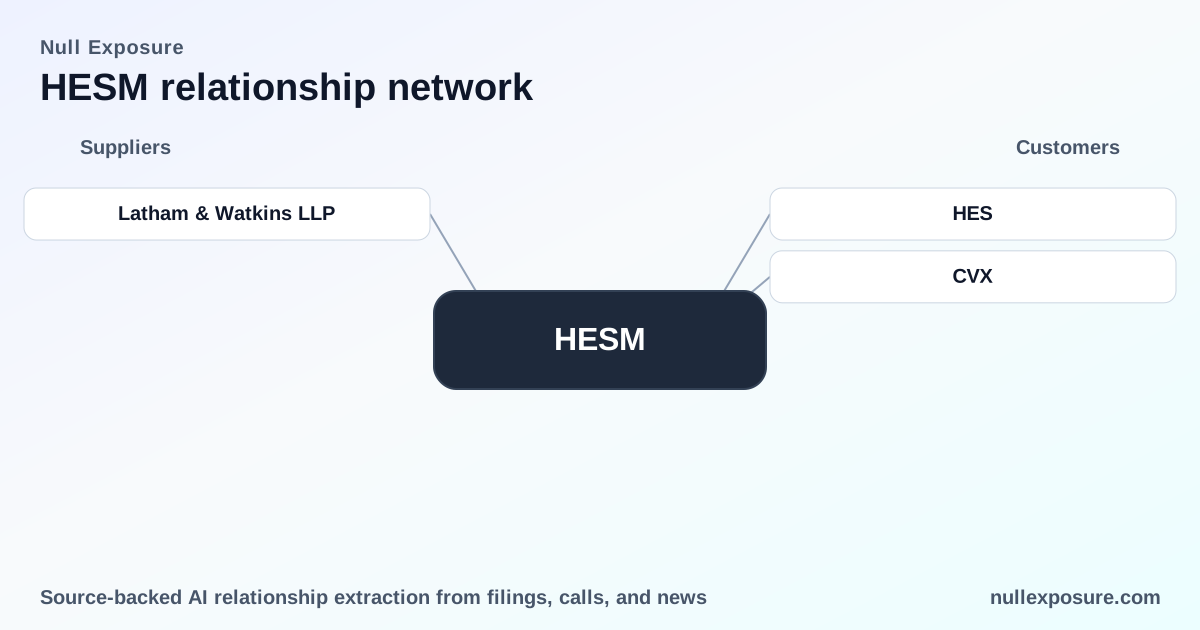
Hess Midstream (HESM) — supplier relationships and what they mean for investors
Hess Midstream Partners LP owns, develops and operates midstream infrastructure in the Bakken and adjacent basins and monetizes through long‑term, fee‑based commercial agreements, processing fees and minimum volume commitments with Hess and third parties, supplemented by joint‑venture processing arrangements and access to capital markets for financing. Its cash flow profile is anchored in contracted throughput and capacity payments, while operational services are largely delivered through secondment and third‑party arrangements. For a deeper supplier-risk map and curated relationship intelligence, visit https://nullexposure.com/.
Two public law-firm engagements — straightforward financing work
Latham & Watkins LLP (FY2024): Latham represented Hess Midstream and a Selling Shareholder in a secondary public offering, acting as corporate counsel on the transaction. Source: Latham & Watkins news release, June 2024 — https://www.lw.com/en/news/2024/06/latham-watkins-advises-hess-midstream-lp-secondary-public-offering
Latham & Watkins LLP (FY2022): Latham previously served as Hess Midstream’s counsel on an earlier secondary offering in April 2022, with a dedicated Houston/Austin corporate team detailed in the firm’s announcement. Source: Latham & Watkins news release, April 2022 — https://www.lw.com/en/news/2022/04/latham-watkins-advises-hess-midstream-lp-secondary-public-offering
Takeaway: Both entries are counsel roles tied to capital markets activity; these are transactional supplier engagements rather than operating dependencies.
How Hess Midstream contracts and where operational risk concentrates
Hess Midstream’s contracting posture blends long‑term, fee‑based backbone contracts with a layer of short‑term and usage-based service agreements. The company has a pronounced long‑term debt and contracting profile: syndicated credit facilities and multi‑year unsecured note issuances frame capital availability and refinancing risk, while the asset base is governed by long‑term commercial agreements that create predictable cash flows.
- Long‑term foundation: The partnership operates under multi‑year credit facilities (including a $1.0bn revolver and five‑year term loan maturing in 2027) and issued senior notes in 2024 and 2022, establishing a medium-term debt maturity ladder and predictable financing costs. (Company filings, 2022–2024)
- Fee‑based commercial contracts with Hess: Gathering assets run under long‑term, fee‑based agreements with Hess that provide minimum volume commitments and fee recalculation mechanisms that stabilize cash flows through contractual floors. (Company filings, 2024)
- Secondment and omnibus arrangements: Operational and administrative staff are supplied under an employee secondment agreement and an omnibus agreement with Hess, where Hess invoices allocable costs plus a markup; this centralizes operating control and concentrates vendor risk around Hess as a service provider. (Company filings, 2024)
- Joint‑venture operating relationships: Processing capacity is shared through a 50/50 LM4 joint venture (operator: Targa) that processes Bakken gas, creating an operator dependency for processing throughput and offload services. (Company filings, 2019–2024)
Bold implication: Hess Midstream’s commercial safety net is contractual rather than fully captive operations; investors should value the predictability of minimum fees while accounting for counterparty and operator concentration.
(If you want a tailored supplier exposure report for HESM, start here: https://nullexposure.com/.)
Spend profile, geography and materiality signals
Hess Midstream’s supplier spend pattern is weighted toward large, multi‑year commitments with material ticket sizes. The company records $100m+ spend bands for financing and repurchase funding and maintains multi‑million operational commitments across maintenance, processing and third‑party rail or water disposal services. The business is geographically concentrated in North Dakota (Bakken), exposing revenue to localized production cycles and state/federal regulatory shifts. Regulatory developments—FERC jurisdiction questions and EPA methane rules—are direct cost and compliance levers for the business.
- Material and critical dependencies: The relationship with Hess and Bakken production is material and in parts critical to throughput; loss of right‑of‑way, reduced Hess activity or a significant operational disruption would materially affect cash flow. (Form 10‑K excerpts, 2024)
- Supplier roles: The supply base functions overwhelmingly as service providers (third‑party processing, rail and disposal services), with Hess acting as both sponsor and supplier of secondees; a minority of procurement is transactional passthrough. (Form 10‑K excerpts, 2024)
Risk profile investors should stress-test
- Counterparty concentration: A single sponsor/counterparty relationship (Hess) supplies both volumes and critical services; diligence should include Hess’s capital and development plan alignment with Hess Midstream’s volume forecasts.
- Regulatory exposure: Changes in FERC classification or stricter methane rules can raise operating costs and reduce revenue on affected facilities. (Regulatory excerpts, 2024)
- Operator and third‑party continuity: LM4 is operated by Targa and the Tioga Rail Terminal uses a contract operator with a 90‑day termination clause; operational interruptions or operator underperformance transmit quickly to cash flow. (Company filings)
- Refinancing and covenant risk: Active debt maturities and covenanted credit facilities require monitoring; the company has issued senior unsecured notes and uses revolver capacity for liquidity management. (Capital structure excerpts, 2022–2024)
Practical procurement and investment implications
- For vendors: prioritize contract models that align with long‑term fee structures or offer performance guarantees that reduce operational transfer risk, because Hess Midstream rewards stability and reliability in third‑party processing and water/rail services.
- For investors: stress test distributable cashflow under scenarios of lower Hess production, shorter-term operator failures, and higher regulatory compliance costs; also review the omnibus/secondment economics because these are recurring pass‑through costs. Audit the fee markup and allocation methodology under the secondment and omnibus agreements.
(Need a supplier risk scorecard built for investors? See https://nullexposure.com/.)
Closing view
Hess Midstream’s supplier ecosystem is clear and investable: predictable revenue from long‑term fee contracts is offset by concentrated operational dependence on Hess and third‑party operators. The Latham & Watkins entries in 2022 and 2024 are transactional counsel engagements tied to capital markets activity, not operational vendors. Investors benefit from the company’s contract structures and minimum volume protections, but must underwrite counterparty concentration, operator continuity and regulatory risk when valuing long‑term cash flow stability.
For an investor‑grade supplier risk dossier and relationship mapping for HESM, visit https://nullexposure.com/ and request the bespoke report.