Home Federal Bancorp Louisiana (HFBL): Supplier relationships that shape liquidity and operating risk
Home Federal Bancorp of Louisiana is a small regional bank holding company that monetizes through net interest margin, fee income and dividend flows from its bank subsidiary. The holding company’s balance sheet is asset-light relative to its banking operations; the parent depends on dividends from Home Federal Bank to fund shareholder distributions and corporate obligations, while the Bank generates revenue from mortgage lending, securities investments and deposit funding in the Shreveport–Bossier market. Investors should evaluate HFBL’s supplier and counterparty footprint for liquidity optionality, concentrated vendor exposure, and contingent funding arrangements. Learn more at https://nullexposure.com/.
Thesis: why supplier relationships matter for a small regional bank
HFBL’s operating model is capital-light at the parent level and capital-backed at the subsidiary level; this creates two strategic facts: (1) funding lines and correspondent relationships are de facto liquidity insurance for the bank and the holding company, and (2) third-party service providers (core processor, auditors, data vendors) are operationally critical because the bank outsources key technology and processing functions. Those relationships drive short-term resilience and long-term margins, and they will determine how quickly HFBL can scale or respond to stress.
FHLB and correspondent capacity: the liquidity lifeline
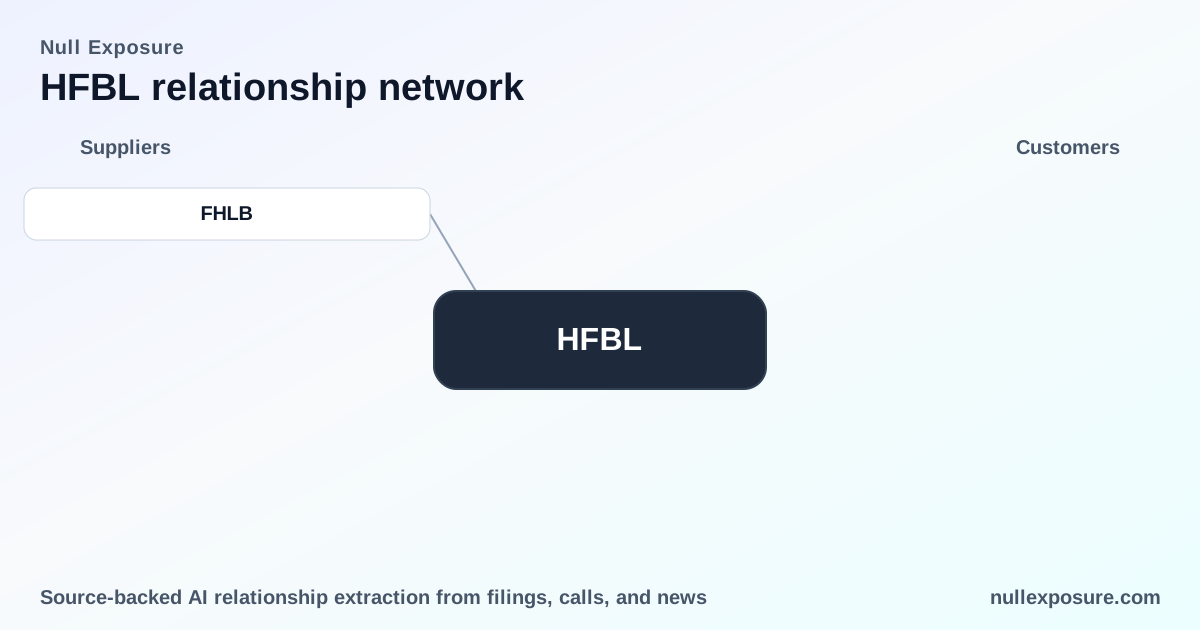
HFBL maintains a formal relationship with the Federal Home Loan Bank (FHLB) system as a member institution. The bank holds FHLB stock, carries available borrowing capacity, and uses secured letters of credit with the FHLB as part of its liquidity toolkit. According to the company’s fiscal disclosures through June 30, 2025, Home Federal Bank had $400,000 in FHLB stock, had no outstanding advances at that date, and reported $56.4 million of available borrowing capacity with the Federal Home Loan Bank of Dallas; secured letters of credit with the FHLB totaled $44.9 million, with $44.9 million expiring within one year. A GlobeNewswire release summarizing FY2026 results reiterated that HFBL reported zero dependency on wholesale funding—no brokered deposits or FHLB advances—at December 31, 2025 and June 30, 2025. (Company FY2025 filings; GlobeNewswire/Globe and Mail, March 2026).
Relationship snapshot: FHLB (Federal Home Loan Bank)
The FHLB relationship gives HFBL a standby line of secured funding and collateralized liquidity through membership stock, borrowings and letters of credit; at June 30, 2025 HFBL had no advances outstanding but retained substantial available capacity and outstanding letters of credit backed by the FHLB. (Company filings for period ended June 30, 2025; GlobeNewswire FY2026 release, March 2026).
Vendor and service-provider exposure: operational concentration to watch
HFBL outsources core banking processing, cybersecurity testing, and a range of IT services to third parties and uses external auditors for financial reporting. Data processing expense rose materially in FY2025 after a billing issue with the core processor required a negotiated settlement, demonstrating vendor financial and operational impact on expense volatility. The company maintains a vendor oversight program and requires third-party notification for security incidents consistent with FFIEC guidance, but the bank remains reliant on external vendors to maintain processing, audit, and cybersecurity functions. Investors should treat vendor performance and contractual terms as first-order operational risk. (Company FY2025 disclosures on vendor oversight and data processing expense).
Contract posture, maturity profile and commitment sizes
HFBL’s contracts show a mix of long-term, framework and short-term arrangements that together define durability and optionality:
- Long-term leases and loan maturities — the bank reports operating leases with weighted-average remaining lease terms (operating leases) extending decades in aggregate and an outstanding loan to First National Bankers Bank maturing in 2034, demonstrating long-dated commitments on the liability and real-estate side.
- Framework purchase agreements — the bank participates in a Master Purchase Agreement with First National Bankers Bank for federal funds purchases up to $20.4 million, giving HFBL intraday/term funding flexibility under pre-established terms.
- Short-term contingent facilities — secured letters of credit with the FHLB and other short-term borrowings create a band of contingent liquidity that is active and renews frequently.
These contract types create a conservative funding posture: long-term fixed commitments for property and some funding, supported by standing framework arrangements and short-term contingent facilities for day-to-day liquidity. (Company FY2025 filings and notes on purchase agreements, leases and loan maturities).
Financial and governance constraints that shape supplier risk
Several company-level signals should inform counterparty analysis:
- Criticality of dividend flows: the holding company explicitly depends on dividends from the bank to pay the parent’s dividends and subordinated debt obligations, which elevates the importance of bank-level liquidity and capital distributions.
- Regulatory and insurance cost sensitivity: the FDIC insurance assessment is a line-item exposure; management discloses the risk that higher FDIC rates would pressure operating margins.
- Spend concentration at multiple bands: HFBL shows spending exposures across the spectrum — modest single-provider commitments in the $100k–$1m band (core processing minimum fees), multi-million-dollar borrowing capacities ($1m–$10m and $10m–$100m bands) tied to correspondent facilities, and sub-$100k recurring lease and occupancy costs.
- Active vendor management required: the bank’s vendor oversight program is explicit, but the FY2025 billing settlement with the core processor demonstrates execution risk when critical vendors underbill or change invoicing.
These constraints are company-level characteristics and should be read as structural features of HFBL’s operating model rather than attributes of any single supplier unless explicitly named in filings. (Company FY2025 disclosures).
What investors should watch next
- Liquidity utilization: monitor FHLB advances and the use of letters of credit as early indicators of deposit stress or funding strain. The bank currently reports zero dependency on wholesale FHLB advances, but available capacity and letter-of-credit levels will signal stress tolerance.
- Vendor contract renewals and minimums: the online processing services contract runs to May 31, 2027 and carries minimum monthly charges; changes or disputes in these contracts can move non-interest expense materially.
- Dividend flow and capital allocation: any restriction on bank dividends will immediately tighten the holding company’s ability to service corporate obligations.
For a deeper supplier-risk view and to track changes in HFBL’s counterparties and contractual posture, visit our research hub at https://nullexposure.com/.
Final read: concentrated, manageable, and monitorable
HFBL is a compact regional franchise with clear liquidity insurance through FHLB membership, but a concentrated operational profile driven by a small set of critical vendors. The FHLB relationship is a strength: available capacity and letters of credit provide contingency funding without current advances outstanding. The principal investor risks are operational vendor execution, potential increases in regulatory insurance costs, and the holding company’s dependence on bank dividends. For portfolio managers and credit officers, this profile is actionable: track FHLB borrowing and letter-of-credit usage, vendor contract renewals and material changes in data processing expenses.
If you want continuous monitoring of HFBL supplier relationships and searchable counterparty signals, start here: https://nullexposure.com/.