HF Foods Group (HFFG) — supplier relationships and what they mean for investors
HF Foods Group is a national foodservice distributor that monetizes by buying and reselling Asian-focused food products and related services to restaurants and retail customers across the United States. The company generates revenue from product sales, inventory markups, distribution services and selective tuck‑in acquisitions that expand geographic reach and SKU depth; its scale is reflected in roughly $1.23 billion in trailing twelve‑month revenue and an operating model centered on distribution margins and logistics efficiency. For investors evaluating supplier exposure, the story is one of an acquisitive buyer integrating specialized seafood and frozen-food suppliers, supported by large credit facilities and periodic capital markets programs to fund working capital and M&A.
If you want a structured view of counterparties and supplier risks for portfolio or operational diligence, visit https://nullexposure.com/ for detailed supplier intelligence and relationship maps.
What drives HF Foods’ supplier posture — how the network actually works
HF Foods operates a hybrid supplier model: centralized procurement and distribution at scale, combined with high supplier fragmentation upstream. The company purchases most of its goods from third‑party suppliers, sources globally for specialty products and aggregates inventory through a national DC footprint to serve a niche Asian foodservice market. According to the FY2024 Form 10‑K, HF Foods purchases domestic staples (meat, poultry, produce) while relying on foreign suppliers for specialty items and maintains two outsourced sales call centers in China to support order flow and customer service.
Key company‑level operating signals:
- Contracting posture mixes both long‑term commitments and short‑term flexibility: the company holds multi‑year real estate and equipment leases while stating that it “generally does not enter into long‑term contracts with our suppliers,” indicating spot and short‑term purchasing behavior for many product categories (FY2024 10‑K).
- Geographic sourcing is global but operationally North America‑centric: distribution centers nationwide (16 facilities, ~1.285M sq ft) support domestic fulfillment while sourcing relationships extend to North America, South America and Asia (FY2024 10‑K).
- Supplier concentration is low but supply criticality is material: no single supplier exceeded 10% of purchases (FY2024 10‑K), yet HF Foods describes supplier relationships as cornerstones of procurement and potential sources of material supply disruption.
- Spend and balance sheet posture reflect scale: the company operates large credit facilities and hedging arrangements (e.g., interest rate swaps, real estate loans and a material revolving credit line) that support inventory financing and acquisitions (FY2024 10‑K).
For operational teams: these signals imply a procurement strategy that prioritizes distribution leverage and inventory financing over long‑term supplier locking; for investors: risk is driven by supply chain shocks, commodity cost pass‑through and the company’s ability to finance working capital during peak seasons.
If your investment or procurement team wants a supplier roster and detailed relationship risk scoring, start with https://nullexposure.com/ for tailored reporting.
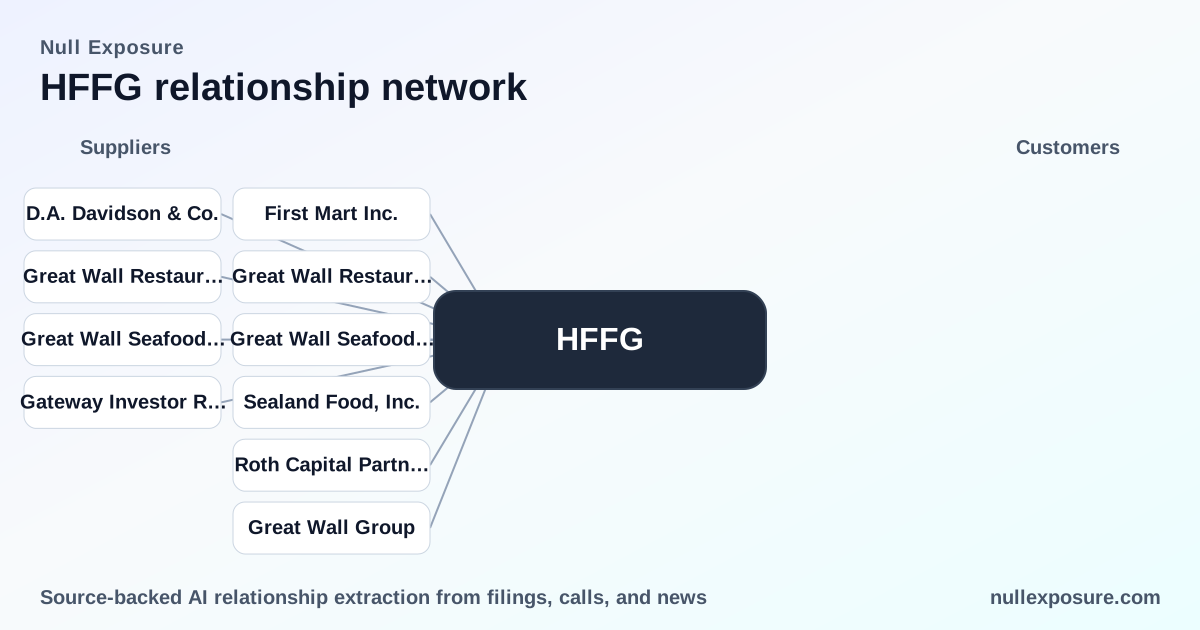
All reported relationships — plain English summaries and sources
Below I cover each relationship reported in the source material; each entry is a two‑sentence plain‑English summary with its source.
-
First Mart Inc. (10‑K, FY2024): HF Foods acquired substantially all of the assets of First Mart Inc. on December 30, 2021 as part of expanding its seafood supply footprint. This acquisition is disclosed in HF Foods’ FY2024 Form 10‑K as a strategic asset purchase to bolster product offerings.
Source: HF Foods Group FY2024 Form 10‑K (acquisition disclosure). -
Great Wall Restaurant Supplier, Inc. (10‑K, FY2024): HF Foods acquired substantially all assets of Great Wall Restaurant Supplier, Inc. on December 30, 2021, integrating an Ohio‑based seafood supplier into its distribution network. The FY2024 10‑K lists this transaction as part of HF Foods’ Great Wall acquisitions.
Source: HF Foods Group FY2024 Form 10‑K (acquisition disclosure). -
Great Wall Seafood Supply, Inc. (10‑K, FY2024): HF Foods acquired substantially all assets of Great Wall Seafood Supply, Inc. (Texas) on December 30, 2021 to expand western region seafood supply capabilities. The acquisition is recorded in the FY2024 10‑K.
Source: HF Foods Group FY2024 Form 10‑K (acquisition disclosure). -
Sealand Food, Inc. (10‑K, FY2024): On April 29, 2022, HF Foods purchased substantially all assets of Sealand Food, Inc., described in the 10‑K as one of the largest frozen seafood suppliers serving the eastern seaboard. The purchase extended HF Foods’ East Coast reach and inventory base.
Source: HF Foods Group FY2024 Form 10‑K (acquisition disclosure). -
Roth Capital Partners, LLC (GlobeNewswire, FY2025): Roth Capital Partners, LLC was named as a sales agent for HF Foods’ $100 million at‑the‑market equity offering program announced in September 2025. The press release lists Roth alongside D.A. Davidson as sales agents for the ATM.
Source: GlobeNewswire press release, September 25, 2025. -
Great Wall Group (GlobeNewswire, FY2022): A GlobeNewswire press release dated January 4, 2022 characterizes the Great Wall Group as one of the largest frozen seafood suppliers servicing the national Asian/Chinese restaurant market and references pro‑pandemic combined revenues around $170–$200 million. HF Foods announced completion of the acquisition of the Great Wall businesses in that release.
Source: GlobeNewswire press release, January 4, 2022. -
D.A. Davidson & Co. (GlobeNewswire, FY2025): D.A. Davidson & Co. is listed with Roth Capital as a sales agent on HF Foods’ September 2025 ATM equity program, handling distribution of newly issued shares into the market.
Source: GlobeNewswire press release, September 25, 2025. -
Great Wall Restaurant Supplier Inc. (GlobeNewswire, FY2022 — press version): The January 2022 press release announced HF Foods had completed acquisition of Great Wall Restaurant Supplier Inc. as part of the Great Wall Group consolidation into HF Foods’ platform. The release frames the transaction as strategic consolidation for seafood distribution to the Asian restaurant channel.
Source: GlobeNewswire press release, January 4, 2022. -
Great Wall Seafood Supply Inc. (GlobeNewswire, FY2022 — press version): The GlobeNewswire item confirms HF Foods’ acquisition of Great Wall Seafood Supply Inc. alongside the other Great Wall operating entities to create greater national distribution capacity.
Source: GlobeNewswire press release, January 4, 2022. -
First Mart Inc. (GlobeNewswire, FY2022 — press version): The January 2022 press release also references First Mart Inc. as part of the group of Great Wall operating companies HF Foods acquired to scale its seafood business.
Source: GlobeNewswire press release, January 4, 2022. -
Gateway Investor Relations (GlobeNewswire, FY2021): A GlobeNewswire announcement dated December 15, 2021 lists Gateway Investor Relations as HF Foods’ investor relations contact and provides a point of contact for shareholder communications.
Source: GlobeNewswire press release, December 15, 2021.
Practical investment takeaways and supplier risk checklist
- Acquisition‑led growth is central: HF Foods has materially expanded capacity through asset purchases (Great Wall components, Sealand, First Mart), converting local seafood suppliers into company‑owned inventory and distribution nodes (FY2024 10‑K; GlobeNewswire 2022).
- Supplier exposure is operationally critical even if not concentrated: no single supplier accounted for more than 10% of purchases, yet HF Foods flags supplier relationships and logistics as material drivers of continuity and margins (FY2024 10‑K). Operational disruptions, tariffs or production interruptions translate directly to margin pressure.
- Financing profile supports inventory leverage but introduces covenant and market risk: large revolving facilities, real‑estate term loans and hedges underpin working capital needs and acquisitions; ATM programs and sales agents are part of capital toolkit to raise equity when required (FY2024 10‑K; GlobeNewswire 2025).
- Supplier mix favors short‑term purchasing with selective long leases: procurement gives HF Foods flexibility to respond to seasonal pricing, while long‑term real estate and vehicle leases lock in distribution capacity (FY2024 10‑K).
If you want a custom brief that maps each counterparty to spend bands, contractual terms and disruption impact, request a supplier intelligence profile at https://nullexposure.com/.
Bottom line
HF Foods operates as a roll‑up and national distributor that monetizes through product sales and distribution scale; its supplier universe is deliberately fragmented upstream but strategically integrated via acquisitions and a large domestic DC footprint. Investors should value HF Foods on the durability of distribution margins, the integration success of recent acquisitions, and the company’s access to working capital under its credit and equity programs. For transactional diligence or portfolio monitoring tied to HFFG counterparties, access next‑level supplier mapping and document‑level evidence at https://nullexposure.com/.