HFRO-P-A: Income-first preferred exposure with active manager ties
HFRO-P-A is a preferred equity instrument positioned for income investors: it pays a fixed dividend and carries a senior claim on assets relative to common equity, while the underlying issuer pursues alternative investment strategies—private equity and illiquid assets—to generate cash flow to support distributions. The instrument monetizes investor capital through steady coupon-like payouts funded by the issuer’s portfolio return and realized income, making it relevant for yield-seeking allocators who trade off liquidity and equity upside for prioritized income. For investors assessing supplier relationships and operational counterparties, the public record links HFRO/related vehicles to an external manager role that influences distribution policy and portfolio positioning. Learn more or run deeper supplier checks at https://nullexposure.com/.
Market context and headline takeaways
- HFRO-P-A is positioned as an income tool anchored by alternative investments and structured as preferred equity, which implies sensitivity to asset-liability matching and manager execution on illiquid holdings.
- Public press coverage in late 2025 highlights active managerial decisions affecting distributions and strategic repositioning, which is relevant to underwriting counterparty execution risk.
- No explicit third‑party contractual constraints are published in the available supplier-scope records, creating a transparency signal that investors should factor into diligence.
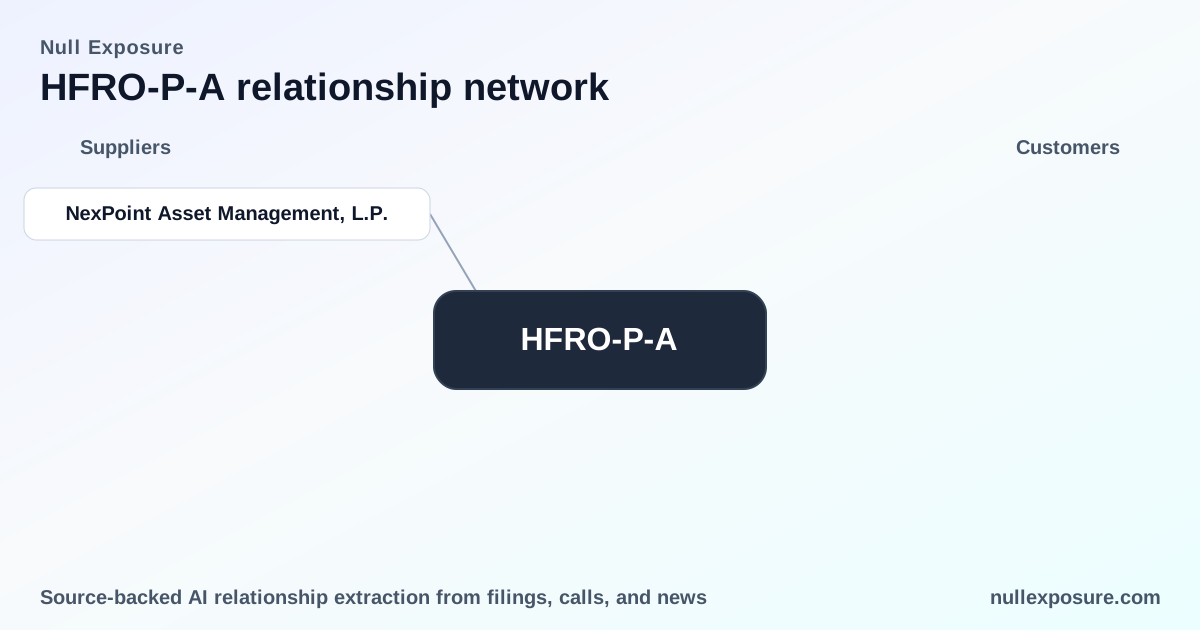
Who is named in the public record and what they do The relationships extracted for HFRO-P-A point to a single active counterparty: NexPoint Asset Management, L.P. Below are each of the recorded mentions with concise plain-English descriptions and source references.
-
NexPoint Asset Management, L.P. — October 2, 2025: The manager executed a strategic repositioning of the fund that led to an adjustment in allocations and supported a monthly distribution policy, signaling a hands-on approach to shaping portfolio exposures and income delivery. According to a MarketMinute report on October 2, 2025 published on Markets.FinancialContent, the adjustment was tied to a broader strategic reallocation by the fund’s manager. (Markets.FinancialContent, MarketMinute, Oct 2, 2025: https://markets.financialcontent.com/malvern-online/article/marketminute-2025-10-2-highland-opportunities-and-income-fund-hfro-declares-october-2025-monthly-distribution-reaffirming-commitment-to-shareholder-income)
-
NexPoint Asset Management, L.P. — October 1, 2025: Coverage notes NexPoint as a central actor overseeing the fund’s investment strategy and distribution policy, underscoring the manager’s operational control over cash-flow decisions that directly affect preferred holders. A MarketMinute item from October 1, 2025 on Markets.FinancialContent explicitly cites NexPoint as a key player in management and distribution oversight. (Markets.FinancialContent, MarketMinute, Oct 1, 2025: https://markets.financialcontent.com/stocks/article/marketminute-2025-10-1-highland-opportunities-and-income-fund-hfro-sustains-monthly-distribution-amidsts-evolving-market-landscape)
Interpreting the manager relationship for investors and operators These public references collectively indicate an active manager relationship that materially influences distribution cadence and portfolio tilt. For holders of preferred instruments such as HFRO-P-A, manager behavior—allocation shifts, distribution policy changes, and liquidity management—translates directly into income stability and tail risk for principal.
Constraints and what their absence signals There are no supplier-scope constraints extracted in the available record for HFRO-P-A. As a company-level signal, the absence of published constraints implies the following operational characteristics:
- Contracting posture: The firm’s public filings or supplier disclosures do not show binding third-party constraints or unusual contractual encumbrances in the supplier dataset, suggesting a conventional manager-client posture rather than a highly encumbered balance sheet visible in supplier records.
- Concentration: While the dataset does not list a broad panel of counterparties, the repeated naming of a single manager (NexPoint) signals potential concentration of critical operational functions—portfolio management and distribution execution—with one external party.
- Criticality: Manager control over distributions makes that relationship operationally critical to income generation and investor returns; absent explicit constraints, contractual protections for preferred holders are not documented here.
- Maturity and disclosure: The recurring monthly distributions reported in late 2025 indicate an established operational pattern; however, limited supplier-constraint disclosure reduces observable transparency into how durable those flows are under stress.
Investment implications — risk and operational checklist
- Manager execution risk is the dominant supplier risk. Given NexPoint’s role in reallocation and distribution policy, investors should focus diligence on manager track record in illiquid asset valuation, realized-return generation, and liquidity management.
- Concentration elevates single-counterparty operational exposure. Integration tests for service continuity, succession planning, and contractual remedies should be high-priority items for operators negotiating with or investing in HFRO-P-A.
- Cash-flow durability is functionally linked to asset realization. Preferred dividends depend on the sponsor’s ability to monetize or extract income from private and illiquid holdings; stress-testing scenarios for liquidity shocks and asset markdowns are essential.
- Disclosure gaps increase monitoring costs. The lack of supplier-constraint data requires investors to supplement public records with bilateral diligence—document reviews, manager calls, and governance reviews—to quantify downside protections.
Actionable next steps for investors and operations teams
- Conduct targeted manager due diligence: request performance attribution, liquidity waterfall mechanics, and recent distribution memos from the manager.
- Negotiate clear contractual protections where possible: specify distribution priority, event-of-default triggers, and reporting cadence that tie manager actions to investor transparency.
- Monitor distribution announcements and manager communications as short-term signals of strategic shifts; integrate them into portfolio rebalancing rules.
For investors evaluating counterparty strength and disclosure depth, an independent supplier review is often decisive. Explore third-party supplier intelligence and deeper relationship mapping at https://nullexposure.com/ to convert these public signals into actionable diligence.
Final read: HFRO-P-A trades on an income-first proposition underpinned by active manager decisions. Manager control over both portfolio allocation and distributions is the single most consequential supplier relationship for preferred holders; absence of explicit supplier constraints heightens the need for direct contractual and operational diligence. For comprehensive supplier mapping and to begin a structured review of HFRO-P-A counterparties, visit https://nullexposure.com/.