Heritage Financial (HFWA): supplier relationships, operating constraints, and what investors should price
Heritage Financial Corporation is the Nasdaq-listed banking holding company for Heritage Bank, monetizing primarily through net interest margin on loan and investment portfolios, deposit gathering, fee income and dividends it receives from the bank. The holding company’s cash flow and capital flexibility are tightly linked to the Bank’s earnings and access to wholesale liquidity sources, and Heritage supplements organic growth with M&A activity that requires a small roster of specialized advisors and service providers.
For a focused supplier-risk profile and transaction history, visit Null Exposure: https://nullexposure.com/
How Heritage’s supplier posture drives capital and risk outcomes
Heritage runs a mixed contracting posture that combines short-term operational contracts (core banking, data processing, professional services) with long-dated financial commitments (LIHTC funding schedules, lease obligations and borrowing facilities). That dual model is characteristic of regional banks that internalize credit and liquidity risk while outsourcing critical infrastructure.
- Contract concentration and criticality: Heritage depends on a small set of third-party vendors for core processing and information systems; its public filings flag difficulty replacing some vendors quickly and regulatory scrutiny of vendor oversight. These relationships are operationally critical and structurally important to customer experience and regulatory compliance.
- Funding framework and maturity ladder: The bank maintains framework-style credit access with the FHLB and the FRB, and it uses both short-term borrowings for liquidity management and longer-term debt or matched funding for asset repricing. The company specifically discloses large available FHLB capacity and material borrowings, showing active use of wholesale liquidity.
- Material dependency on the Bank: At the company level Heritage’s ability to pay dividends and service its holding-company obligations depends materially on dividends from the Bank—an explicit critical constraint that investors must price into valuations and stress tests.
Who Heritage engaged in FY2026 deals (transaction roster and citations)
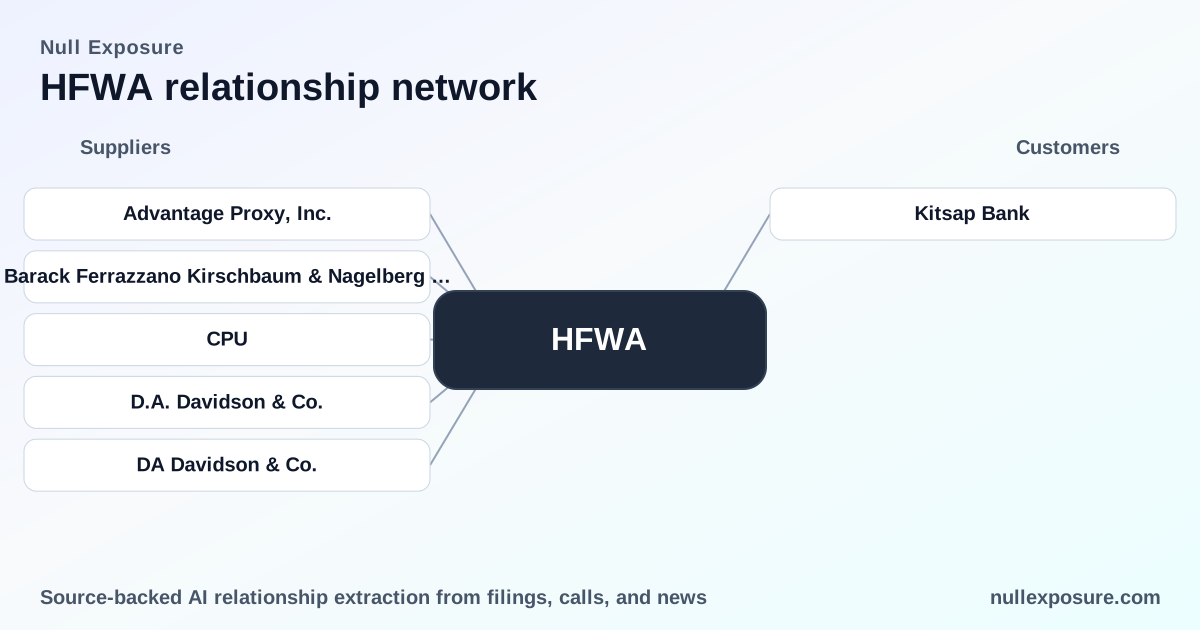
The following suppliers and advisors are tied to Heritage’s recent transaction activity; each entry is a plain-English summary with the reporting source.
-
Advantage Proxy, Inc. — Advantage Proxy acted as the information agent for Heritage in a recent acquisition and was paid a fee of $7,500 for proxy-related services. This was reported in a MarketScreener article on the completion of Heritage’s acquisition activity in March 2026.
Source: MarketScreener, March 2026. -
Barack Ferrazzano Kirschbaum & Nagelberg LLP — The firm served as legal counsel to Heritage on transaction work, with named attorneys providing counsel in connection with acquisitions announced in early 2026. Legal advice for M&A and regulatory filings is concentrated with this law firm.
Source: MarketScreener and USA Herald coverage of Heritage’s acquisitions, March 2026. -
Computershare Limited — Computershare acted as transfer agent to Heritage, handling shareholder recordkeeping and transaction logistics during the acquisition and related corporate actions.
Source: MarketScreener, March 2026. -
D.A. Davidson & Co. — D.A. Davidson served as Heritage’s financial adviser and provided a fairness opinion on at least one recent acquisition, reflecting Heritage’s reliance on a regional investment bank for deal execution and valuation support.
Source: MarketScreener and USA Herald, March 2026.
(Each relationship above is documented in public reporting on Heritage’s FY2026 acquisition activity; the citations reference March 2026 coverage of completed and announced transactions.)
Relationship implications for investors
Each advisor and vendor listed fulfills a discrete role crucial to Heritage’s M&A and corporate governance workflows: proxy and transfer services are administrative and low-dollar but necessary; legal counsel and financial advisers provide transaction execution and fairness opinions that support deal certainty and regulatory compliance. The dollar value of advisory fees in these transactions is modest relative to Heritage’s balance sheet, but the operational dependence on core processing vendors and the legal/advisory bench for M&A is strategic.
Operating constraints and company-level signals investors should price
Heritage’s public disclosures surface a set of persistent constraints and operational signals that affect supplier risk, liquidity and capital allocation:
- Long-term financial commitments exist alongside short-term funding needs. Heritage disclosed LIHTC funding commitments (e.g., $65.3M scheduled for 2025, $5.5M for 2026, with residual funding into 2041) and long-dated lease obligations; concurrently the bank carries short-term borrowings and lines that mature within a year. These dynamics require active asset-liability management and constrain near-term liquidity options.
- Framework credit relationships underpin liquidity. The company maintains FHLB credit facilities and access to the FRB discount window (historically the BTFP), creating a framework-style backstop for liquidity that supports lending and deposit volatility management.
- Vendor concentration and regulatory scrutiny of third parties. Heritage outsources core systems and flags regulatory attention on vendor oversight; core vendor renewals have driven material professional services expense in prior periods and can be difficult to replace quickly.
- Government and agency counterparties are significant. Investment and funding exposures include U.S. government and agency securities and FDIC/DFI assessment obligations—typical for a regional bank but reinforcing exposure to public-sector policy and supervisory actions.
- Materiality of dividends flows. The holding company depends materially on dividends from the Bank to meet holding-company cash needs, a structural leverage point that can limit corporate flexibility if the Bank must retain capital.
- Spend profile spans modest to large commitments. Documented purchase obligations include $17.8M in service contracts and multi-hundred-million dollar movement in investment securities and borrowings, indicating both tactical vendor spend and strategic balance-sheet repositioning.
Valuation, risk-reward and what to monitor
Heritage trades with a trailing P/E of 12.7, price-to-book near 1.11, a market cap around $1.04B, and a dividend yield roughly 3.9%—metrics that position the stock as a value/ income candidate in regional banking. Investors must monitor three priority items:
- Dividend flow from Heritage Bank and any regulatory limits on dividend distributions.
- Core vendor stability and timing of major contract renewals, particularly the core processing platform.
- Wholesale funding availability and FHLB borrowing activity alongside asset quality trends and LIHTC exposures.
For a deeper supplier-risk breakdown and transaction history, see Null Exposure: https://nullexposure.com/
Practical calls to action for analysts and operators
- Analysts: incorporate a scenario where dividend flows to the holding company are reduced and stress-test coverage for debt service and buyback capacity.
- Operators: prioritize vendor discovery and contingency planning for core processing contracts; regulatory exams will emphasize vendor oversight.
- For a comprehensive supplier-first lens on HFWA and comparable regional banks, follow our coverage at Null Exposure: https://nullexposure.com/
Bottom line: Heritage’s supplier roster for transactional work is lean and conventional—legal counsel, financial adviser, transfer agent and proxy services—but the firm’s true operational risk sits with its core processing vendors, long-term LIHTC and lease commitments, and the structural dependence on dividends from the Bank. Investors should price the combination of steady earnings, modest valuation, and conditional liquidity into any target price or portfolio allocation.