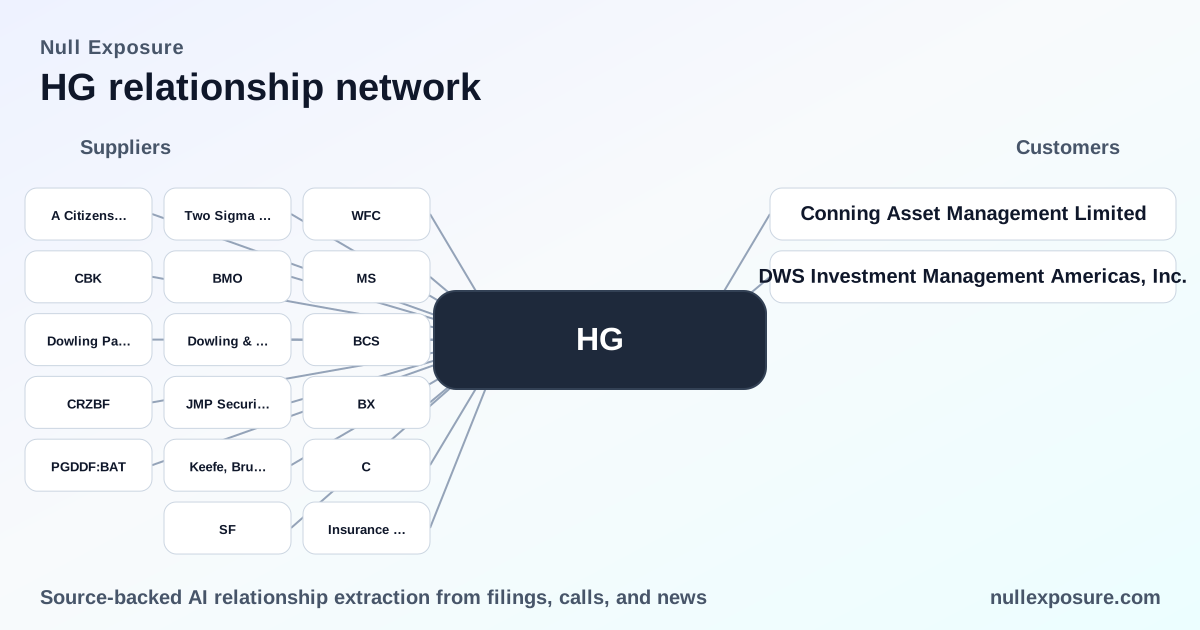
Hamilton Insurance Group (HG) — Supplier relationships, concentration, and operational constraints
Hamilton Insurance Group underwrites specialty insurance and reinsurance globally and monetizes through underwriting margins, investment income and fee/incentive arrangements tied to its sizeable allocation to the TS Hamilton Fund. The company writes mostly 12‑month insurance/reinsurance contracts while retaining a material, long-term investment commitment to quantitative manager Two Sigma, which produces a large share of net investment income and incentive fees that flow to Hamilton’s P&L. For investors evaluating counterparties and supplier risk, the story is therefore two‑fold: traditional capital markets and broker relationships that support distribution and credit capacity, and a concentrated, economically critical investment management relationship that drives returns and volatility.
Learn more about how we map supplier risk at https://nullexposure.com/.
Quick read: what to watch in HG’s supplier map
Hamilton’s commercial model depends on three supplier pillars: (1) capital and financing counterparties that provide letters of credit, syndicate and underwriting capacity; (2) investment managers (notably Two Sigma) that run a high‑risk/high‑return portion of assets; and (3) underwriting and distribution intermediaries (brokers, MGAs and co‑managers) that place and ceded business. Two Sigma’s role is both material and contractually entrenched, while a broad set of banks and investment banks serve episodic but important functions around IPOs, LOCs, and underwriting. This combination creates upside capture through investment alpha and downside concentration through a single, long‑term manager.
Counterparty snapshots — every relationship in the results
Below are concise, investor‑focused summaries of every counterparty referenced in the source collection.
Citigroup
Citigroup acted as a joint bookrunning manager for Hamilton’s IPO and related offering activity, underwriting and coordinating distribution of shares during the 2023 offering process — a role described in contemporaneous press coverage of the IPO. (Bernews, Nov 2023; Hamilton press release, Nov 2023)
Wells Fargo Securities
Wells Fargo Securities served as a joint bookrunning manager and arranger on Hamilton’s public offering and later financing arrangements, providing underwriting and credit‑market access support during the IPO and follow‑on activity. (Bernews, Nov 2023; Hamilton press release, Nov 2023)
Morgan Stanley
Morgan Stanley was named as a joint lead bookrunning manager on the IPO, sharing primary underwriting responsibilities for Hamilton’s public offering priced in late 2023. (Bernews, Nov 2023)
Barclays
Barclays operated as a joint lead bookrunner alongside Morgan Stanley for the IPO, participating in distribution to institutional investors. (Bernews, Nov 2023; Hamilton press release, Nov 2023)
BMO Capital Markets
BMO Capital Markets is listed among the co‑managers on Hamilton’s offering syndicate and participates in the firm’s capital markets distribution and letter‑of‑credit arrangements cited in filings. (Bernews, Nov 2023; Hamilton press release, Nov 2023)
Dowling & Partners Securities LLC
Dowling & Partners acted as a co‑manager on the IPO syndicate, playing a supporting distribution role in the offering. (Bernews, Nov 2023; Hamilton press release, Nov 2023)
JMP Securities
JMP Securities participated as a co‑manager on the offering — part of the broader syndicate of regional and specialist firms that distributed Hamilton’s shares. (Bernews, Nov 2023; Hamilton press release, Nov 2023)
Keefe, Bruyette & Woods (A Stifel Company)
Keefe, Bruyette & Woods served as a co‑manager in the syndicate, contributing to retail and institutional placement activities for the IPO. (Hamilton press release, Nov 2023)
Commerzbank
Commerzbank participated as a co‑manager in the IPO syndicate and is listed among the banks providing financing and letter‑of‑credit capacity to the group. (Hamilton press release, Nov 2023; Bernews, Nov 2023)
A Citizens Company
A Citizens Company is named among the co‑managers on the offering syndicate, indicating a role in distribution and placement for the IPO. (Hamilton press release, Nov 2023; Bernews, Nov 2023)
Insurance Advisory Partners LLC
Insurance Advisory Partners served as financial advisor to Hamilton for the public offering, providing transaction advisory and placement counsel. (Bernews, Nov 2023)
Blackstone Alternative Solutions LLC
Blackstone Alternative Solutions sold 9,124,729 Class A common shares to the group at $12 per share in a block transaction, a secondary share purchase disclosed in coverage of Hamilton’s capital activity. (The Royal Gazette, May 2024)
Two Sigma Hamilton Fund
The TS Hamilton Fund is Hamilton’s primary outsourced investment vehicle and generated substantial net investment income reported for recent years; Two Sigma serves as the fund’s investment manager under a multi‑year Commitment Agreement. This relationship produces management and incentive fees and is contractually required under Hamilton’s commitment terms. (The Royal Gazette, May 2024; Hamilton filings, FY2024)
What the constraints tell investors about HG’s operating model
The textual constraints in Hamilton’s filings reveal clear structural characteristics that translate into investment consequences.
- Contracting posture — mixed short and long horizons. Hamilton writes mostly 12‑month underwriting contracts and relies on short‑term LOCs and letters of credit for operating liquidity, but it is also bound to a long‑term Commitment Agreement with Two Sigma requiring multi‑year capital allocation (explicitly named in filings). That dual horizon increases liquidity sequencing risk: underwriting is short and cyclical while a material chunk of capital is locked into a long‑dated investment relationship.
- Concentration and criticality. The TS Hamilton Fund and Two Sigma are explicitly described as material and critical to Hamilton’s investment return profile; filings note that losses at the fund could exceed assets and materially impair results. That makes the investment manager a single‑point risk for shareholders.
- Supplier maturity and scope. Hamilton uses established global banks and established regional co‑managers for capital markets and LOCs; these suppliers are mature and episodic but not replaceable overnight for large transactions. Conversely, licensed software, proprietary models (HARP) and vendor catastrophe models create operational dependency that is company‑level rather than tied to any single counterparty.
- Geographic footprint. Hamilton concentrates underwriting risk in North America while maintaining operational footprint and regulatory entities in EMEA and Bermuda, which creates cross‑jurisdictional regulatory dependencies and distribution channels.
These constraints combine into a distinct risk profile: high operational and investment manager concentration offset by diversified capital‑market relationships and traditional reinsurance protections.
Explore a supplier‑risk assessment tailored to investment due diligence at https://nullexposure.com/.
Risk/return takeaways for investors and operators
- Investment upside is levered to Two Sigma’s performance — incentive fees and net investment income materially support earnings; that is a return amplifier and a volatility driver.
- Liquidity sequencing is non‑trivial because short underwriting cycles coexist with long‑term investment commitments and bank LOC tenors; stress scenarios can force asset sales or margin calls at the TS Hamilton Fund level.
- Distribution and capital markets relationships are broad but transactional — the firm has established underwriting and syndication partners (bank co‑managers and brokers) to support capital events and letters of credit, which reduces execution risk for financings and offerings.
- Operational dependencies (licensed tech, vendor models, claims processing) are company‑level weak points that require active governance in vendor contracting and cyber resilience.
If you are evaluating Hamilton as a supplier or counterparty, prioritize documentation of the Two Sigma Commitment Agreement, LOC/backstop capacity, and the firm’s procedures for replacing critical licensed technology and actuarial/modeling inputs. Get practical, prioritized supplier reports and monitoring tools at https://nullexposure.com/.
Hamilton’s supplier map is a hybrid of breadth in capital markets and narrowness in investment manager reliance. For portfolio managers and corporate operators, the immediate actions are clear: stress‑test scenarios with the TS Hamilton Fund decoupled, review LOC expiries and renewal mechanics, and confirm contingency plans for licensed technology and claims administration. Those three items determine whether Hamilton’s supplier configuration is an engine of alpha or a concentration that amplifies downside.