Highland Global Allocation Fund (HGLB): what investors and operators need to know
Highland Global Allocation Fund (NYSE: HGLB) is a closed-end investment vehicle that monetizes through investor capital deployed into a diversified portfolio and through an externally negotiated management fee to its asset manager. The fund delivers income to shareholders via monthly distributions and derives economic value from asset performance, leverage policy, and the management contract that governs portfolio decisions.
If you evaluate counterparties or supplier relationships, start here: HGLB's economics are tightly coupled to its external manager and distribution policy — that relationship is the operational fulcrum for both performance and governance. Learn more on the NullExposure homepage: https://nullexposure.com/
Why this matters now
- Closed-end structure concentrates operational dependence: the fund's NAV, distribution level and premium/discount dynamics are controlled by portfolio and capital-management decisions made under its management agreement.
- Distribution behavior is an active signal: recurring monthly payouts are an investor-facing promise that influences capital flows and secondary market pricing.
- Counterparty (manager) alignment is central: the manager sets trading, leverage and cover policies that determine realized returns and liquidity.
Read on for a breakdown of the reported supplier relationships, direct source notes, and company-level operating-model signals that are material to investors and operators.
How HGLB runs and how it makes money
HGLB is a closed-end fund that sells a fixed number of shares and invests the proceeds under an external management contract. The fund pays monthly distributions that are funded from investment income and realized gains; the manager is entitled to fees that reduce net returns to shareholders. Closed-end funds like HGLB also routinely use modest leverage, which amplifies returns and increases sensitivity to market moves. Secondary-market pricing — the premium or discount to NAV — creates an additional source of shareholder value or dilution depending on capital flows and distribution stability.
Operationally, HGLB’s supplier relationship with its manager is the single most important vendor interaction: manager selection, contract terms, and oversight determine portfolio tilt, trading cadence, and ultimately distribution coverage.
Explore NullExposure’s full supplier signals and relationship intelligence here: https://nullexposure.com/
The reported supplier relationships (every mention in our collection)
Below are every recorded mention in our results. Each entry is a direct plain-English summary followed by the source reference.
-
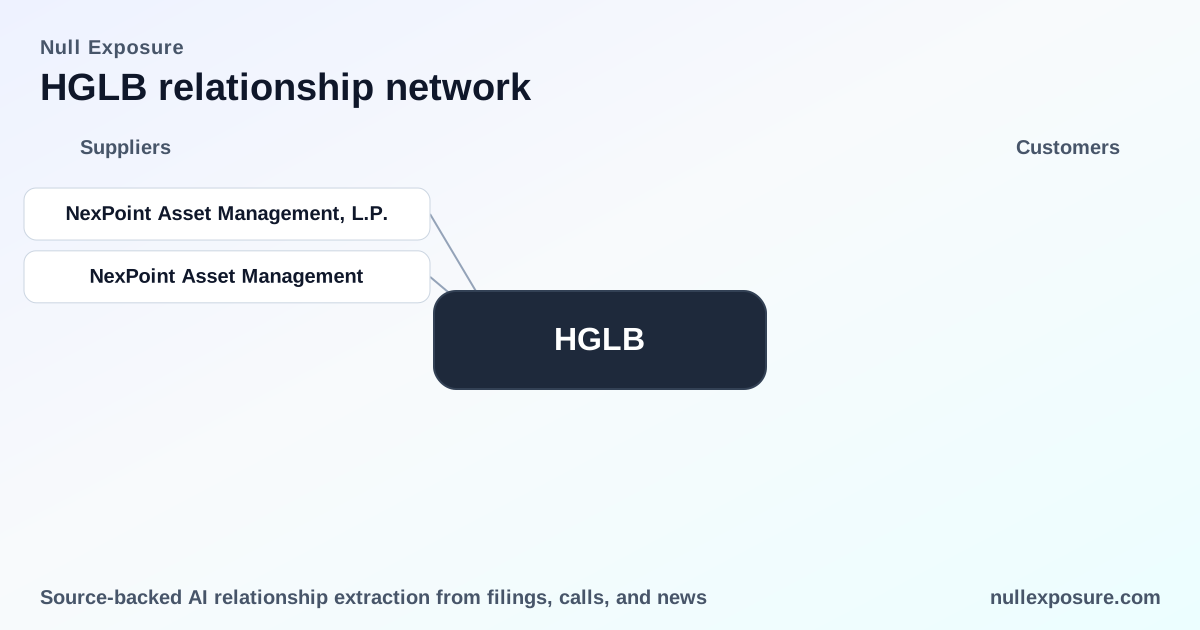
NexPoint Asset Management, L.P. — The Highland Global Allocation Fund is managed by NexPoint Asset Management, L.P.; the role of NexPoint as the fund's portfolio manager is stated in a Yahoo Finance article included in our FY2025 collection (article posted March 10, 2026).
Source: Yahoo Finance, FY2025 (published March 10, 2026). -
NexPoint Asset Management, L.P. — MarketScreener reported in FY2026 that HGLB is a closed-end fund managed by NexPoint Asset Management, L.P., noting the manager in the context of a declared monthly distribution announcement.
Source: MarketScreener, FY2026 (distribution notice). -
NexPoint Asset Management — A markets chronicle entry covering Q4 2025 distributions explicitly identified NexPoint Asset Management as the manager when reporting a monthly distribution of $0.088 per share for the fourth quarter of 2025, tying declared income to manager oversight.
Source: ChronicleJournal market minute, FY2025 (Q4 2025 distribution report). -
NexPoint Asset Management, L.P. — A second Yahoo Finance distribution notice in our FY2026 capture reiterates that HGLB is managed by NexPoint Asset Management, L.P., underscoring consistent public messaging about the management relationship across filings and press releases.
Source: Yahoo Finance, FY2026 (distribution announcement).
All four records reference the same counterparty relationship: NexPoint Asset Management is the external manager named across public distribution notices and press summaries.
Company-level operating-model signals and constraints
There are no extracted constraint excerpts in the current record, so the following are company-level signals inferred from the fund’s structure and the reported relationships:
- Contracting posture: HGLB operates under an external investment management agreement, which centralizes portfolio authority with the contracted manager and codifies fee, performance and termination terms at the fund level.
- Concentration: Operational concentration is high because a single external manager controls day-to-day investment decisions; this creates single-supplier dependency for portfolio governance and trading execution.
- Criticality: Management is a mission-critical supplier — manager capability directly affects NAV, distribution sustainability and the fund’s market discount/premium.
- Maturity: The closed-end format signals a mature, ongoing operating model with recurring monthly distributions and a stable corporate vehicle rather than an ad-hoc or start-up operating posture.
These signals should be treated as structural characteristics of the fund rather than discrete performance metrics.
What investors and operators should prioritize in diligence
- Manager contract review: examine fee schedules, termination clauses, and performance incentive alignments to understand long-run cost and governance implications. The manager’s authority over leverage and distribution policy is contractually defined and economically material.
- Distribution coverage analysis: reconcile declared monthly distributions (public notices report $0.085–$0.088 in the captured releases) with realized income and capital flows to assess sustainability. Market statements in late 2025 and early 2026 pointed to consistent monthly payouts across reporting windows.
- Counterparty concentration risk: a single-manager model requires strong governance and independent oversight; assess board composition, related-party transactions, and vote structures.
- Liquidity and discount/premium behavior: closed-end funds are priced in secondary markets; evaluate historical discount dynamics and how distribution announcements influenced demand.
Key risks: single-manager dependence, distribution funding mismatch, and leverage sensitivity are the primary operational vulnerabilities for HGLB.
Final perspective and next steps
HGLB is a classic externally managed closed-end fund where the manager is the primary supplier and the single most consequential operational relationship for investors. Public reporting in FY2025–FY2026 consistently cites NexPoint Asset Management, L.P. as the manager and records recurring monthly distributions — both of which frame the most material diligence questions for counterparties and service providers.
For a deeper supplier risk profile and governance review, consult NullExposure’s supplier intelligence hub: https://nullexposure.com/ — and if you need tailored relationship analysis or ongoing monitoring, start here: https://nullexposure.com/
Bold operational facts, contract scrutiny, and distribution coverage are your actionable levers when evaluating HGLB as a counterparty or portfolio holding.