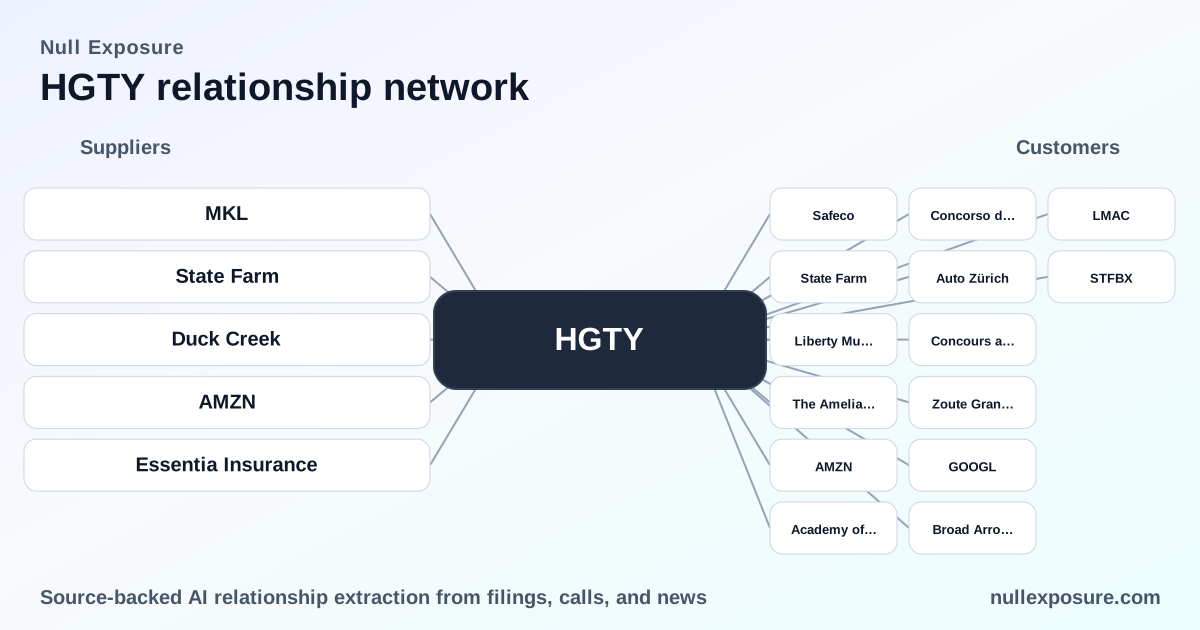
Hagerty Inc (HGTY): Supplier relationships that shape underwriting economics and growth
Hagerty monetizes a niche ecosystem built around automotive enthusiasts by combining specialty insurance underwriting and distribution with recurring membership, events, digital media, and valuation services. Insurance commission and reinsurance economics drive the majority of revenue, while strategic partnerships and distribution agreements provide customer acquisition scale and capital flexibility. This note reviews the supplier and partner relationships disclosed in public reporting and press coverage that materially affect Hagerty’s underwriting economics, growth trajectory, and operational risk profile.
For more supplier and counterparty intelligence on Hagerty and peer comparisons visit NullExposure.
Why these supplier ties matter to investors
Hagerty’s model is hybrid: product-plus-platform. The company earns traditional earned-premium and commission income, but it also captures recurring revenue through memberships and monetizes brand extensions (media, events, valuation tools). Critically, Hagerty’s insurance economics are layered: ceding commissions, quota-share reinsurance, and fronting arrangements directly change top-line recognition and underwriting margins. Investors should value Hagerty both as a specialty insurer and as a high-margin consumer platform where distribution deals (State Farm, agents) scale acquisition cheaply.
- Profitability lever: retaining more premium (or economic control) shifts profitability from ceded partners to Hagerty’s P&L and balance sheet.
- Acquisition lever: distribution partnerships accelerate new business and recurring commission streams at relatively low incremental acquisition cost.
- Risk lever: reinsurance, fronting partners, and technology vendors are critical — failures or changes materially affect capital, claim flows, and operational continuity.
If you want deeper counterparty scoring and covenant visibility for HGTY, see the research offerings at NullExposure.
Contracting posture and business-model constraints
Hagerty’s disclosures show a mix of short and long contracting horizons and concentrated, critical vendor exposures:
- Contracting posture: policy ceding and commission recognition are typically on 12‑month cycles (short-term insurance policy cadence), while credit and lease facilities extend multi-year, indicating mixed-term obligations.
- Concentration: Hagerty relies on a limited number of payment processors and reinsurance partners, and a large portion of revenue is tied to Hagerty Re and related quota-share structures — this is a material concentration risk.
- Criticality: catastrophe and treaty reinsurance are critical to capital protection; failures or reinsurer defaulting would be materially adverse.
- Maturity and spend: the company operates with meaningful capital facilities (credit facilities with JPM and BAC, fixed-maturity securities >$500m) and vendor projects (SaaS implementation costs), indicating an enterprise at growth and scale with multi-year vendor commitments. These company-level signals inform due diligence on counterparties, liquidity, and operational resiliency.
Supplier and partner relationships in the public record
Below are the supplier/partner mentions extracted from recent reporting; each entry is summarized in plain English with the original source noted.
Markel — PR Newswire (FY2026)
Hagerty reported that 2025 commission revenue tied to the alliance with Markel reached $437 million, with ceding commission expense of $344 million, signaling large, material flow-through between the two firms that shaped 2025 economics. (PR Newswire, March 2026)
Markel — The Globe and Mail (FY2026)
Hagerty is renegotiating its Markel arrangement to capture 100% of premiums, a structural change expected to materially increase underwriting profits and margins beginning in 2026. (The Globe and Mail press release, March 2026)
State Farm — Sahm Capital analysis (FY2026)
The ramping State Farm partnership is expected to provide access to 500,000 program vehicles and thousands of agents, materially expanding Hagerty’s acquisition funnel and recurring commission revenue over coming years. (Sahm Capital, February 2026)
Markel — Sahm Capital analysis (FY2026)
Hagerty’s 2026 guidance reflects a fronting arrangement with Markel that changes premium retention and revenue recognition, altering near-term reported revenue and profitability patterns. (Sahm Capital, March 2026)
Markel — Sahm Capital analysis on guidance (FY2026)
Hagerty issued 2026 guidance expecting lower reported revenue (~$1.28–$1.30bn) under the new Markel fronting arrangement and an expected net loss—a function of shifting revenue treatment despite improved underlying underwriting economics. (Sahm Capital, March 2026)
Markel — Motley Fool / earnings call transcript (FY2025)
Management explained that moving to a 2% fronting arrangement with Markel lets Hagerty control 100% of premiums and risk starting in 2026, increasing operational control and the opportunity to capture underwriting and investment income. (Earnings call transcript, Q3 2025)
State Farm — Sahm Capital (FY2026, multiple mentions)
Several Sahm Capital briefs reiterate the State Farm program's scale and its strategic role in accelerating new business growth and recurring commission margins for Hagerty. (Sahm Capital, January–February 2026)
Duck Creek — Sahm Capital (FY2025)
Hagerty disclosed technology execution risks tied to the implementation and migration to the Duck Creek policy administration platform, highlighting operational and cyber continuity exposure to a third-party platform. (Sahm Capital, December 2025)
Amazon Prime Video — The Globe and Mail (FY2026)
Hagerty has extended its media footprint with the Hagerty Channel debuting on Amazon Prime Video, illustrating brand extension into streaming media as a distribution/engagement channel. (The Globe and Mail, March 2026)
Markel Corp. — Insurance Business (FY2025)
Coverage notes a nonbinding letter of intent with Markel for Hagerty to take full control of underwriting and investment economics, underscoring ongoing negotiations to shift economics away from a ceded model. (Insurance Business, 2025)
Markel — Sahm Capital (FY2026 follow-up)
Analysts flagged Hagerty’s stock reaction to Q3 2025 results and the new Markel fronting arrangement as a catalyst for valuation re-assessment. (Sahm Capital, March 2026)
Markel Group — Sahm Capital (FY2026)
Sahm Capital highlighted that Hagerty extended key agreements with Markel Group and Essentia Insurance through 2028, reinforcing multi-year partnership continuity for the insurance business. (Sahm Capital, January 2026)
Essentia Insurance — Sahm Capital (FY2026)
Hagerty extended arrangements with Essentia Insurance through the end of 2028, which supports the company’s reinsurance and MGA distribution continuity. (Sahm Capital, January 2026)
What investors should watch next
- Execution of the Markel fronting transition: watch reported premiums retained vs. ceded and the timing of earnings recognition; this is the single largest driver of near-term margin expansion.
- State Farm rollout pace and economics: distribution scale is compelling, but underwriter economics and any related term-loan servicing (State Farm Term Loan) are balance-sheet items to monitor.
- Technology migrations and vendor resilience: Duck Creek implementation risk is operationally material; uptime, data integrity, and integration are key.
- Reinsurance and capital protection: catastrophe reinsurance expiry, counterparty credit, and treaty terms determine Hagerty Re’s solvency and ability to scale.
For modeled counterparty exposure, credit covenant monitoring, and a tailored supplier risk brief on Hagerty, visit NullExposure.
Conclusion and action steps
Hagerty’s partnerships are both strategic growth levers and operational dependencies: capturing more premium economics via Markel reshapes profitability, while State Farm access materially scales customer acquisition. Investors should prioritize monitoring premium retention shifts, partner contract terms, and vendor execution on core policy systems. For ongoing monitoring, counterparty scoring, and covenant surveillance on Hagerty and its suppliers, explore the research tools available at NullExposure.