Hilton Grand Vacations (HGV): supplier relationships that determine the margin and operational risk profile
Thesis: Hilton Grand Vacations monetizes branded vacation ownership through sales of vacation ownership interests (VOIs), recurring club membership and resort management fees, and financed sales; the company leverages a long-term licensing relationship with Hilton plus a network of marketing and distribution partners to drive tour flow and conversion, while financing and securitization activity funds working capital and inventory. Investors should value HGV as a licensing-led consumer franchise with material, contractually entrenched obligations and a mixed variable/fixed cost base that amplifies both growth and cyclicality. For a deeper view of supplier exposure and contract risk, visit https://nullexposure.com/.
What HGV’s supplier map looks like — the commercial relationships that matter
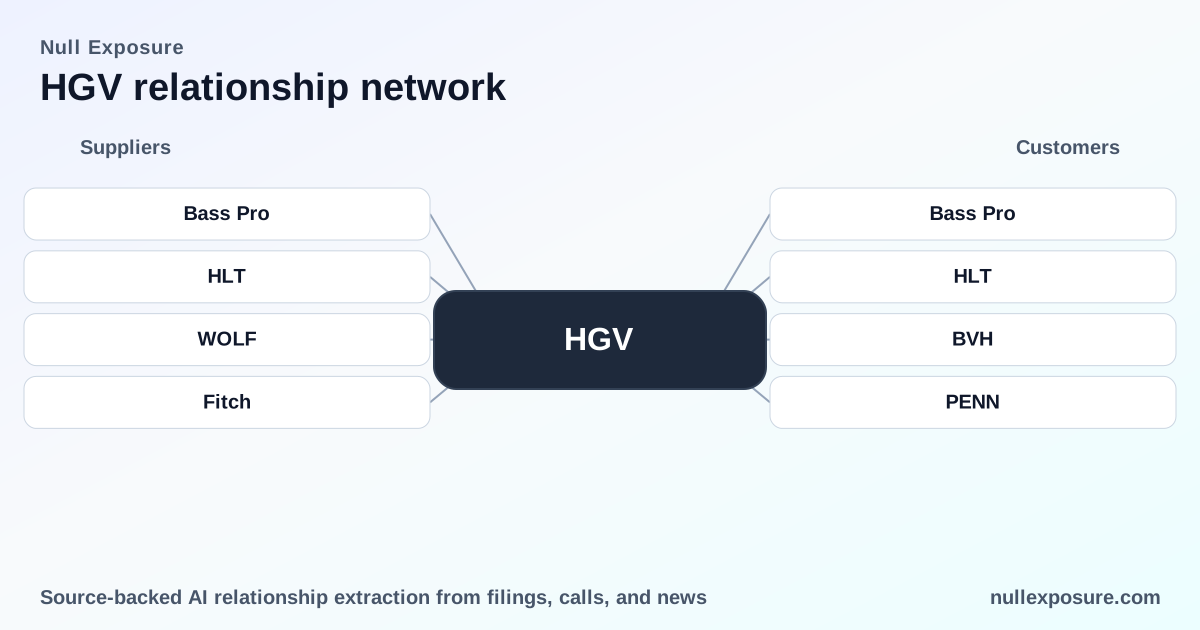
The public record shows a concentrated set of commercial partners that feed HGV’s sales, marketing and financing engine. Below I cover the relationships disclosed in the public results and what each partner contributes to the business.
Hilton — the core branding and distribution relationship
Hilton is HGV’s exclusive licensor and strategic marketing partner; HGV pays a royalty (reported around 5% of gross revenues, with additional fees and negotiated concessions after acquisitions) for the right to use Hilton trademarks, loyalty data and reservation systems, and benefits from Hilton call transfers and co‑marketing arrangements. According to TradingView and the company’s filings, the license agreement is long‑dated, operationally critical, and contains performance and exclusivity provisions that, if modified, would materially impact HGV’s ability to sell and market VOIs (FY2024–FY2026 filings and related news). (Sources: HGV FY2024 Form 10‑K; TradingView / FY2026 coverage.)
Bass Pro — a marketing and lead‑generation partner
HGV disclosed a marketing relationship with Bass Pro following the Bluegreen acquisition; Bass Pro provides retail channels and co‑marketing access to outdoor and leisure customers to support tour flow and lead generation. This relationship is documented in HGV’s FY2024 10‑K as part of the expanded marketing footprint post‑Bluegreen. (Source: HGV FY2024 Form 10‑K, FY2024.)
Great Wolf — a partner for marketing site expansion and lead flow
HGV has opened new marketing sites in collaboration with Great Wolf to increase tour flow; management highlighted opening 41 joint marketing sites with Hilton, Bass Pro and Great Wolf as part of investments in lead generation during the Q4 2025 earnings commentary. (Source: Q4 2025 earnings call transcript reported by InsiderMonkey / FY2026 coverage.)
Fitch — a financing/ratings reference relevant to securitizations
Fitch’s final ratings (noted in market commentary) are referenced in connection with HGV’s securitization transactions and note offerings, which are a material part of the company’s funding strategy for timeshare receivables. Market write‑ups referencing Fitch’s ratings help investors assess funding cost and capacity for HGV’s securitized debt programs. (Source: SimplyWallSt coverage referencing Fitch / FY2025.)
How to read these relationships as an investor — structural implications
HGV’s supplier relationships define three core behavioral characteristics of the company’s operating model:
-
Contracting posture: long-term anchors with variable overlays. The company operates under a mix of entrenched, long‑term contracts (the Hilton license with rights through multi‑decade terms and a formal initial term to 2116 and other long‑dated debt and securitizations) alongside usage‑based and contingent agreements (commissions, contingent rent, purchase commitments and call transfers priced on a per‑use or percentage basis). The FY2024 10‑K documents both the license fee mechanics and numerous long‑dated financing agreements, as well as contingent payments tied to revenue and performance (FY2024).
-
Concentration and criticality are high. HGV’s reliance on the Hilton license for branding, loyalty access and call transfers is explicitly identified by management and filings as critical, and termination or material amendment would have a significant and immediate impact on revenue and marketing capability. That criticality is a single‑point risk that investors must monitor. (Source: HGV FY2024 Form 10‑K; TradingView summary.)
-
Maturity and spend scale vary across partners. The company runs very large, strategic expenditures and balance‑sheet decisions (acquisitions such as Bluegreen at ~$1.6 billion, repeated securitizations of hundreds of millions) alongside mid‑sized and small recurring payments (license fees in the $100M+ range annually; payments for Hilton Honors points and call transfer services in the single‑digit to low‑double‑digit millions). These signals come from the company’s fiscal disclosures on licensing expense, acquisition consideration and securitization programs. (Source: HGV FY2024 Form 10‑K.)
If your model stresses downside scenarios, focus on the license economics, call transfer volumes, and securitization access — those three levers simultaneously drive distribution, conversion and funding capacity. For a full supplier risk matrix and scoring, check https://nullexposure.com/.
Operational risk vectors that flow from the supplier base
Several operational risks follow from the partner mix and contractual terms:
-
Funding risk: HGV uses securitizations and term loans repeatedly; financing volatility or a ratings downgrade (Fitch) would raise costs or reduce capacity for purchasing VOIs and for financing customer loans. (Source: FY2024 securitization and financing disclosures.)
-
Performance risk with third‑party developers and service providers: HGV sources inventory via fee‑for‑service and just‑in‑time agreements with third‑party developers; failure of those partners to deliver or obtain financing is identified in filings as a material operational risk. (Source: HGV FY2024 Form 10‑K.)
-
Reputational and brand dependency: The exclusivity and quality standards in the Hilton license create reputational leverage — deterioration of Hilton’s brand, or non‑compliance at resort level, could reduce sales and management fees materially. (Source: HGV FY2024 Form 10‑K.)
Mid‑article action: if you are evaluating counterparty exposure for due diligence or underwriting, start with the licensing terms and the securitization program documentation at https://nullexposure.com/.
Takeaways for investors and operators
- Hilton is the single largest operational dependency — pricing, data access and customer flows are routed through that agreement; treat it as a systemic partner in any valuation or risk assessment. (Source: HGV FY2024 Form 10‑K; TradingView FY2026 coverage.)
- HGV balances fixed contractual obligations with variable, usage‑based costs, which drives higher operating leverage on upside and amplified downside on weaker demand. (Source: HGV FY2024 Form 10‑K.)
- Funding and securitization capacity are strategic levers — monitor note issuance, rating agency activity and revolver availability as forward indicators of inventory buying power. (Source: FY2024–2025 disclosures and market commentary.)
For investors modeling downside scenarios or preparing supplier diligence, HGV’s filings and public transcripts provide the raw contract indicators; our platform collects these signals and maps exposure across license, marketing and financing partners — learn more at https://nullexposure.com/.
Final call to action: if your thesis depends on counterparty stability or the license economics, prioritize primary‑document review of HGV’s license exhibits and securities offering materials and use https://nullexposure.com/ to access curated relationship evidence and constraint summaries.