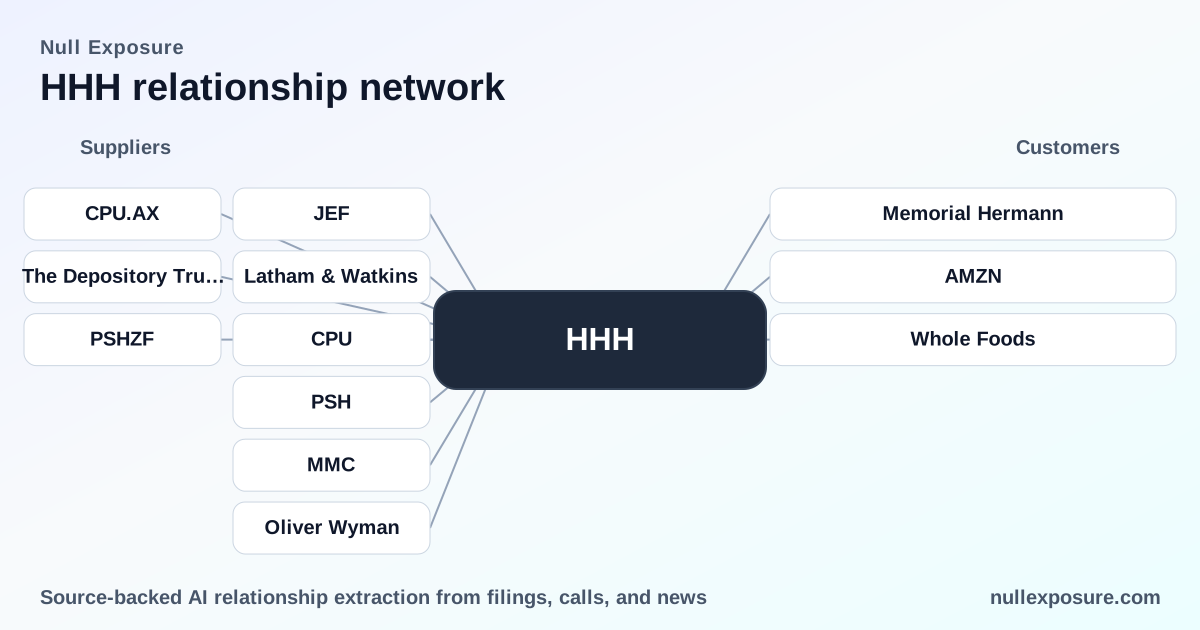
Howard Hughes Holdings (HHH): supplier and advisor relationships that shape the next phase of growth
Howard Hughes Holdings owns, manages, and develops commercial, residential, and mixed‑use real estate across the United States and monetizes primarily through property development profits, leasing cash flows, disposition of completed assets, and selective acquisitions that expand recurring fee and asset‑management income. Recent strategic activity — notably the announced acquisition of Vantage Group Holdings — reorients HHH toward an asset‑manager plus operating‑real‑estate model where advisory, legal, actuarial and trustee relationships are incremental to execution and financing. For a concise view into supplier exposures, keep reading or visit Null Exposure for related supplier intelligence: https://nullexposure.com/
What investors need to know up front
Howard Hughes runs a capital‑intensive development business with high fixed and contractual commitments. The balance sheet shows multi‑year, long‑term debt maturities and active interest‑rate hedging positions, while the company uses large third‑party advisors and trustees to execute M&A and capital markets actions. That combination creates both scale economics in development and concentrated counterparty risk where failures would be material.
- Capital intensity: $5.1 billion of outstanding debt and meaningful undrawn lender commitments support development pipelines.
- Contracting posture: a mix of long‑term mortgage and note agreements plus shorter operating contracts (leases, short vendor terms).
- Counterparties: government entities, large financial institutions, and major professional services firms dominate the roster.
If you want a deeper supplier‑level read, browse the platform at https://nullexposure.com/ for structured supplier profiles.
Supplier and advisor relationships that matter now
Below I cover every relationship surfaced in the source results. Each entry is a plain‑English take on the role and a concise source pointer.
Jefferies LLC — exclusive financial advisor on the Vantage transaction
Jefferies is acting as exclusive financial advisor to Howard Hughes in the announced $2.1 billion acquisition of Vantage Group Holdings, positioning Jefferies at the center of deal execution and financing discussions. According to a GlobeNewswire press release dated December 18, 2025, Jefferies served as the exclusive financial adviser to Howard Hughes in the transaction (FY2025). (Source: GlobeNewswire, 12/18/2025)
Latham & Watkins — legal counsel for the acquisition
Latham & Watkins is engaged as legal counsel for Howard Hughes’ acquisition work, supplying transaction, regulatory and closing support for the Vantage deal as described in the company press release. (Source: GlobeNewswire, 12/18/2025)
Oliver Wyman — actuarial advisor to the company
Oliver Wyman provided actuarial advisory services for Howard Hughes in connection with the Vantage acquisition, supporting diligence on specialty insurance and reinsurance economics (reported in the December 2025 press materials). (Source: GlobeNewswire / QuiverQuant, FY2025)
Pershing Square — strategic investor and proposed asset manager for Vantage assets
Pershing Square is identified both as a major owner and as the proposed manager of Vantage’s investment assets under the announced plan, and its role is central to the new asset‑management thesis for the combined business. Industry press and coverage connect Pershing Square and Bill Ackman to the Vantage transaction and post‑close management arrangement. (Sources: Artemis (news), ts2.tech analysis, December 2025)
Computershare Trust Company, N.A. — trustee and paying agent for redeemed notes
Computershare Trust Company, N.A. is the trustee, paying agent and registrar cited in Howard Hughes’ February 4, 2026 notice of redemption for its 5.375% Senior Notes due 2028. That positions Computershare as the operational counterparty for debt redemption mechanics. (Source: GlobeNewswire press release, 02/04/2026; Sahm Capital reprint)
The Depository Trust Company (DTC) — redemption payment routing
The Depository Trust Company is named as the system through which redemption payments will be made, indicating standard industry settlement mechanics for the notes redemption disclosed in early 2026. (Source: Sahm Capital / press reprint of Howard Hughes redemption notice, 02/04/2026)
How these relationships map to Howard Hughes’ operating constraints
Assessing the constraints that govern supplier risk and operational posture gives investors the context needed to judge resilience.
- Contracting posture is largely long‑term. The company holds fixed‑rate notes, mortgages and interest‑rate swap agreements with maturities stretching into the 2030s and beyond, and routinely refinances development loans into long‑term fixed debt. This signals a long‑dated exposure to credit markets and interest‑rate movements rather than a short‑term vendor reliance.
- Short‑term relationships exist and are operationally necessary. Short‑term leases, interest‑only loans with five‑year profiles, and routine payables create cyclical working‑capital needs that must be funded from liquidity or secured financing.
- Framework financing capacity is an explicit resource. HHH reports significant undrawn lender commitments and secured‑note capacities that functionally act as a development funding framework for projects.
- Counterparty mix is broad but leans large and institutional. Evidence flags government counterparts (permits, municipal bonds), large financial institutions for cash and derivatives, and major professional services firms for legal and actuarial work — a concentration of systemic counterparties that increases operational interdependence.
- Materiality: several supplier failures would be material. The company’s disclosures explicitly call out that joint‑venture partners, subcontractors, and large vendors can create material negative impacts if they default or underperform.
- Geographic footprint is primarily North American with global supply linkages. Operations and counterparties are U.S.‑centric, but HHH’s exposure to global commodity and energy markets for construction inputs creates indirect international risk.
What investors should watch next
- Integration and execution of the Vantage acquisition — Jefferies, Latham & Watkins and Oliver Wyman will be critical to deal closure and post‑close integration; monitor filings and transitional service arrangements for fee and liability allocation.
- Debt management and redemptions — trustee and DTC mechanics for note redemptions are operational but the larger question is how refinancing and interest‑rate hedging evolve if rates move; the Computershare/DTC notices are a window into active liability management.
- Counterparty concentration and construction supply prices — with large project spend bands and reliance on external contractors, any supplier stress or commodity inflation directly affects project yields.
For a tailored supplier risk briefing or to download a consolidated supplier map for HHH, visit Null Exposure: https://nullexposure.com/
Final read: positioning and action
Howard Hughes is evolving from a pure developer into a hybrid operator and manager where external advisors and trustees are not peripheral — they are executional levers. Investors should treat these supplier and advisor relationships as operationally critical: they help close transactions, manage actuarial and legal risk, and execute debt mechanics. Monitor deal‑level disclosures and trustee notices for signals of financing stress or successful liability management.
If you want ongoing coverage and supplier‑focused alerts for HHH and peer developers, sign in at Null Exposure: https://nullexposure.com/