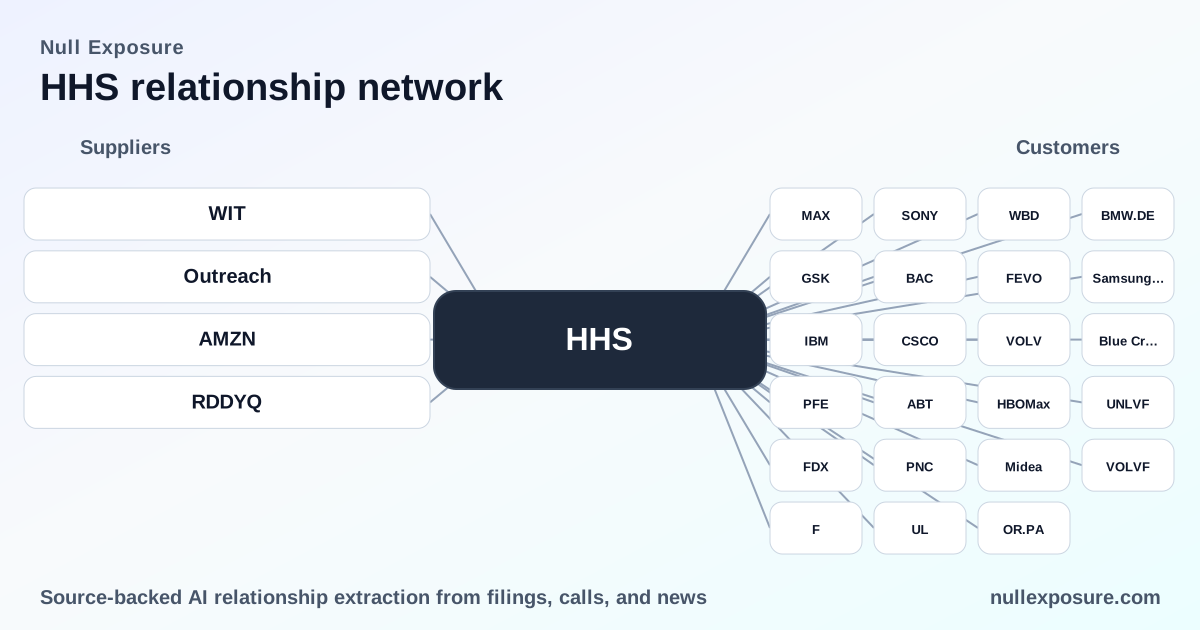
Harte Hanks (HHS) supplier relationships — who matters, how they’re contracted, and what investors should price in
Harte Hanks is a customer-experience services company that monetizes by selling a mix of managed services, analytics and marketing-technology implementations to enterprise clients, plus licensed data and platform integrations for contact-center and sales engagement workflows. Revenue is driven by recurring service contracts, licensed data usage and platform-enabled professional services; margins and cash flow depend heavily on third‑party technology partners and subcontractors who deliver critical components of Harte Hanks’ outsourced customer-care and data capabilities. For an annotated supplier map and relationship risk scoring, visit https://nullexposure.com/.
How suppliers plug into Harte Hanks’ operating model
Harte Hanks runs a hybrid delivery model: it retains core agency and analytics expertise in-house while outsourcing infrastructure, cloud platforms and specialized AI tools to vendors. That structure creates predictable revenue from retainer-style engagements but also exposes the company to third‑party cost pressure and operational concentration.
- Contracting posture: Company disclosures show a mix of long‑term commitments (multi‑year leases and a multi‑year $25 million credit facility) alongside short-term and licensing arrangements; this suggests a blended vendor portfolio where infrastructure and facility commitments are durable while product and platform licenses are more flexible.
- Counterparty diversity: Filings reference individual employment contracts, government/public data sources, and external investment managers — indicating relationships span individuals, public-sector data providers, and institutional vendors.
- Operational criticality and maturity: Harte Hanks identifies third‑party data access and third‑party data centers as critical to operations. That elevates vendor risk relative to more self-contained service businesses: loss of a data feed or a cloud platform interruption would have material operational impact.
- Spend profile: Public disclosures imply vendor spend bands ranging from sub‑$1m items (insurance stop‑loss, small leases) up through ten‑to‑tens of millions (asset-based credit facility, lease assets), so procurement is a mix of programmatic small buys and a few material line items.
For a detailed supplier list and to track new disclosures, see https://nullexposure.com/.
Relationship roll call: the suppliers referenced in public reporting
Below are the supplier relationships surfaced in public sources and reporting; each short entry gives the operational role and a concise source pointer.
Wipro Limited — a technology delivery alliance
Harte Hanks announced a teaming arrangement to combine Harte Hanks’ agency capabilities with Wipro’s global technology delivery to offer marketing-technology services, upgrade analytics and create a scalable IT operating model. This partnership was publicly announced on March 15, 2017 and reported in press coverage tied to the FY2018 narrative. (Source: company announcement reported by SanAntonioReport.org; referenced in FY2018 coverage.)
Outreach — sales engagement platform used to build pipeline
Harte Hanks adopted the Outreach platform to engage customers and expand sales pipeline, integrating the vendor into its go‑to‑market tooling for outbound and account-based operations. This was announced in a company news release in FY2024. (Source: AccessWire news release, FY2024.)
Amazon Connect — cloud contact‑center platform for AI pilots
Harte Hanks is leveraging Amazon Connect as its cloud-based contact‑center platform to pilot and test new AI tools aimed at augmenting technical support and facilitating client migrations to advanced contact‑center platforms. The platform is referenced in FY2025 SEC reporting and subsequent summaries. (Source: Harte Hanks’ FY2025 SEC filings as summarized on TradingView, FY2025.)
Reddy — AI-driven agent training and feedback for global centers
Harte Hanks will use Reddy’s platform to support global call-center operations by improving agent onboarding, automating training, and providing agent feedback — a tactical move to scale agent effectiveness with AI-driven tooling. This collaboration was announced in FY2024 press coverage. (Source: FinancialContent/Accesswire coverage of Harte Hanks and Reddy collaboration, FY2024.)
What the relationship map implies for investors and operators
The supplier set, combined with company-level constraints, produces clear risk and opportunity vectors.
- Vendor reliance is structurally significant. Company disclosures identify third‑party data and data‑center providers as critical to operations; loss or restriction of data access is described as potentially material to results. That elevates counterparty and concentration risk for a services firm whose value proposition hinges on data and platform performance.
- Contracts are mixed-duration by design. The firm runs a combination of long-term obligations (multi‑year leases and a $25m asset-backed credit facility) and short-term/licensing relationships for technology. This balances continuity of operations with the ability to pivot product-level partnerships, but it also creates inflection points when leases roll or credit terms are renegotiated.
- Third‑party delivery compresses margins. Harte Hanks acknowledges margin pressure from higher service charges when relying on subcontractors and external platforms, which is an operational lever investors need to monitor alongside revenue trends.
- Governance and people risk are visible. The filings show individual employment and separation agreements and substantial insider ownership — factors that influence governance dynamics and operational continuity.
- Spend concentration exists across bands. Public evidence shows procurement ranges from sub‑$1m items (insurance stop‑loss limits, small leases) to multi‑million commitments (leases and the credit facility), implying that while day‑to‑day spend is modest, a handful of material obligations could swing cash flow.
Strategic takeaways and near‑term signals to watch
- Monitor platform migrations and AI pilots (Amazon Connect, Reddy): successful commercial rollouts will expand upsell opportunities; failures would exacerbate margin pressure. Track sequential commentary in quarterly filings for pilot-to-commercial conversion.
- Watch data access and licensing terms. The company explicitly warns that curtailment of data access would be material — any regulatory or vendor policy shifts that restrict data use should be treated as downside catalysts.
- Lease and credit maturity dates are functional stress points. Rolling leases and the extension history on the credit facility create discrete events that can affect liquidity and cost of capital; review maturity schedules in the next 12–24 months.
For investors and operators seeking the full supplier map and continuous monitoring, review the Harte Hanks supplier profile at https://nullexposure.com/ and subscribe for updated relationship scoring.
Final action items
- For investors: price third‑party operational concentration into scenario models rather than assuming fixed margins; follow quarterly statements for vendor‑related disclosures.
- For operators and procurement: prioritize vendor redundancy for critical data and contact‑center functions and negotiate usage‑based rather than fixed‑fee pricing where possible.
Explore the annotated relationship database and alerts at https://nullexposure.com/ to stay ahead of vendor-driven risks and opportunities.