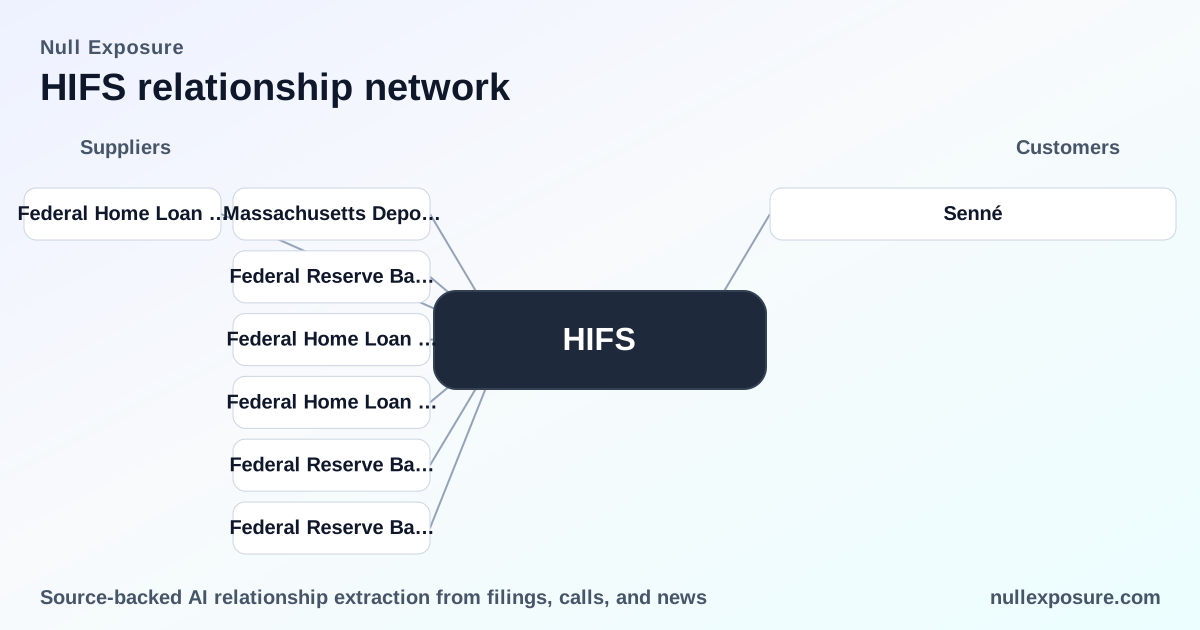
Hingham Institution for Savings (HIFS): what its supplier footprint tells investors
Hingham Institution for Savings operates as a Northeast regional bank that monetizes a franchise through net interest income on mortgage and commercial lending, complemented by fee income and a consistent cash dividend. The bank funds growth with a mix of retail deposits and sizeable wholesale borrowings, preserves customer confidence via participation in state-level deposit insurance, and delivers high operating margins that convert into industry-leading profitability metrics for a bank of its scale.
If you want a concise supplier-risk briefing tied to HIFS’s public disclosures and earnings releases, start with the relationships below and the liquidity posture they reveal. For deeper, tracked supplier analytics visit https://nullexposure.com/ for ongoing monitoring.
Big-picture investor takeaways up front
- HIFS runs a dual funding model: retail deposits plus significant wholesale lines that are actively managed and partially reduced over time.
- Liquidity backstops are centralized: the Federal Home Loan Bank system and the Federal Reserve are the principal providers of immediately available borrowing capacity.
- Deposit insurance is a client-facing stability signal: participation in the Massachusetts Depositors Insurance Fund underpins local-market trust.
- Balance-sheet scale is modest but concentrated: wholesale funds and FHLB borrowings are large relative to total assets — a structural supplier concentration to monitor.
Explore supplier monitoring and risk pages at https://nullexposure.com/ for a regular feed of updates.
The supplier relationships that matter (documented in company releases)
Below are concise, source-tagged summaries of every relationship surfaced in HIFS’s recent press releases and investor communications.
Massachusetts Depositors Insurance Fund
HIFS states it participates in the Massachusetts Depositors Insurance Fund, giving depositors full and unlimited insurance coverage and supporting customer confidence during dislocation. This participation is referenced in multiple earnings releases, including the FY2025 third-quarter and FY2025 annual results (GlobeNewswire, Oct 10, 2025; GlobeNewswire, Jan 16, 2026).
Federal Reserve Bank (FRB)
HIFS reports maintaining immediately available borrowing capacity with the Federal Reserve as part of its emergency and short-term liquidity framework; the bank cited combined FRB access and cash as a key liquidity metric in FY2025 and FY2026 filings. See the company’s third-quarter 2025 release (GlobeNewswire, Oct 10, 2025) and its FY2025 results summary (GlobeNewswire, Jan 16, 2026).
Federal Home Loan Bank (FHLB)
The company uses the FHLB system as a primary wholesale funding source, reporting borrowings from the FHLB of $1.464 billion at December 31, 2025 and historical FHLB borrowings of $1.526 billion at September 30, 2025 in its filings. Those disclosures show the FHLB as a persistent source of term and short-term liquidity (GlobeNewswire, Jan 16, 2026; GlobeNewswire, Oct 10, 2025).
Federal Home Loan Bank of Boston (FHLB of Boston)
HIFS explicitly cites the FHLB of Boston when detailing available borrowing capacity, reporting hundreds of millions of dollars of immediately available capacity at multiple quarter-ends (for example, $934.5 million available as of Dec. 31, 2025). This is documented in public releases across FY2024–FY2026 (GlobeNewswire, Jan 16, 2026; GlobeNewswire, Oct 10, 2025; GlobeNewswire, Apr 12, 2024).
Federal Reserve Bank of Boston
HIFS attributes a portion of interest income to reserves held at the Federal Reserve Bank of Boston and highlights the FRB Boston stock dividend as a contributor to yields on interest-earning assets in earlier quarterly commentary. The bank referenced this dynamic in its Q1 2024 investor release (GlobeNewswire, Apr 12, 2024).
(Each relationship summary above references HIFS press releases and investor communications published on GlobeNewswire and syndicated outlets in FY2024–FY2026.)
What the relationship map implies about HIFS’s operating model
- Contracting posture: HIFS contracts for liquidity through well-established, arm’s-length central credit lines (FHLB and FRB) rather than bespoke bilateral wholesale lenders. That posture reduces negotiation friction but concentrates counterparty exposure to system institutions. The company’s filings show active management of these lines — the bank reduced some wholesale balances and replaced portions with retail and commercial deposits as part of liability optimization (GlobeNewswire, Oct 10, 2025).
- Concentration risk: Wholesale funding is material — wholesale funds were reported at $1.956 billion at year-end 2025, a meaningfully large component of total liabilities and a source concentration to monitor. Reliance on the FHLB system for over a billion dollars in borrowings implies operational criticality of that relationship (Company press releases, FY2025–FY2026).
- Criticality and maturity: Relationships with the FHLB and FRB are mission-critical for intraperiod liquidity and contingency planning; the FHLB of Boston and FRB of Boston are mature, market-standard counterparties whose contractual terms are broadly stable but subject to systemic policy and rate shifts. The bank’s long-term membership in the Massachusetts Depositors Insurance Fund is a local-market stability factor and not a short-lived arrangement (GlobeNewswire releases, FY2024–FY2026).
- Operational signal to investors: HIFS’s high operating margin and profit conversion (operating margin TTM of 77.9% and profit margin of 49.9% per the company overview) combined with a disciplined liability strategy indicate effective management of funding costs relative to asset yields. That advantage depends on continued access to FHLB/FRB capacity and stable deposit flows.
If you track counterparty exposure across banks and public institutions, you can integrate these supplier relationships into scenario models and stress tests. Learn how we map counterparty exposure and liquidity lines at https://nullexposure.com/.
Risk vectors investors should watch
- Wholesale roll-over exposure: A meaningful shift in FHLB or brokered deposit pricing would press net interest margins given the material size of HIFS’s wholesale book. Company statements show active replacement of wholesale with retail deposits, but investor monitoring should focus on trends in wholesale balances and available FHLB/FRB capacity (GlobeNewswire, Oct 10, 2025; Jan 16, 2026).
- Local-market deposit dynamics and insurance perceptions: The Massachusetts Depositors Insurance Fund is a competitive advantage for local deposit gathering; any change in the scope or perception of that coverage would directly affect funding stability. HIFS emphasizes that coverage repeatedly in its earnings commentary (GlobeNewswire, FY2024–FY2026).
- Rate and policy shifts at the Fed/FHLB: Changes to discount window terms, FHLB collateral rules, or systemic liquidity programs will translate into funding-cost shifts for HIFS given its operational reliance on these institutions.
Bottom line and next steps
Hingham Institution for Savings runs a profitable regional franchise anchored by retail deposits but materially supported by the FHLB and Federal Reserve for liquidity and term funding. The supplier footprint is concentrated but conventional — it leans on regulated, system-level counterparties that supply large, immediately available lines. Investors should prioritize monitoring FHLB borrowings, wholesale funding trends, and the company’s stated borrowing capacity in quarterly releases.
For continuous monitoring, scenario analysis, and supplier-risk dashboards tied to HIFS and peer institutions, visit https://nullexposure.com/ to subscribe to updates and alerts. If you want a tailored counterparty exposure brief for HIFS, our team can prepare a concise risk memo—start at https://nullexposure.com/ and request a supplier brief.