HIG-P-G (The Hartford) — Supplier Relationships That Matter to Investors and Operators
The Hartford is a diversified insurance and investment franchise that monetizes through underwriting premiums, fee income from asset management, and investment returns on float; HIG-P-G represents a preferred equity instrument that benefits from the company’s capital generation and dividend policy. Suppliers and external partners — from sub-advisors to technology vendors and telematics providers — plug directly into both underwriting distribution and investment management, creating operational levers that influence capital efficiency, expense trends, and service delivery.
Explore deeper supplier intelligence and signals at https://nullexposure.com/ for a full supplier profile and monitoring setup.
How The Hartford structures third‑party relationships and why it matters
Large insurers contract for scale and specialty. The Hartford uses a mix of world‑class sub‑advisors and third‑party technology providers to outsource investment management capabilities and customer‑facing operations. That contracting posture produces predictable benefits — access to specialized alpha and reduced fixed investment in tech — and predictable risks: vendor performance, contract economics, and integration complexity.
Company‑level signals to track as an investor or operator:
- Contracting posture: Long‑term strategic relationships and sub‑advisor agreements that shift active management risk and allow internal focus on underwriting and risk management.
- Concentration: Multiple named sub‑advisors reduce single‑vendor concentration, but critical vendors for customer interactions increase single‑point operational risk.
- Criticality: Technology partners that handle customer touchpoints and telematics platforms are mission‑critical to customer acquisition, retention, and claims efficiency.
- Maturity: Partners cited are established incumbents and specialty firms, implying mature integrations rather than experimental pilots.
These characteristics shape cashflow stability for preferred shareholders and the operational playbook for procurement and vendor management teams. If you want to track supplier changes and contractual shifts automatically, start monitoring supplier intelligence at https://nullexposure.com/.
The supplier map — documented relationships and what they mean
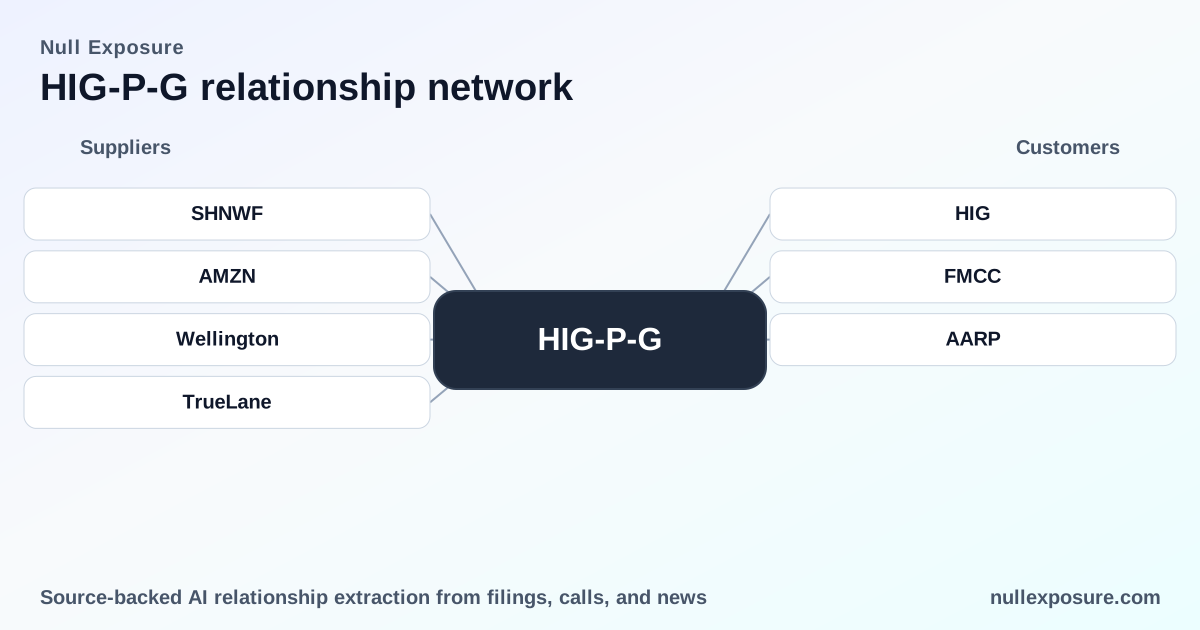
Below are every supplier relationship pulled from recent public coverage and how each partner contributes to The Hartford’s business.
Schroders — global sub‑advisor on the investment side
The Hartford referenced Schroders as a “world‑class sub‑advisor” in its Q4 2025 earnings call, indicating Schroders manages portions of investment mandates that support Hartford’s fee and investment revenue streams. According to InsiderMonkey’s transcript of The Hartford’s Q4 2025 earnings call (published March 10, 2026), Schroders is named alongside other sub‑advisors as part of the firm’s outsourced investment approach. https://www.insidermonkey.com/blog/the-hartford-financial-services-group-inc-nysehig-q4-2025-earnings-call-transcript-1685988/
Wellington — another core sub‑advisor for active management
Wellington is listed in the same earnings call as a key sub‑advisor, reinforcing a multi‑manager strategy that diversifies asset management execution risk and gives The Hartford access to specialist capabilities without expanding internal portfolio teams. The same Q4 2025 transcript published March 10, 2026, names Wellington as part of Hartford’s sub‑advisor roster. https://www.insidermonkey.com/blog/the-hartford-financial-services-group-inc-nysehig-q4-2025-earnings-call-transcript-1685988/
Amazon — technology vendor for customer interaction tooling
Management disclosed deployment of Amazon’s call center technology and multimodal capabilities in operations to enhance customer interactions, signaling reliance on cloud and contact‑center platforms for scale and digital engagement. The earnings call transcript (InsiderMonkey, March 10, 2026) directly references Amazon’s technology improving customer interactions. https://www.insidermonkey.com/blog/the-hartford-financial-services-group-inc-nysehig-q4-2025-earnings-call-transcript-1685988/
TrueLane — telematics and usage‑based insurance partner
TrueLane is cited in a MarketWatch insurance review as the provider behind The Hartford’s usage‑based/telematics offerings, confirming Hartford’s commercial adoption of usage‑based insurance products to drive pricing precision and claims outcomes. A MarketWatch review of The Hartford’s insurance products (accessed March 10, 2026) lists TrueLane under Usage‑based / Telematics Insurance. https://www.marketwatch.com/insurance-services/auto-insurance/the-hartford-insurance-review/?gaa_at=eafs&gaa_n=AWEtsqfv2f2S9jmyaGCL3AynVgcYTtjo2fmTCuD6z_YwyGMfYXtc6N_xHvvB&gaa_ts=6998b66a&gaa_sig=O27GzqeCFqurtXoaHFis_cwy7LR86nnvDU3B2cz2QhnhAHExd1fBwh0Hg5jrx4GO6ei2iLzvB7wiMJTmLYSfrA%3D%3D
What these relationships imply for investors and operations
The supplier set is strategically balanced: experienced asset managers offset active management risk; third‑party cloud and contact center technology scale customer service; telematics providers enable product differentiation. Collectively, these partners underpin both revenue generation and expense trajectories.
Key operational and investment implications:
- Diversified sub‑advisor footprint reduces single‑manager risk and can improve net‑of‑fee outcomes if sub‑advisor performance is consistent.
- Dependence on major tech providers increases operational leverage — outages or contract disputes with cloud/contact center vendors would have outsized customer impact.
- Telematics adoption is a revenue and loss‑ratemaking lever that changes premium segmentation and loss cost predictability.
Risks to monitor:
- Sub‑advisor underperformance that increases investment volatility.
- Contract terms and renewal timelines with technology vendors that could change cost structure.
- Regulatory and privacy risks associated with telematics data collection.
Practical steps for due diligence and vendor monitoring
Investors and procurement teams should adopt a focused monitoring checklist:
- Track sub‑advisor AUM and performance relative to benchmarks and Hartford’s internal targets.
- Review technology vendor SLAs, scalability plans, and incident histories.
- Monitor telematics adoption rates and any regulatory developments affecting usage‑based pricing.
For operator playbooks and to set up ongoing surveillance of supplier dynamics, register for supplier intelligence and alerts at https://nullexposure.com/.
Final takeaways and next steps
The Hartford’s supplier posture blends established asset managers and leading technology vendors to support both underwriting and investment functions; this structure reduces some concentration risks but creates critical dependencies on vendor performance and data‑driven product models. For preferred‑stock investors focused on dividend stability, supplier performance is a second‑order but material driver of operating leverage and cost trends.
If you are evaluating counterparty risk, procurement strategy, or dividend sustainability, start a tailored supplier-monitoring plan at https://nullexposure.com/ to convert these relationship signals into actionable operational and investment intelligence.