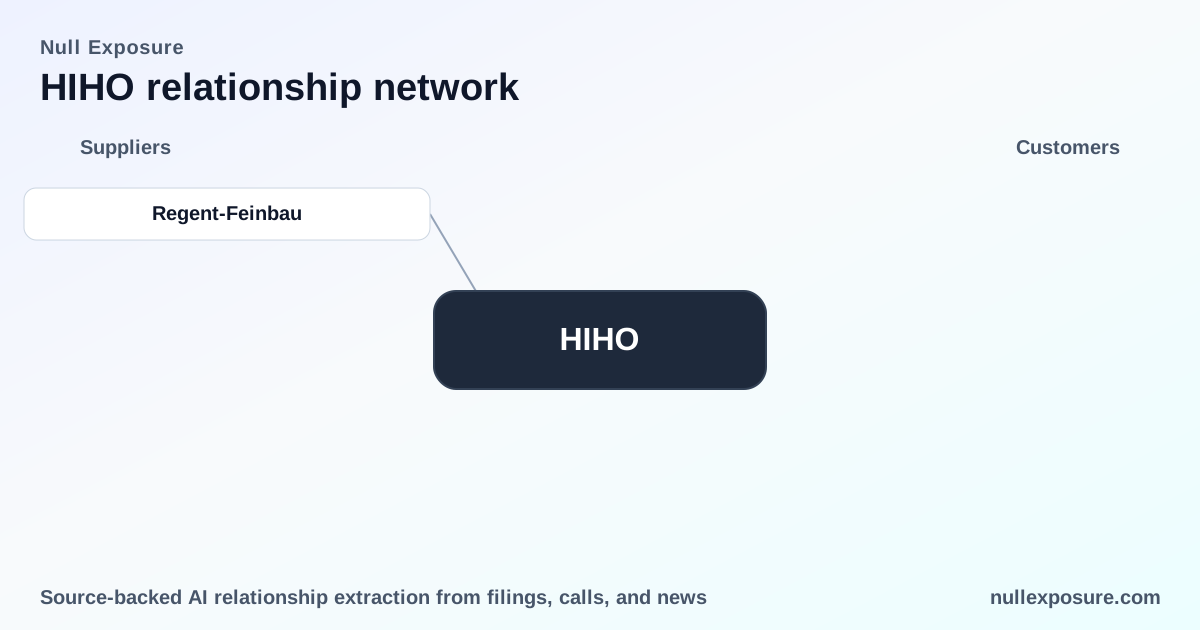
Highway Holdings (HIHO): Supplier strategy in a capital-light metal fabrication niche
Highway Holdings manufactures and supplies metal, plastic, electrical and electronic components and subassemblies to OEMs and contract manufacturers, monetizing through product sales and targeted acquisitions that expand capability and vertical reach. The company's near-term revenue engine is component sales to automotive and industrial OEMs, complemented by strategic minority acquisitions to internalize precision sheet-metal capabilities. For an investor evaluating supplier relationships, the Regent-Feinbau transaction is the pivotal signal that Highway is shifting from commodity parts supplier toward higher-value precision fabrication. Learn more at https://nullexposure.com/.
The business model in plain English: what investors buy into
Highway Holdings is a small-cap, Hong Kong–headquartered metal fabricator listed on Nasdaq that sells finished components and subassemblies to OEMs and contract manufacturers. According to company disclosures for the latest quarter (2025-06-30), TTM revenue is $7.08M with gross profit of $2.336M, while operating margin is negative and EBITDA is negative on a trailing basis. The company’s market capitalization is roughly $6.5M, with 36.5% insider ownership and only ~5% institutional ownership, highlighting a tightly held equity base and limited sell-side coverage.
These figures translate into several practical operating characteristics investors should treat as company-level signals:
- Contracting posture: Highway operates as a direct supplier to OEMs and contract manufacturers, relying on order-based revenue rather than recurring subscription-style cash flows; the business is sensitive to OEM production cycles and customer order books.
- Concentration and criticality: Component supply is mission-critical to OEM assembly lines, but Highway’s small scale and product breadth imply customer concentration risk and limited bargaining power versus larger Tier 1 suppliers.
- Maturity: The combination of negative operating margin, small market cap, and low institutional ownership indicates an early-to-mid stage industrial firm that is executing on capability-building rather than delivering stable, predictable cash flows.
The Regent-Feinbau relationship — what changed and why it matters
Highway Holdings completed a move to acquire 51% of Regent-Feinbau, a precision sheet-metal manufacturer, as part of a strategic push into higher-value fabrication and the automotive sector. A news report from Timothy Sykes referencing FY2025 coverage noted the acquisition and described Regent-Feinbau as a specialist that aligns with Highway’s ambition to fortify its footprint in the automotive sector, especially in the Chinese market (reported March 10, 2026).
This majority stake accomplishes two immediate objectives for Highway:
- Capability upgrade: Internalizing precision sheet-metal capability reduces reliance on third-party subcontractors for higher-margin components.
- Market access: Regent-Feinbau’s specialization supports Highway’s stated push into automotive OEM supply chains, a logical step to capture larger contract opportunities.
Relationship detail table (narrative)
Every relationship surfaced in the supplier search is covered below.
- Regent-Feinbau — Highway acquired 51% of the specialist precision sheet-metal manufacturer to strengthen its automotive-oriented supply capabilities and target expansion into China; reported in FY2025 coverage by Timothy Sykes on March 10, 2026 (news report).
This is the only supplier-level relationship surfaced in the available results; no other named supplier relationships or contractual counterparties were identified in the search results.
What the acquisition implies for contract posture and supply risk
The Regent-Feinbau stake changes Highway’s supplier posture in concrete ways. By shifting from outsourcing precision work to owning a controlling interest, Highway reduces third-party dependency for a critical input, which improves gross margin opportunity on higher-complexity parts. At the same time, concentration risk shifts from external suppliers to integration risk — integrating a new manufacturing asset creates execution risk that can pressure working capital and margins during transition.
Notably, the constraints dataset returned with the supplier search is empty, which is itself a signal: no supplier-specific contractual constraints or enumerated sourcing limitations were disclosed in the relationship data, so investors should rely on company filings and transaction announcements for operational detail rather than expecting supplier-side covenants to appear in public records.
Learn more about supplier footprints and transaction impact at https://nullexposure.com/.
Financial and governance considerations investors must price in
- Small scale and limited liquidity: Market cap near $6.5M and a float of ~2.82M shares produce liquidity and volatility considerations for institutional-sized positions.
- Profitability profile: A trailing operating margin of -8.92% and negative EBITDA indicate the company is operating below sustainable margin levels and relies on operational improvements or scale to move into positive cash generation.
- Concentrated ownership: 36.5% insider ownership and ~4.9% institutional ownership suggest insider-aligned decision-making but low independent institutional scrutiny; this is a governance signal that affects exit liquidity and strategic flexibility.
- Coverage vacuum: No analyst consensus target is available and there is limited sell-side presence, which places a premium on direct due diligence and cautious position sizing.
These are not abstract issues — they determine how quickly an acquisition such as Regent-Feinbau can be accretive to revenue and margins, and how much runway Highway holds to absorb integration costs.
Tactical implications for operators and procurement teams
From an operator or OEM sourcing perspective, Highway’s move to own precision capability signals a potential new supplier for higher-margin, lower-volume precision parts where vertical integration matters. Procurement teams should:
- Evaluate quality and capacity certifications from Regent-Feinbau post-close before shifting critical assemblies.
- Consider dual-sourcing during the integration window to mitigate disruption risk.
- Monitor unit economics post-integration to confirm Highway converts capability into reliable supply and margin improvement.
Bottom line and recommended next steps for investors
Highway Holdings is executing a capability-driven consolidation strategy that is rational for a small metal fabricator pursuing automotive OEM starts. The Regent-Feinbau acquisition is a meaningful strategic step that upgrades Highway’s manufacturing content and positions the company for higher-value contracts, but the firm’s small scale, negative operating margin, and limited institutional coverage create execution and liquidity risks that investors must price.
Next steps:
- Review the company’s audited filings and the full transaction terms for Regent-Feinbau to quantify capex and working-capital impact.
- Conduct supplier-level due diligence on Regent-Feinbau’s certifications, customers, and order pipeline.
- Watch operational KPIs across the next two fiscal quarters for margin and revenue conversion.
For a deeper look at supplier relationships and how they move small-cap industrial strategies, visit https://nullexposure.com/.