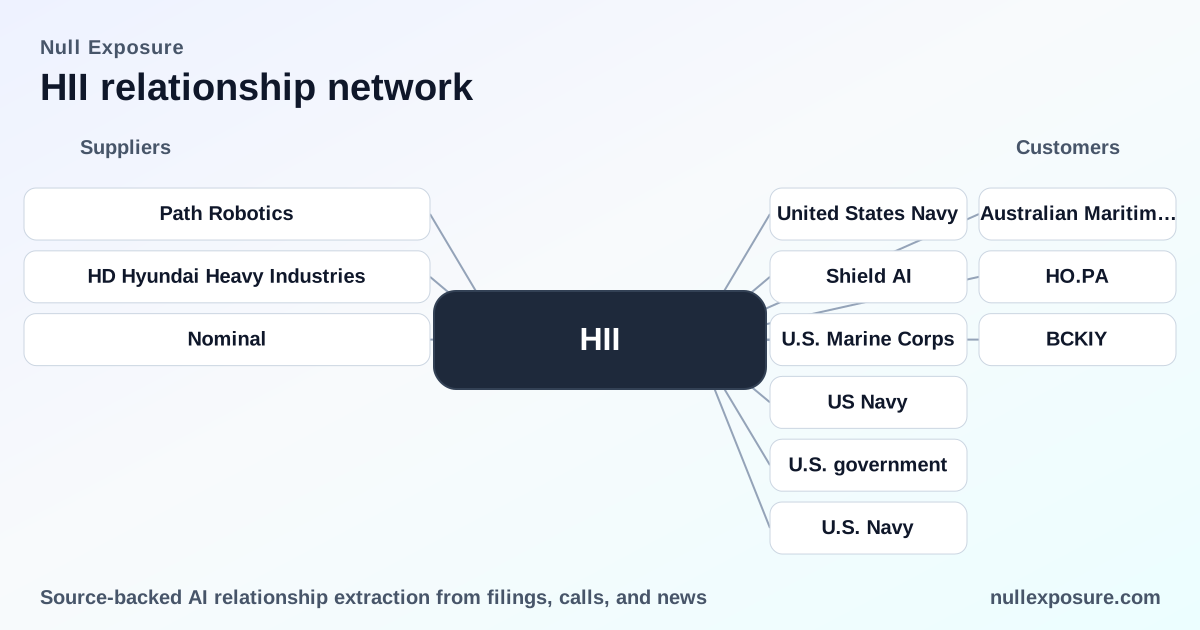
Huntington Ingalls Industries (HII): supplier relationships that shape shipbuilding margins and strategic optionality
Huntington Ingalls Industries is the United States’ largest military shipbuilder and a provider of professional services to government and industry; it monetizes through long‑term U.S. government shipbuilding and sustainment contracts, recurring systems and services work, and targeted M&A to extend manufacturing capability. For investors and operators, HII’s supplier roster and strategic partnerships are a direct lever on throughput, program risk, and the company’s ability to convert defense budget tailwinds into sustainable margins. Learn more about how supplier exposures and partnership initiatives are captured and tracked at Null Exposure: https://nullexposure.com/.
How HII runs its supply chain — the business model implications
HII operates with a contracting posture that combines long‑duration program economics and significant near‑term purchase obligations. This creates a supplier profile that ranges from strategic, single‑source inputs to high‑volume commodity buys.
- Contracting mix: HII’s public disclosures emphasize long‑term customer contracts, long leases on yard real estate, and a credit facility structure that supports multi‑year programs. These elements underpin predictable revenue streams but lock in long procurement tails.
- Concentration and criticality: The company recognizes that some components are effectively single‑source for defense programs, which elevates supplier criticality and the operational risk of supplier failures.
- Operational posture: HII functions as both a manufacturer and a service integrator, outsourcing major sub‑assemblies while retaining systems integration and program management responsibility. That makes supplier performance and cybersecurity controls central to contract delivery.
- Spend profile and scale: Purchase obligations of roughly $7.1 billion as of year‑end 2025 reflect high absolute spend and a meaningful proportion of future cash outflows tied to third parties.
These signals combine into a supplier risk framework that rewards investments in capacity, automation, and verified supplier compliance. For a deeper drilldown into HII supplier relationships and how they affect exposure models, visit https://nullexposure.com/.
Partnerships investors should track
Path Robotics — automating welding in shipyards
HII executed a memorandum of understanding with Path Robotics in February 2026 to explore integration of Path’s physical AI welding systems into HII’s manned and unmanned shipbuilding operations, intended to accelerate fabrication throughput and augment the welding workforce across complex naval fabrication tasks. According to a Finviz report on March 10, 2026, and supporting coverage from Sahm Capital in early March 2026, the MOU is explicitly positioned to strengthen the maritime industrial base through autonomous welding technology integration (FY2026 reporting).
HD Hyundai Heavy Industries — a memorandum of agreement for future collaboration
During HII’s Q4 2025 earnings call management disclosed a memorandum of agreement with HD Hyundai Heavy Industries reinforcing strategic collaboration to explore partnership opportunities, signaling openness to trans‑ocean industrial cooperation on shipbuilding and related systems. The company mentioned this arrangement on the Q4 2025 call as part of broader industry engagement and capability expansion (2025Q4 earnings call).
Nominal — data modernization for unmanned fleets
HII signed a multi‑year partnership with Nominal in FY2026 to revamp how data is collected and analyzed across its REMUS and ROMULUS unmanned maritime systems, aimed at centralized data management and improved operational analytics for autonomous platforms. SimplyWallSt reported this partnership as part of HII’s push into autonomous maritime systems (FY2026 coverage).
What these relationships mean for margins and program risk
HII’s partnerships illustrate a dual strategy: deploy automation and data partners to raise throughput and reliability while selectively engaging global shipbuilders for strategic capability. Path Robotics and Nominal are incremental to margin expansion because they target manufacturing productivity and fleet analytics; the HD Hyundai MOA is strategic optionality that could unlock new industrial scale or supply diversification.
- Upside: Automation and better data reduce labor intensity and rework, improving unit economics across repeat shipbuilding programs. Partnerships with robotics and analytics providers are a lever to compress cycle times and reduce subcontractor variability.
- Risk reduction: Improving supplier data and introducing automation reduces dependence on scarce skilled trades—important given HII’s emphasis on workforce training in the Maritime Industrial Base.
- Program risk remains material: HII’s disclosures stress that supplier performance, single‑source components, and cyber threats continue to be primary drivers of contract execution risk; partnerships reduce but do not eliminate those exposures.
For investors focused on supplier‑driven margin improvement or downside protection, these relationships are credible strategic moves. Track updates and supplier performance signals at Null Exposure: https://nullexposure.com/.
Quick operational takeaways for operators
- Automation partnerships like Path Robotics accelerate fabrication throughput but require integration capital and qualification cycles.
- Data modernization through Nominal converts disparate sensor and mission data into a single analytics foundation that improves lifecycle sustainment economics.
- Global industrial moats such as MOAs with HD Hyundai provide access to alternative build practices and subcontracting capacity, useful during U.S. bottlenecks.
Key risk factors to model
- Single‑source dependency: Some program components are approved from one supplier only; a disruption will have outsized contract consequences.
- Supplier performance and cost inflation: Delays or quality issues from subcontractors feed directly into contract cost overruns and margin compression.
- Cybersecurity exposure: HII emphasizes supply‑chain cybersecurity requirements; breaches at suppliers can cause bidirectional program disruption.
- Contractual rigidity: Long‑term customer contracts include pricing and performance regimes that limit short‑term pass‑through of raw‑material inflation.
Bottom line for investors and operators
HII is converting defense budget growth into durable economics by marrying scale shipbuilding with targeted supplier partnerships in automation and data. The company’s supplier relationships are strategically aligned to lift throughput and reduce operational variability, while established long‑term contracts and large purchase obligations create both resilience and concentrated execution risk. For portfolio decisions, weigh automation and data partnerships as margin expansion catalysts against persistent single‑source and cyber risks.
Explore a structured view of HII’s supplier exposures and relationship momentum at Null Exposure: https://nullexposure.com/.