Himax Technologies (HIMX): supplier relationships, commercial posture, and what investors need to know
Himax Technologies is a factory‑less semiconductor company that designs and licenses display imaging and microdisplay technologies and monetizes through product sales and design licensing to OEMs across AR/VR, mobile displays, and consumer electronics. The company generates revenue from chip and display-module sales and from IP and design partnerships, with a global footprint concentrated in Asia and meaningful exposure to the AR supply chain. For a concise, enterprise-grade supplier map and exposure analysis, visit https://nullexposure.com/.
Why the supplier lens matters for HIMX investors
Himax’s business is fundamentally B2B and partner-driven: revenue depends on wins with device manufacturers and the integration of Himax display components into OEM subsystems (for example, waveguides and microdisplays). Financially, Himax posts roughly $832 million in trailing revenue with thin operating margins (3.36%) and modest net margins (5.28%), making supplier relationships and product placements critical levers for margin expansion and revenue growth. The stock’s forward P/E (9.84) versus trailing P/E (38.24) implies the market expects a step-up in earnings from current commercial traction.
For a deeper look at how these supplier links translate to enterprise risk and opportunity, see https://nullexposure.com/.
The operating model and company‑level signals investors must weigh
Himax’s operating profile and the dataset produce a set of company-level signals that shape supplier risk and opportunity:
- Factory‑less model (fabless): Himax outsources manufacturing, so its contracting posture is supplier-to-OEM/packager and dependent on third‑party fabs and assemblers for execution and quality control.
- Customer criticality: Himax supplies key components (microdisplays, driver ASICs) that are critical to AR/optical module performance; placement inside an OEM design confers stickiness but also project-level concentration risk.
- Revenue and margin maturity: With $832M TTM revenue, positive EBITDA ($66.7M) and low operating margins, Himax is a mid‑sized public semiconductor supplier in a mature-ish segment where scale and design wins drive margin expansion.
- Concentration and governance: Insider ownership around 31% and institutional ownership around 20% indicate significant insider influence over strategic direction and potential stability of executive priorities.
- Cyclical demand sensitivity: Negative quarterly earnings and revenue growth rates year-over-year (-74.4% and -14.4% respectively for quarterly metrics) signal exposure to product cycle swings and OEM inventory cadence.
These signals describe the company as a strategic component supplier that depends on successful OEM integrations, third‑party manufacturing, and a handful of design wins to convert revenue into sustained margin improvement.
Supplier relationships: who Himax is working with and why it matters
Below I cover every relationship captured in the available results and explain the investment relevance.
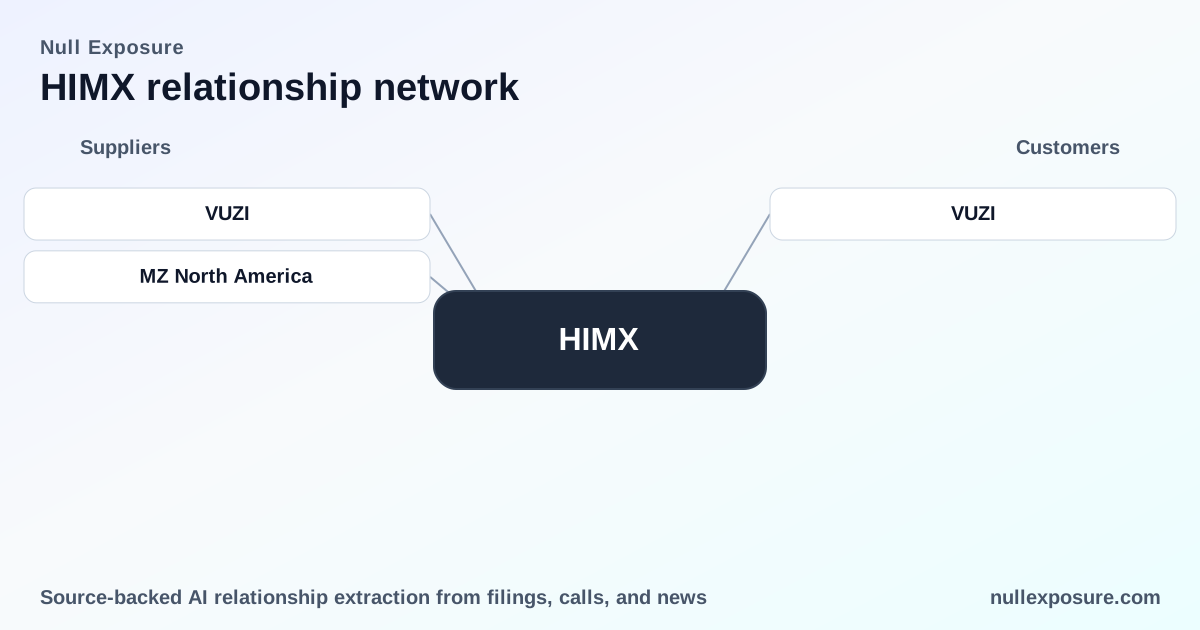
Vuzix — AR OEM integration with Himax microdisplay
Himax’s HX7319FL LCoS microdisplay is paired with Vuzix waveguide technology, indicating a design-level integration between Himax microdisplays and Vuzix optical modules. This is a direct commercial validation of Himax’s microdisplay IP in the AR headset market, reinforcing criticality to AR subsystem suppliers. According to a Simply Wall St note dated March 10, 2026, the design pairs Himax’s HX7319FL with Vuzix waveguides (FY2026 reporting window).
MZ North America — investor relations and US representation
MZ North America is listed as the U.S. investor‑relations representative for Himax, providing IR contact and media coordination for conference calls and earnings releases. A GlobeNewswire release on January 12, 2026, names Mark Schwalenberg of MZ North America as the U.S. IR contact for Himax’s Q4 and FY2025 results, showing how Himax routes U.S. investor communications through an external IR firm.
What these relationships reveal about commercial strategy
The Vuzix integration signals product-level traction in AR, where Himax’s microdisplay is a component that materially affects user experience; securing such placements increases revenue visibility if the OEM gains meaningful end‑market traction. The use of MZ North America for IR work signals professionalized investor communications and market outreach in the U.S., which supports liquidity and analyst coverage.
- Commercial implication: Winning design slots with AR OEMs is a gateway to recurring module orders and licensing; each confirmed integration is a high-value commercial asset.
- Operational implication: Fabless execution and reliance on contract manufacturers place operational risk beyond Himax’s direct control and elevate the importance of supply-chain oversight.
For further supplier and exposure mapping, check the analysis hub at https://nullexposure.com/.
Key risks and monitoring priorities for investors and operators
- Design concentration risk: Large program wins are binary — a design loss or a delayed OEM ramp materially impacts revenue. Track published OEM product launch schedules and Himax program announcements.
- Execution dependency: As a fabless supplier, Himax depends on external fabs and subcontractors; monitor external supply disruptions and capacity constraints.
- Margin pressure from product mix: Current operating margins are low; margin recovery depends on higher ASP products (microdisplays) and better utilization of SG&A and R&D spend.
- Market sentiment vs. fundamentals: The forward P/E versus trailing P/E gap signals market expectations of improved profitability; investors should reconcile that with order book visibility and confirmed design wins.
Actionable next steps for investors and operators
- For investors: Track program-level confirmations (OEM design wins and shipment schedules) and quarterly IR disclosures that reference customer ramps; prioritize Himax when AR OEM placements convert into visible revenue.
- For operators and procurement leads: Verify supply-chain contracts and contingency arrangements with Himax and its contract manufacturers to mitigate execution risk.
- For teams building exposure maps: use a supplier‑centric approach that weights relationships by product criticality and program scale rather than headline customer names alone.
Explore structured supplier maps and risk modeling tools at https://nullexposure.com/ to translate these relationship signals into investment or operational actions.
Himax stands as a specialized supplier whose valuation and margin runway are tightly coupled to a few strategic OEM integrations and successful transitions from design wins to volume shipments. For investors, the critical questions are whether current AR placements scale and whether Himax can convert design momentum into sustained margin recovery. For operators, the focus is on supply reliability and program-level commitments. For more supplier intelligence and exposure analysis, visit https://nullexposure.com/.