Hippo Holdings (HIPO) — supplier relationships, operational constraints, and what investors should price in
Hippo is an insurtech that underwrites and distributes homeowners insurance through a combination of proprietary technology, MGA partnerships and captive/admitted carriers; it monetizes primarily via net earned premium, ceded-commission income, and service fees associated with program administration and distribution. The company simultaneously acts as an insurance originator and platform operator—buying reinsurance to manage volatility while selling underwriting and distribution services to partners—so counterparty strength and contract design are first-order drivers of capital efficiency and earnings stability. For a fast read on supplier signals, start at Null Exposure: https://nullexposure.com/.
The business model in plain language: why counterparties matter
Hippo combines digital direct distribution, third‑party agent channels (including First Connect), and insured-capacity through its insurance subsidiaries and affiliated captive structures. Revenue is driven by premium volume and the margin between gross written premium and net retained risk after reinsurance, plus commission income on ceded premiums and fees for platform services. That mix creates dual reliance: Hippo depends on reinsurance markets and payment/cloud vendors to run the product, and it depends on distribution partners to scale new business. These supplier relationships therefore influence capital usage, loss volatility and go‑to‑market velocity.
For an integrated view of Hippo’s supplier exposures, visit https://nullexposure.com/.
Named supplier relationships you need to know
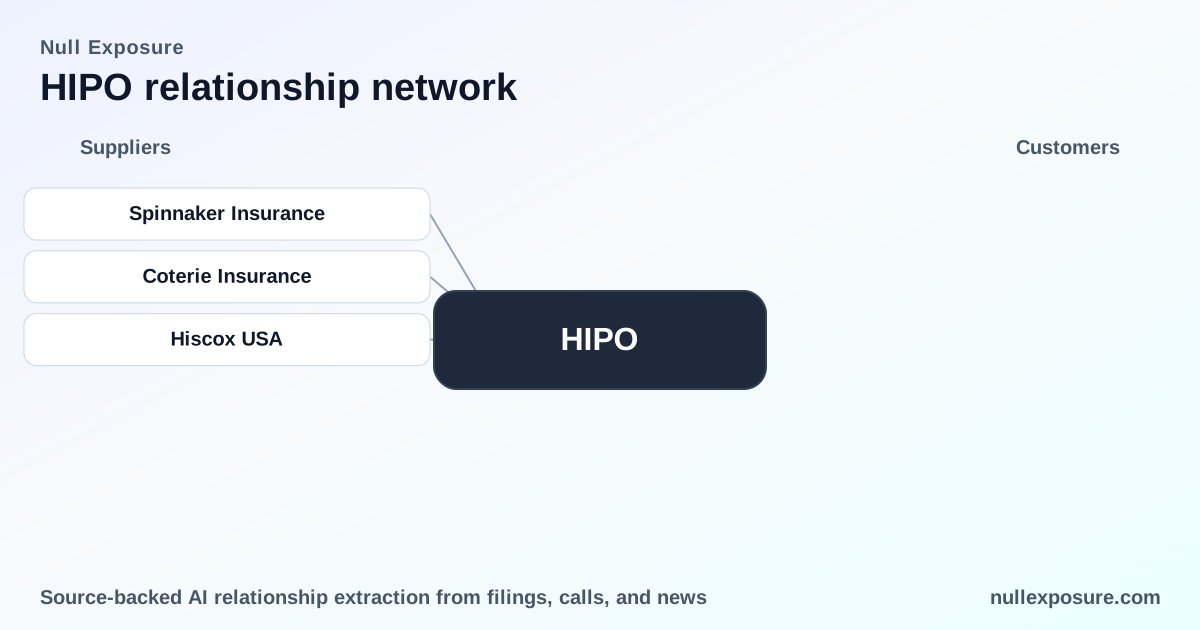
Spinnaker Insurance
Spinnaker serves as Hippo’s hybrid fronting carrier and is an active participant in Hippo’s reinsurance architecture; Spinnaker reported a surplus increase to $223 million in FY2025, a sign of capacity growth in that fronting channel. Insurance Business Magazine reported this development on March 10, 2026: https://www.insurancebusinessmag.com/us/news/breaking-news/hippo-enjoys-revenue-surge-545357.aspx.
Takeaway: Spinnaker is a material operational partner on the underwriting front and figures directly into Hippo’s admitted-capacity and program risk profile.
Coterie Insurance
Coterie is referenced as a carrier partner reached via Hippo’s First Connect platform, which First Connect has positioned as a distribution channel for independent agents since the relationship began in 2021 (press release FY2024). PR Newswire covered the milestone in 2026 describing Coterie’s role: https://www.prnewswire.com/news-releases/hippos-first-connect-hits-100-carrier--mga-milestone-and-launches-new-appetite-finder-feature-302094942.html.
Takeaway: Coterie is a distribution partner accessible through Hippo’s aggregation services; this underscores Hippo’s strategy of scaling distribution via multi-carrier access.
Hiscox USA
Hiscox USA is another carrier that joined Hippo’s First Connect marketplace, helping Hippo reach a 100‑carrier and MGA milestone on the platform in FY2024 (press release). See PR Newswire, FY2024: https://www.prnewswire.com/news-releases/hippos-first-connect-hits-100-carrier--mga-milestone-and-launches-new-appetite-finder-feature-302094942.html.
Takeaway: Hiscox’s participation validates Hippo’s ability to attract established specialty carriers to its distribution platform, strengthening the firm’s product breadth for independent agents.
Contracting posture, concentration and maturity — what the constraints reveal
Hippo operates with a layered contracting posture: a mix of long‑term agreements (leased offices, multi‑year cloud arrangements, and multi‑year reinsurance structures such as an XOL treaty with Mountain Re through June 2026) and short‑term, transactional contracts (annual reinsurance treaties and state‑level hurricane programs). The company’s filings show one‑year reinsurance treaties are common while catastrophe XOL protection frequently sits on multi‑year placements.
- Contract length and flexibility: Long‑term cloud and some XOL arrangements provide stability; annual quota‑share and ceded treaties create renewal exposure each year.
- Concentration: Technology infrastructure is concentrated across a handful of cloud providers (Google Cloud, AWS, Salesforce) and a small set of payment processors, making operational continuity a single‑point risk in practice.
- Criticality and materiality: Multiple disclosures flag third‑party data, cloud platforms and reinsurance counterparties as material or critical to operations; outages or counterparty underperformance can immediately impair quoting, sales and claims processing.
- Maturity: The firm’s reinsurance approach is mature and programmatic—quota shares complemented by excess‑of‑loss cover—while its distribution marketplace (First Connect) is scaling and attracting recognized carriers.
Where constraints name an entity, the text references it directly: the XOL treaty with Mountain Re is documented as covering Hippo through June 2026, and Spinnaker’s use of the Florida Hurricane Catastrophe Fund is specifically disclosed.
Commercial roles and spend signals investors should track
Hippo acts as both buyer and seller in the reinsurance ecosystem: it purchases XOL and quota share protection to limit loss volatility and simultaneously receives ceded premium commissions and offers Insurance‑as‑a‑Service through Spinnaker and related entities. Supplier spend signals in filings range from sub‑$10m acquisition and lease commitments to 100m+ figures tied to ceded reinsurance and recoverables—evidence of large capital flows through the reinsurance channel rather than traditional operating vendor spend.
- Segments to monitor: services (third‑party claims and security consultants), infrastructure (cloud providers), and software/data licensing (ISO and other underwriting data).
- Spend bands: selective M&A and contingent consideration sit in the $1m–$10m band; reinsurance ceded volumes and recoverables drive 10m–100m and 100m+ flows.
For a deeper look at supplier risks and exposures, explore https://nullexposure.com/.
Investor implications and operational priorities
- Capital allocation: Evaluate Hippo’s reliance on ceded reinsurance and sliding‑scale commissions when modeling retention and operating leverage. Reinsurance structure changes materially impact required capital at the insurance‑subsidiary level.
- Operational resilience: Cloud and payment‑processor concentration are actionable operational risks; investors should expect Hippo to continue investing in redundancy and TPRM (third‑party risk management).
- Counterparty credit and regulatory exposure: Government programs (FHCF) and state regulatory regimes are embedded in Hippo’s catastrophe protection and admitted writing; these exposures should be incorporated into stress scenarios.
Next steps for operators and investors
- For operators: prioritize contractual protections around vendor SLAs for cloud and payment services, and insist on collateral and credit protections in reinsurance placements.
- For investors: stress-test earnings and capital scenarios under alternative reinsurance renewal and cloud‑service disruption assumptions, and monitor First Connect carrier additions as a leading indicator of distribution traction.
If you want a consolidated supplier risk brief tailored to HIPO, start here: https://nullexposure.com/. For subscription access and ongoing monitoring of supplier signals, see https://nullexposure.com/ — the fastest path to continuous counterparty intelligence.
Final takeaway: Hippo’s model scales when reinsurance capacity and third‑party tech operate reliably; the firm’s supplier map is an explicit lever on capital and growth. Investors should treat carrier and cloud relationships as primary inputs to valuation and downside risk.