Health In Tech (HIT): Supplier Relationships and Counterparty Risk Profile
Health In Tech (HIT) operates a technology-first platform that sells digital health underwriting, plan administration and network services to employers and brokers, monetizing through a mix of per-user fees, subscription charges, third‑party service margins, and insurance-related revenue flows (including quota-share reinsurance and captive management fees). The company earns platform revenue when third‑party administrators and carriers place business through HIT’s eDIYBS and HI Card products, while infrastructure and AI partners deliver the predictive and hosting capability that drives pricing and enrollment. For investors, HIT’s economics are therefore a blend of software-as-a-service economics and insurance underwriting economics, with significant dependency on third‑party partners for both technology and carrier capacity.
Explore deeper supplier intelligence at https://nullexposure.com/.
How to read HIT’s supplier posture — the compact thesis
HIT’s supplier footprint shows a dual profile: strategic, long‑tenor infrastructure and AI partners that are operationally critical, and variable, usage‑based economic relationships that scale with enrollments. Company disclosures for the year ended December 31, 2024, note that three primary service providers accounted for 61.2%, 10.6% and 8.3% of cost of revenues, signaling high vendor concentration on a small set of outsourcers. At the same time, contract excerpts and payment terms reveal a mix of usage‑based billing (per‑user minimums), fixed monthly subscriptions, and conventional multi‑year leases, producing a hybrid contracting posture that combines recurring revenue with demand‑sensitive spend.
Key operating signals (company‑level):
- Contracting posture: A mix of long‑term leases (five‑year HQ lease through Oct 2027) and short‑term, 12‑month arrangements, with explicit usage‑based and subscription billing clauses (evidence of minimum monthly fees and per‑user pricing).
- Concentration and criticality: Three primary service providers dominate cost of revenues, and the business “relies solely on third‑party service providers” for critical AI functionality — a material operational dependency.
- Maturity and lifecycle: Many supplier relationships are active and multi‑year (contracts extending to 2026–2027), but HIT has also executed transactional, short‑term arrangements and one notable termination/deconsolidation event in mid‑2023.
- Spend profile: Supplier spend bands range from sub‑$100k items to multi‑million transactions (audit and captive management activity), indicating both low‑value operational vendors and several higher‑value strategic partners.
These signals mean investors should treat HIT as asset light on technology but asset heavy in counterparty exposure: volatility or failure at a handful of service providers would materially affect delivery and cost structure.
The supplier roster — who’s on the record (every relationship in the results)
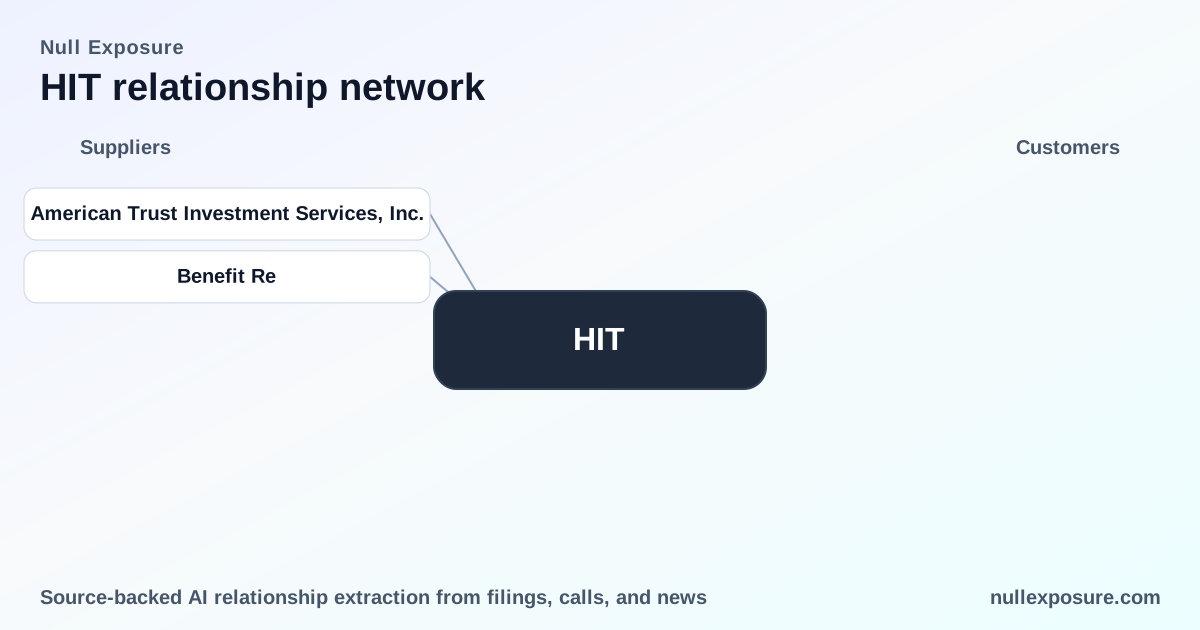
American Trust Investment Services, Inc.
American Trust acted as the sole book‑running manager for HIT’s initial public offering and is named in the company’s underwriting documentation. According to a PR Newswire release announcing HIT’s IPO closing, American Trust served in that underwriting capacity; HIT’s filings also reference an Underwriting Agreement dated December 20, 2024 between the company and American Trust. (Source: PR Newswire, IPO closing notice, March 2026; HIT underwriting agreement disclosure, FY2024 filing.)
Benefit Re
HIT has entered a strategic collaboration with Benefit Re to launch over 100 customized stop‑loss, self‑funded healthcare plans for employers, positioning Benefit Re as a carrier/partner in new go‑to‑market offerings. The alliance was announced in media coverage and described by HIT as part of an expansion of captive and stop‑loss capabilities. (Sources: MarketScreener report on HIT–Benefit Re collaboration, March 2026; Sahm Capital press release on the collaboration, January 8, 2026.)
(Note: both Benefit Re references in the results reflect the same strategic collaboration announced across multiple outlets; each source confirms the carrier partnership and go‑to‑market focus.)
What these relationships imply for investors and operators
HIT’s business model stitches together software distribution, underwriting flow, and carrier/captive arrangements. That architecture creates concentrated counterparty exposure with several implications:
- Operational dependency on third‑party AI and data vendors. The company discloses that its eDIYBS functionality is backed by third‑party AI providers and that vendors are relied upon to deliver predictive modeling and decision engines. This makes HIT’s service delivery highly dependent on vendor uptime, IP licensing and data security practices (company FY2024 disclosure).
- Contract mix increases both flexibility and fragility. Usage‑based and per‑user minimums (for example, minimum monthly fees and a $16,250 monthly subscription cited in filings) allow costs to scale with revenue, but create downside if utilization falls below thresholds because minimums create fixed cash obligations in practice. At the same time, long‑term office leases and multi‑year AI work orders extend fixed overhead across cycles.
- Concentration is a single‑point risk. The three primary service providers’ outsized share of cost of revenues is a material signal: a vendor disruption, regulatory failure, or contract termination would require costly replacement and could materially disrupt service to carriers and employers.
- Insurance flows add complexity. HIT executes quota‑share reinsurance treaties (ceding 80% of claims), captive management and carrier arrangements that entwine operational supplier risk with balance‑sheet risk; operational vendor failures can cascade into underwriting and claims performance.
These are not hypothetical: HIT’s filings explicitly warn that vendor security incidents, contract noncompliance or changes in vendor operations could materially affect financial condition and reputation (FY2024 risk disclosures).
Explore supplier risk analytics and counterparty mapping at https://nullexposure.com/.
Quantitative touchpoints that matter for due diligence
- Vendor concentration: Three providers contribute the majority of cost of revenues (61.2% / 10.6% / 8.3% as of Dec 31, 2024).
- Spend scale: Vendor spend ranges across bands—from sub‑$100k development items to $1m+ captive transactions and IPO underwriting fees—meaning diligence must cover both operational vendors and large strategic partners.
- Contract tenure: Active multi‑year agreements (some extending to 2027) coexist with short‑term and usage‑based contracts; track renewal cliff dates for core AI and hosting partners.
- Role mix: The company is both a buyer and a seller in its ecosystem (it purchases services, licenses technology, and also sells rights and administrative collection streams to carriers or via captive arrangements).
Investment takeaways and recommended next steps
- Primary risk to monitor: vendor concentration and data/AI supply chain controls. HIT’s growth is contingent on third‑party AI and carrier relationships; a failure in those partners would be an immediate operational risk.
- Contract profile is mixed risk: usage‑based economics support upside, but minimums and long‑term leases create fixed commitments that can pressure margins in downturns.
- Catalyst calendar focus: watch AI vendor contract expirations (noted 2026–2027), underwriting/captive reinsurance treaty renewals, and any regulatory scrutiny tied to AI usage in underwriting.
For investors evaluating partnership or supplier exposure, prioritize:
- Vendor security audits and SOC/pen‑test evidence
- Clarity on substitution options for the top three service providers
- Timeline and economics of carrier/captive treaties and reinsurance arrangements
If you want a granular counterparty map or comparative supplier scoring for HIT, start here: https://nullexposure.com/.
Bold summary: HIT’s business scales by outsourcing core AI and underwriting functions to a concentrated set of suppliers; that structure accelerates go‑to‑market but concentrates operational and regulatory risk. Investors should treat vendor resilience and contract cliff timing as primary monitoring metrics. For tailored supplier risk reports and ongoing monitoring, visit https://nullexposure.com/.