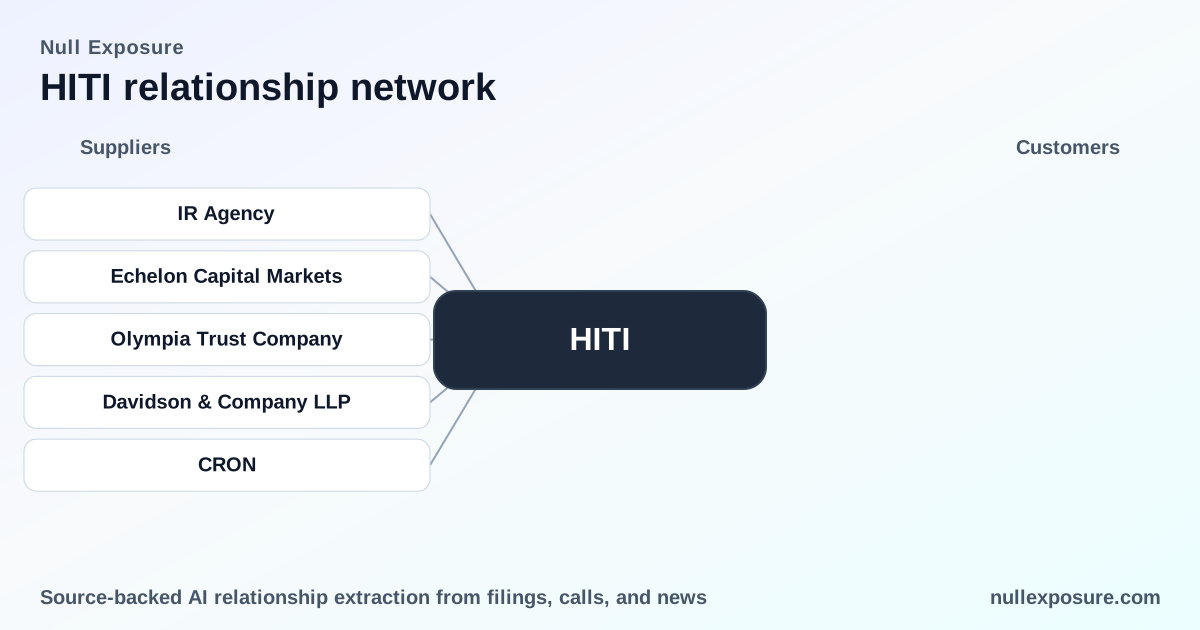
High Tide Inc. (HITI): Supplier and advisor network shapes capital and communications posture
High Tide is a vertically integrated cannabis operator that monetizes through retail, branded product sales and wholesale distribution across Canada, the United States and international markets. The company supplements operating cash flow with external capital and third-party services—investor relations, financial advisors, trustees and auditors—to manage financing, disclosure and governance as it scales. For investors evaluating supplier relationships, the recent mix of advisors and capital partners signals an active capital-cycle strategy and a reliance on external specialists for credibility and capital execution. Learn more about supplier and advisor profiles at https://nullexposure.com/.
What these partner moves mean for investors: a concise thesis
High Tide’s recent disclosures show a clear operating posture: outsourced capital formation and market communications are central to execution. The company uses specialist firms to raise subordinated debt, administer trust agreements, and reengage investor relations while maintaining an independent accounting review function for interim disclosures. That combination reduces internal execution risk but creates concentration and counterparty risk around a small set of external providers that are critical to financing and market access.
- Contracting posture: High Tide routinely engages external advisors for financing and communications rather than relying solely on in-house capabilities.
- Concentration: Multiple roles are filled by single-purpose firms (financial advisor, trustee, IR provider), creating discrete counterparties whose performance is material to outcomes.
- Criticality: Trustee and financing counterparties are critical to capital structure implementation; investor relations and verified accounting input are critical to market perception.
- Maturity signal: Use of an independent registered public accounting firm and institutional trustees represents governance maturity consistent with public company obligations.
If you want deeper supplier mapping for portfolio risk management, start here: https://nullexposure.com/.
Relationship map — what each partner does and why it matters
Below are the relationships identified in recent public filings and press releases; each entry includes a concise, plain-English summary and a source reference.
-
IR Agency — High Tide reengaged an investor relations agency effective December 19, 2025 to support communications with existing and prospective shareholders and the investment community, signaling a renewed emphasis on market messaging and shareholder outreach (PR Newswire press release, FY2025; December 2025). https://www.prnewswire.com/news-releases/high-tide-welcomes-historic-executive-order-on-cannabis-rescheduling-and-medicare-reimbursements-for-cbd-products-302646336.html
-
Echelon Capital Markets — Echelon is acting as financial advisor in connection with High Tide’s financing that included binding subscription agreements for subordinated debt, indicating the company relied on an external capital markets adviser to structure and place debt (High Tide press release, FY2026). https://hightideinc.com/high-tide-executes-binding-subscription-agreements-for-15-million-in-subordinated-debt/
-
Olympia Trust Company — Olympia Trust Company is named to serve as trustee and collateral agent under a debenture trust indenture that will govern the company’s debentures, a formal legal role central to administering secured/subordinated debt and protecting creditor mechanics (High Tide press release, FY2026). https://hightideinc.com/high-tide-executes-binding-subscription-agreements-for-15-million-in-subordinated-debt/
-
Davidson & Company LLP — High Tide’s independent registered public accounting firm, Davidson & Company LLP, provided a standard disclosure that it does not express an opinion on preliminary estimated results, reflecting external verification practices around interim guidance and financial disclosure processes (High Tide press release, FY2025). https://hightideinc.com/high-tide-announces-preliminary-q3-2025-guidance/
-
Cronos (CRON) — An external report noted that High Tide secured $30 million from Cronos to fund global expansion, which represents a strategic capital relationship with an industry peer or investor and contributes to the company’s financing runway and international ambitions (InsiderMonkey report, FY2026). https://www.insidermonkey.com/blog/high-tide-inc-hiti-among-high-growth-canadian-stocks-to-buy-1681104/?amp=1
Analysis: implications for credit, governance and execution
High Tide’s supplier and advisor roster creates a layered risk-reward profile for investors.
-
Capital execution: binding subscription agreements and a named trustee show the company is structured to issue formal debentures; this improves legal clarity for creditors but also creates scheduled obligations and covenants that investors must monitor. The appointment of a financial advisor to facilitate the financing reduces execution risk but increases reliance on external deal origination and placement capability.
-
Market perception and liquidity: Reengaging an IR agency is a deliberate move to influence market narratives and investor access. Active investor relations improves disclosure flow and can compress valuation volatility if executed well.
-
Governance and controls: Use of an independent registered public accounting firm for guidance-related disclosures supports credibility in interim results, but language confirming non-opinion on preliminary results is standard and reinforces that final audited outcomes remain the benchmark.
-
Strategic capital partner: The reported Cronos funding—if confirmed by company filings—constitutes a direct balance-sheet support and strategic endorsement from an industry player; that alters the capital structure and provides optionality for expansion.
For investors focused on counterparty exposure and covenant risk, these relationships are not decorative: trustees and debt underwriters are operationally critical to the company’s financing lifeline.
Explore supplier exposures and partner tracking at https://nullexposure.com/ to integrate these signals into your investment or supplier due diligence.
Practical investor checklist
- Verify final documentation for the subordinated debentures and review trustee terms with Olympia Trust to understand collateral and priority.
- Track performance of the IR engagement against disclosure cadence and tone to assess market impact.
- Confirm the terms and timing of any Cronos capital infusion through company filings to quantify dilution or debt capacity implications.
- Monitor auditor commentary and any subsequent revised guidance; preliminary estimates are non-authoritative until audited.
Bottom line and recommended next steps
High Tide’s recent supplier and advisor set-up reflects a company actively managing capital formation and market communications through specialist partners. That reduces in-house execution risk but concentrates operational dependency on a handful of external firms that are essential for financing, trustee administration and market perception. Investors should prioritize review of the debenture indenture, trustee obligations and any formal capital agreements with Cronos, and monitor IR output for changes in guidance or strategic messaging.
For a deeper supplier-risk profile tailored to portfolio priorities, visit https://nullexposure.com/ and engage with our supplier mapping tools and research services.