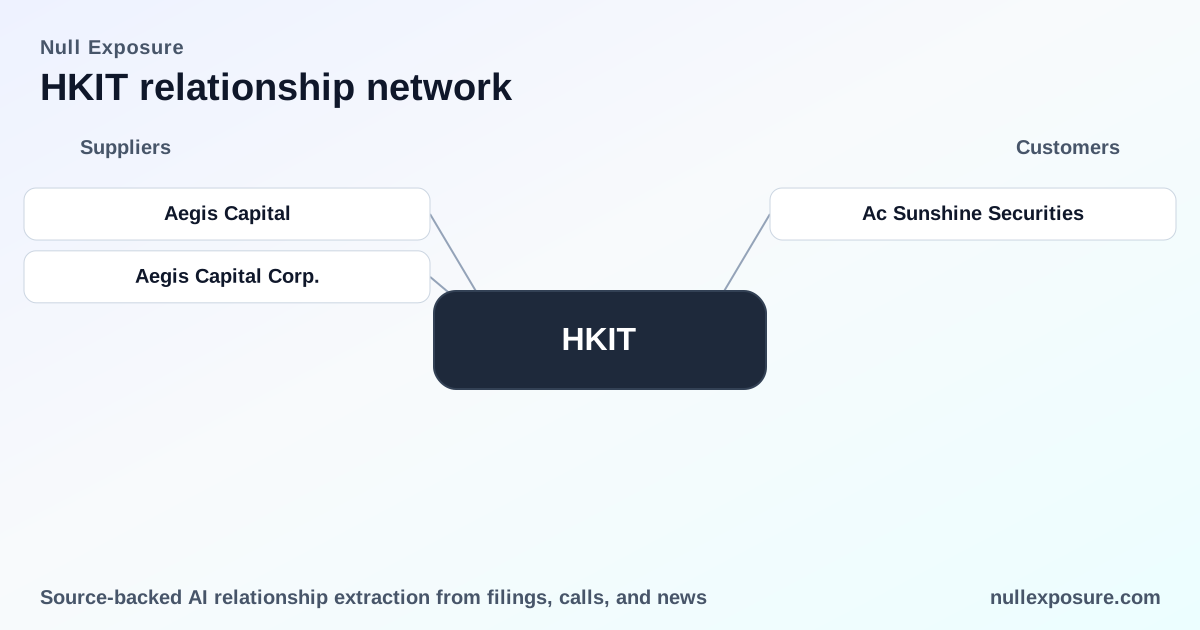
Hitek Global (HKIT): Supplier Relationship Profile and Risk Readout
Hitek Global operates as a small-cap technology vendor focused on blockchain and digital asset solutions for enterprise clients and monetizes primarily through software product sales, project engagements, and strategic partnerships that can include equity financing arrangements; revenue is modest, and cash-raising via capital markets has been part of the company’s operating playbook. Investors evaluating HKIT as a supplier relationship should prioritize financing posture, dilution risk, and execution capacity—those factors drive whether Hitek can sustain vendor commitments and scale product delivery.
Visit the research hub for ongoing supplier risk tracking: https://nullexposure.com/
How Hitek runs the business and why that matters to partners
Hitek Global is a micro-cap listed on NASDAQ with $1.8M in trailing revenues and negative operating margins, which frames every supplier relationship as financially sensitive. The company’s operating model shows classic early-stage commercialization characteristics: small revenue base, negative profitability, concentrated insider and retail ownership, and active use of capital markets tools to raise liquidity. These signals translate into four practical supplier-level constraints:
- Contracting posture: Suppliers should expect short-term, cash-constrained contracts rather than long multi-year fixed-price engagements; Hitek will prioritize arrangements that preserve optionality and minimize early cash outflow.
- Concentration and criticality: With limited revenue and product maturity, Hitek is not yet a critical platform vendor for most large enterprise ecosystems; this reduces counterparty leverage for suppliers negotiating payment terms.
- Maturity and execution risk: Negative EBITDA and declining quarterly revenue growth indicate operating execution risk; suppliers should include performance milestones and staged payments.
- Capital sourcing behavior: Public filings show active engagement with equity markets for liquidity, so counterparties must monitor capital-raising activity as a forward signal for solvency and potential dilution.
These are company-level signals derived from Hitek’s financial profile (Market Cap ~$31.2M, Revenue TTM $1.8129M, EBITDA negative, Shares Outstanding ~21.1M, Institutions ~0.024%). Suppliers should bake these structural features into contract design and credit exposure limits.
Supplier relationship log: what every linked relationship says
Below are the relationships surfaced in public reporting and what they imply for counterparties.
Aegis Capital — TipRanks / CNN report
HiTek Global ended an at-the-market (ATM) equity offering agreement with Aegis Capital; the program was terminated before any shares were sold. According to a TipRanks item syndicated on CNN Markets (first seen March 10, 2026), the ATM arrangement with Aegis concluded without executions, signaling either a deliberate decision to avoid dilution or limits in access to market demand. Source: TipRanks/CNN Markets (Mar 2026).
Aegis Capital Corp. — Company press release covered by The Globe and Mail
On January 15, 2026, HiTek Global and Aegis Capital Corp. mutually agreed to terminate a previously announced ATM equity offering sales agreement effective January 18, 2026; no shares were sold under the program before cancellation. This press release confirms the termination and the absence of share issuances under the program, providing a company-level factual record of the financing posture. Source: HiTek press release reported on The Globe and Mail (Jan 2026).
What the Aegis termination concretely implies for suppliers and counterparties
The two records describe the same counterparty relationship—an aborted ATM financing with Aegis—and that outcome has immediate operational implications for vendor partners:
- Immediate liquidity signal: The termination of the ATM without share sales is a direct signal that planned equity liquidity did not materialize through that channel, raising near-term funding pressure for Hitek.
- Dilution and capital strategy: Since the ATM was cancelled rather than executed, dilution risk from that program is removed, but the company retains the option to pursue alternative financing routes, which could include negotiated private placements or debt.
- Contract exposure: Suppliers with open receivables or deliverable schedules face a higher probability of renegotiation requests, delayed payments, or a pivot to barter/stock-based settlement if Hitek pursues non-cash consideration for services.
These are actionable takeaways for procurement and vendor risk teams: tighten payment terms, demand more frequent performance evidence, and insert protective clauses that limit exposure if capital-raising stalls.
Visit the platform for supplier-specific monitoring and alerts: https://nullexposure.com/
Portfolio-level assessment: risk, concentration, and opportunity
Hitek’s profile combines startup-stage revenue dynamics and public-market financing behavior. For business users and research teams evaluating supplier relationships, the investment-operations intersection highlights three priorities:
- Risk controls first. Negative margins, small revenue, and minimal institutional ownership create a profile where counterparty default is a realistic operational risk. Contracts should require escrowed funds or progressive invoicing tied to milestones.
- Negotiation leverage exists. Hitek’s modest scale and dependence on capital raises give suppliers leverage to secure favorable credit terms and higher unit pricing to offset payment risk.
- Strategic upside is constrained but present. If a supplier seeks commercial upside through co-development or equity, there is room for negotiated equity-for-services structures—but these require careful valuation and governance protections given low liquidity (Shares Float ~5.8M) and insider ownership near 11%.
Key takeaway: treat Hitek as a conditional, high-risk supplier that can deliver niche blockchain capability, but only with contract structures that materially mitigate funding uncertainty.
Final read and action plan
Hitek’s cancelled ATM with Aegis is a clear financing signal that affects supplier risk exposure. For procurement, legal, and business development teams: (1) move near-term engagements to payment-on-delivery or escrowed arrangements; (2) insist on performance milestones and rollback clauses; and (3) maintain active market-watch on Hitek’s capital activities as a primary trigger for contract reviews.
If you need continuous supplier monitoring or want a tailored risk readout for your counterparty list, explore our reporting and alerts at https://nullexposure.com/
This profile consolidates public filings and press reporting into a single read for operators and investors. Treat relationships with Hitek as strategically interesting but financially brittle—structure every deal accordingly.