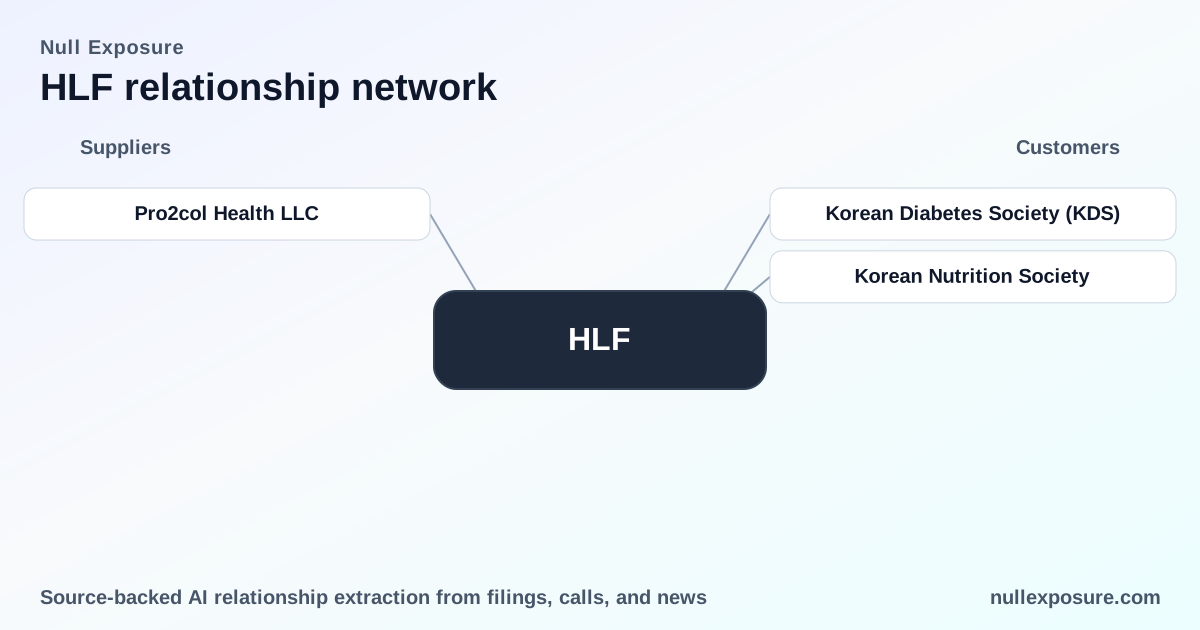
Herbalife Nutrition (HLF) — supplier relationships and what investors should price in
Herbalife operates a global direct‑selling nutrition business that monetizes primarily through product sales to its Members and compensatory overlays (royalty overrides and service fees), with a manufacturing mix of in‑house plants and more than 50 third‑party contract manufacturers. The company’s supplier posture is a hybrid: highly global and strategically concentrated, with long-term real estate and financing commitments underpinning distribution and manufacturing capacity, offset by routine short‑term sourcing and hedging to manage working capital and FX. For investors evaluating counterparty and supplier risk, focus on China structural exposure, top third‑party manufacturers, and the company’s debt and lease maturity profile. Learn more at https://nullexposure.com/.
How Herbalife structures supplier relationships in practice
Herbalife combines long-term operational commitments (leases, debt facilities and multi‑year supply terms) with short-term commercial flexibility (inventory purchase commitments, foreign exchange contracts, professional services and SaaS). The company confirms that product supply contracts “generally have three‑year terms,” while many leases and financing instruments extend into the late 2020s and early 2030s. This mix produces two practical consequences for investors:
- Operational leverage and lock‑in: long lease terms for distribution centers and manufacturing footprint create fixed overhead that benefits scale but reduces agility to re‑site production rapidly.
- Tactical flexibility: short‑dated inventory contracts and monthly FX hedges allow management to react to input‑price and currency volatility without long-term vendor lock‑in.
Key takeaway: Herbalife’s contracting posture is intentional: long‑term capital and property commitments for continuity of supply, paired with short‑term commercial arrangements to manage price and currency risk.
Where Herbalife sources and why geography matters
Herbalife’s supplier footprint is truly global, with manufacturing and sourcing concentrated across APAC (notably China and India), Europe (including Fine Foods in Italy), and North America. The company states it uses contract manufacturers in India, Italy, U.S., Brazil, South Korea, Taiwan, Germany and the Netherlands and maintains leases for major facilities in the U.S., China, Mexico and Europe. China is a structural outlier: the China business uses independent service providers and unique compensation mechanics, receives provincial government grants, and faces stricter regulatory oversight. That combination creates high upside from scale in China and higher regulatory tail‑risk. Evidence in the company filings shows government grant receipts and service fee accounting for China over recent years.
Concentration and supplier criticality
Herbalife uses over 50 contract manufacturers but discloses that approximately 23% of products (by production then sold worldwide in 2024) were sourced from its top three third‑party manufacturers, and Fine Foods (Italy) is cited as a major supplier for meal replacements and protein products. The company explicitly describes its ability to make and move products globally as critical to success, so any disruption at major suppliers or logistics nodes would have immediate revenue impact.
The one reported supplier relationship in the record: Pro2col Health LLC
Herbalife made a $3.0 million contingency payment to Pro2col Health LLC in Q4 following the release of Pro2col Beta 2.0 in the U.S., Canada and Puerto Rico in December 2025, in accordance with an April 2025 asset purchase agreement. This payment is disclosed in Herbalife’s FY2026 press materials. (Source: Herbalife investor relations press release on net sales and FY2026 results, March 2026 — https://ir.herbalife.com/news-events/press-releases/detail/936/herbalife-delivers-fourth-quarter-and-full-year-net-sales)
Contract and counterparty profile you need on your risk checklist
Herbalife’s constraints and disclosures generate clear signals for investors and operators:
- Contract maturity and duration: the company carries multiple long‑term leases (some expiring in 2031–2034) and long‑dated debt instruments (senior secured notes maturing in 2029 and convertible notes spanning 2024–2028). These are company‑level facts that drive refinancing and liquidity considerations.
- Short‑term commercial exposures: inventory purchase commitments, freestanding FX derivatives and short leases are common and concentrated within 12–15 month windows; the majority of freestanding FX derivatives expirations are within one month.
- Counterparty diversity: Herbalife deals with governments (grants and tax assessments), large financial institutions (syndicated lenders and noteholders), individual consultants/employees (SARs, deferred comp), distributors and independent service providers—particularly in China where service fees are a material line item.
- Materiality spectrum: some items are immaterial operationally (product returns ~0.1% of net sales), while others are material or critical—notably China’s business model, supplier concentration (top three manufacturers ≈23% of products), and potential supply interruptions.
- Spend profile: the firm runs multiple high‑value relationships (hundreds of millions) tied to debt and large service payments, alongside mid‑range exposures such as FX hedges (~$70 million notional) and government grants in the single‑ to double‑digit millions.
Bold implication: the combination of concentrated manufacturing suppliers and long lease/debt maturities increases the company’s operational risk premium, while robust short‑term sourcing practices and hedges dampen price and currency volatility.
What investors and operators should monitor next
- Track the China regulatory environment and any changes to the independent service provider model; this is the single largest operational asymmetric risk. The company’s own disclosures list multiple scenarios where Chinese enforcement could force significant business model change.
- Watch supplier concentration metrics (any movement away from the top‑three suppliers) and notifications from major contract manufacturers like Fine Foods (Italy).
- Follow the debt maturity ladder and covenant tests: senior secured notes and term loan maturities through 2029 create refinancing sensitivity if markets reprice risk or restrict liquidity.
- Monitor Pro2col milestones and contingent payments schedule; the initial $3.0 million contingency payment signals earnouts and product‑release tied obligations that could continue to move cash flow.
If you want a concise supplier‑risk briefing tailored to HLF’s contract maturities and top counterparties, visit https://nullexposure.com/ for granular supplier intelligence.
Bottom line: how to think about HLF supplier exposure as an investor
Herbalife’s supplier network is global, partially concentrated, and strategically critical. The company balances long‑term commitments that secure capacity and distribution with short‑term commercial tools to manage volatility. For an investor, the value levers are clear: manage China regulatory exposure, monitor top‑supplier concentration, and scrutinize the near‑term financing and lease maturities. Operators should focus on supplier contingency planning for the top three manufacturers and ensure supply continuity for critical SKUs.
For an in‑depth supplier map and ongoing monitoring of counterparties, use the resources at https://nullexposure.com/ — the signals you should be tracking are already in the filings; the question is how actively you want to monitor them.