Helios Technologies (HLIO): Supplier relationships, operating constraints, and what investors should watch
Helios Technologies designs, manufactures and sells hydraulics and electronics systems to OEMs and aftermarket customers and monetizes through product sales, integrated hardware/software platforms, and recurring aftermarket/service revenue driven by long-standing customer relationships and engineered components. Its operating model combines in-house manufacturing with a network of third‑party manufacturers and service providers; financial leverage and committed credit facilities support M&A and capital spending while concentrated operational links (notably in Mexico, Italy and APAC) create supplier and operational risk vectors that deserve active monitoring.
Visit https://nullexposure.com/ for deeper supplier intelligence and relationship maps.
Why supplier relationships are central to Helios’s investor case
Helios’s value proposition rests on engineered, integrated solutions — precision hydraulic manifolds, electronic controls and embedded displays — that generate stickiness because of upfront engineering, customization and aftermarket replacement cycles. The company runs a hybrid sourcing model: established manufacturing centers in North America, Europe and Asia and third‑party providers for both labor and specialized components. According to the company’s public filings and disclosures, Helios leverages operating leases, committed service agreements and multiple credit facilities to scale operations and smooth working capital through growth cycles.
- Contracting posture is mixed: the company uses both short‑term operational leases and long‑dated credit agreements. Its revolving facility and term loans extend maturities into 2029, giving balance‑sheet runway for strategy execution as disclosed in its 2024 filings.
- Geographic footprint drives complexity: cash and operations span APAC, EMEA and the Americas; a committed third‑party service provider in Mexico supports nearly 525 jobs and is integral to the supply chain.
- Supplier criticality is high: Helios flags dependence on suppliers for parts and raw materials as a material and critical risk that can affect production and revenue.
Learn more about supplier exposures at https://nullexposure.com/.
Identified supplier and partner relationships (direct summaries)
Below are the relationships surfaced in recent public materials; each entry links to the source used for the observation.
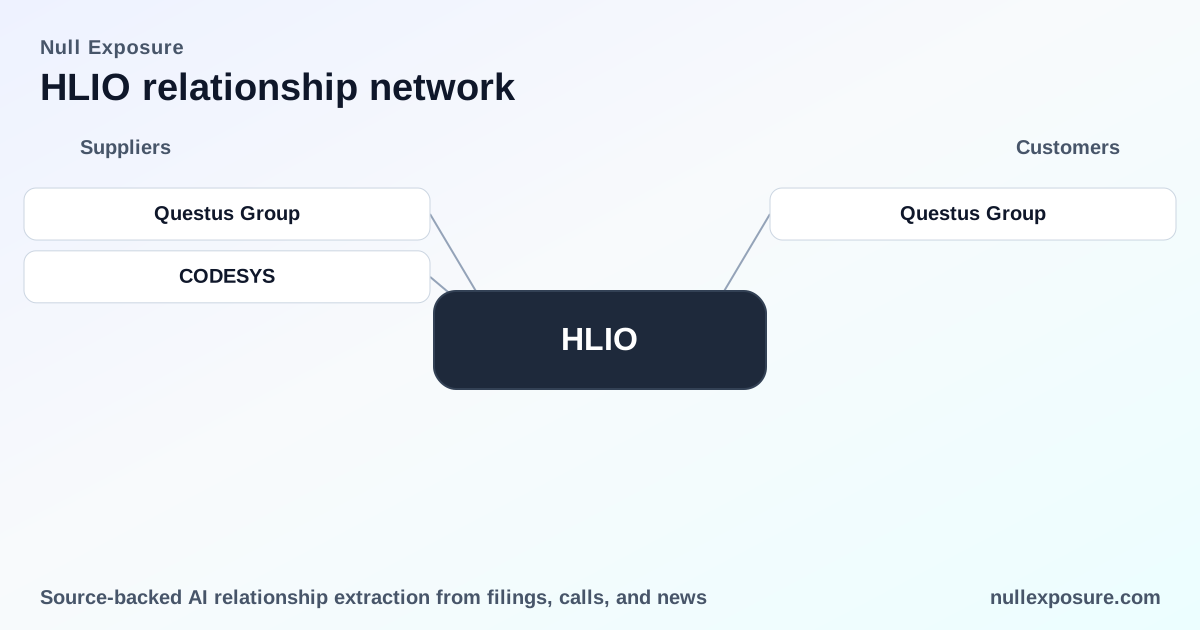
Questus Group — exclusive distributor/fulfillment partner in Australia
Helios aligned its Australian go‑to‑market for Sun Hydraulics products through an exclusive distribution and fulfillment agreement with Questus Group, consolidating regional distribution and bringing local logistics under a single partner in APAC. This was disclosed in the company’s Q4 2025 earnings call transcript summarized by InsiderMonkey in March 2026 (Q4 2025 / FY2026 commentary).
Source: InsiderMonkey Q4 2025 earnings call transcript (published March 2026) — https://www.insidermonkey.com/blog/helios-technologies-inc-nysehlio-q4-2025-earnings-call-transcript-1708821/
CODESYS — software integration for OpenView display platform
Helios expanded its OpenView™ display platform by integrating CODESYS® functionality, increasing the software flexibility and programmability of its displays and strengthening product differentiation for OEM customers that require embedded control environments. This product development was reported in a market note from SAHM Capital in February 2026.
Source: SAHM Capital update on Helios (Feb 2026) — https://www.sahmcapital.com/news/content/helios-codesys-openview-update-meets-fair-value-and-momentum-story-2026-02-05
What the constraints tell investors about operational posture and risk
The constraint evidence from Helios’s filings and disclosures outlines a clear set of company‑level signals that affect supplier strategies and financial resilience:
- Contract duration mix: The company runs short‑term operational leases (remaining lease terms range up to nine years) alongside long‑term credit facilities (revolving credit and term loans with maturities stretching to June 2029). This combination shows a preference for operational flexibility for fixed assets and longer debt tenor for financing scale and acquisitions (company 2024 filing disclosures).
- Leverage and liquidity posture: As of the latest disclosures Helios carries hundreds of millions in borrowings (term loans ~ $300m; revolving borrowings ~ $150m outstanding at year‑end 2024), and capital expenditures are moderate (total CAPEX ~$27m in 2024), indicating financing for growth and working capital is materially bank‑driven rather than equity funded.
- Geographic concentration and supply criticality: Operations and cash balances are materially distributed across APAC, EMEA and North America, and critical services are outsourced in Mexico where a third‑party provider supports ~525 jobs — the company explicitly marks that provider as integral, a material/critical counterparty.
- Supplier roles are diverse and strategic: Helios’s supplier base covers manufacturing partners (precision components and manifolds), service providers (audit, valuation, cybersecurity testing), and software integrators — reflecting a business that purchases both commodity inputs and high‑value, engineered capabilities.
- Hedging and derivatives posture: The company terminated interest‑rate swaps in mid‑2024 in connection with refinancing and reported no forward FX contracts at year end 2024, showing a deliberate reduction of hedge positions concurrent with balance‑sheet restructuring.
- Maturity and stability of relationships: Some supplier relationships are mature (long‑standing auditors, manufacturing partners), others are active (credit facilities, open purchase orders), and a few hedging relationships were terminated as part of financing activity — this pattern signals active balance‑sheet management alongside stable operational partnerships.
Key implications for investors and operators
- Operational risk is concentrated and material. The committed service agreement in Mexico and manufacturing footprints in Italy and APAC create single‑point exposures that can generate outsized operational disruption; investors should monitor recovery and contingency plans tied to those sites.
- Financial flexibility is real but leveraged. Longer credit maturities through 2029 reduce near‑term refinancing risk, but outstanding term loan and revolving balances position Helios as dependent on bank facilities for liquidity and M&A funding. Track covenant compliance and leverage trends.
- Product stickiness is increasing via software integrations. Integration of CODESYS into OpenView and distribution exclusivity in Australia for Sun Hydraulics products strengthen competitive moat — these are positive read‑throughs for aftermarket revenue and switching costs.
- Hedge reductions increase exposure to rate and FX moves. The termination of swaps and lack of FX forwards at the end of 2024 reduce the company’s downside protection; operators should stress‑test margin sensitivity to commodity and FX swings.
Bold action items for investors/operators:
- Monitor supplier concentration metrics and vendor contingency plans for Mexico and Italian manufacturing hubs.
- Watch covenant compliance and net leverage metrics given material borrowings.
- Evaluate product roadmap and customer adoption for OpenView+CODESYS integrations as a driver of higher margin aftermarket sales.
For detailed relationship mapping and continuous monitoring, visit https://nullexposure.com/.
Final verdict and next steps
Helios combines engineered product strength and growing software integration with a mixed contracting posture that balances operational flexibility and long‑term financing. Supplier relationships are strategically important and operationally material; the company’s reliance on certain third‑party service providers and regional manufacturing creates concentrated operational risk against a backdrop of bank‑sourced liquidity. Investors should pair financial due diligence with supplier and geographic risk analysis; procurement and operations teams must prioritize resilience planning for critical service providers and manufacturing sites.
Take the next step: learn how Helios’s supplier architecture maps to risk and revenue scenarios at https://nullexposure.com/.