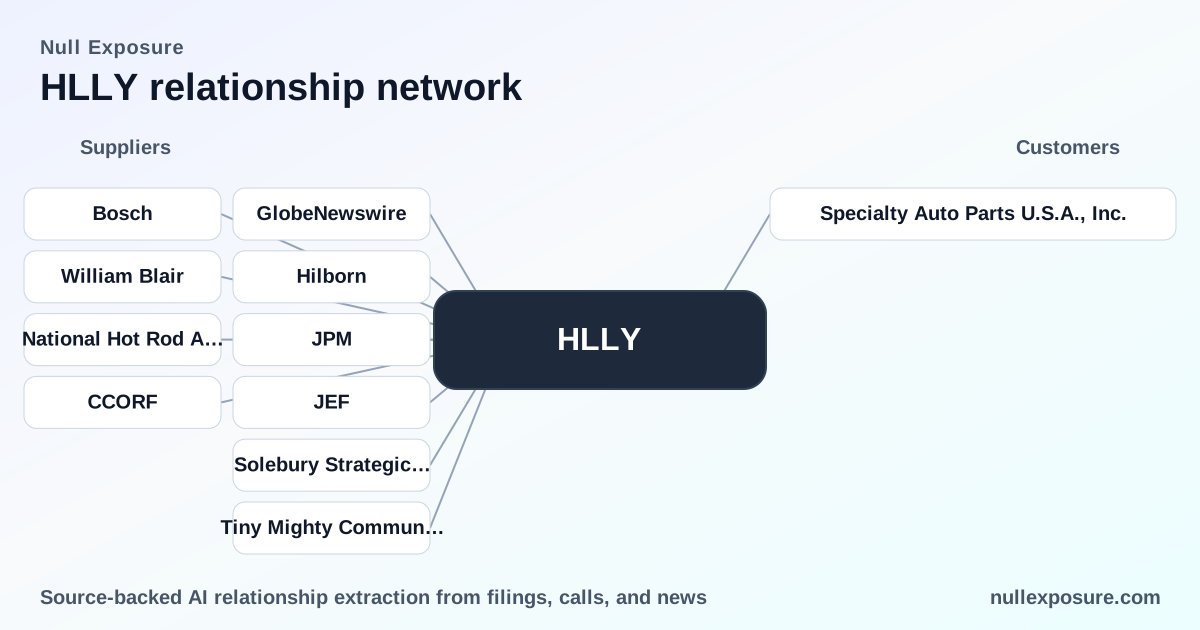
Holley Inc (HLLY) — supplier relationships that shape margin and inventory risk
Holley Inc. designs, manufactures and markets enthusiast-focused automotive aftermarket hardware and software, monetizing through direct product sales, licensing deals and distribution agreements across the U.S., Canada, Europe and China. Revenue is generated mainly from aftermarket parts and related services, supported by recent licensing activity and occasional capital markets transactions (Revenue TTM $613.5M; EBITDA $108.9M). For investors and operators, the key question is how Holley’s mix of short-term supplier contracts, longer-term financing and selective licensing deals affects inventory, working capital and margin volatility.
Explore Holley relationship signals and supplier intelligence at https://nullexposure.com/.
How Holley’s contracting posture and supplier footprint read for investors
Holley runs a hybrid operating model with clear implications for procurement and financial risk. The company combines short-term operational contracts and leases with longer-term financing and targeted perpetual licensing purchases, producing a supplier posture that is flexible but exposed to input-price and component shortages.
- Contracting posture: Holley reports material short-term lease activity and variable, usage-linked lease costs alongside long-dated credit facilities and collars—this creates operational flexibility but requires disciplined cash management.
- Concentration and geography: Management states a diverse global supplier base with imports from non-U.S. suppliers; geopolitical exposure to APAC and broader global risks is explicitly acknowledged.
- Criticality and materiality: Supply disruptions and raw-material inflation are treated as material risks that can materially impact operations and distributor health.
- Maturity and stage: Relationships span active service providers and manufacturers, with some mature, ongoing financial arrangements (credit agreements) and occasional terminations tied to strategic rationalization.
For a platform-level view of Holley’s commercial network and risk scoring, visit https://nullexposure.com/.
Who Holley is talking to — a relationship-by-relationship readout
Below I cover every public relationship referenced in the recent coverage. Each entry is a concise, plain-English read and a source note.
GlobeNewswire
A company press release distributed via GlobeNewswire announced Holley’s third-quarter 2025 financial results release date and conference call logistics, a routine investor-communications event used to coordinate analyst and investor access. Source: GlobeNewswire press release reproduced on QuiverQuant (FY2025).
Hilborn (Hagerty)
Holley has discontinued production of the Hilborn fuel-injection brand it acquired in 2019, ending manufacture of a legacy mechanical fuel-injection product line — a strategic brand consolidation that reduces SKU complexity. Source: Hagerty reporting on Holley’s decision (FY2024).
J.P. Morgan
J.P. Morgan acted as a lead book-running manager and representative of the underwriters on Holley’s 14 million share secondary offering priced at $2.75 per share, signaling direct capital markets engagement to expand free float or fund liquidity needs. Source: QuiverQuant coverage of the secondary offering (FY2025).
Jefferies
Jefferies joined as the co-lead book-running manager for the same secondary offering, partnering with J.P. Morgan on distribution and underwriting responsibilities for the share sale. Source: QuiverQuant coverage of the secondary offering (FY2025).
Solebury Strategic Communications
Solebury Strategic Communications is listed as an investor-relations contact on Holley’s March 2026 investor communications, indicating Holley’s use of external IR advisors to manage investor outreach and message discipline. Source: Holley press materials distributed via QuiverQuant / GlobeNewswire (FY2025).
Tiny Mighty Communications
Tiny Mighty Communications is identified as a media-relations contact for Holley, reflecting Holley’s layered PR strategy with multiple external agencies supporting media and stakeholder communications. Source: Holley press materials distributed via QuiverQuant / GlobeNewswire (FY2025).
Bosch
Product coverage of Holley-era electronics references Genuine Bosch LSU 4.9 wideband control hardware compatibility, showing Holley’s sourcing and component interoperability with established tier‑one automotive suppliers. Source: LSXmag product article referencing Bosch components (FY2022).
William Blair
William Blair served as a joint book-running manager on Holley’s secondary offering alongside Canaccord, participating in the underwriting syndicate to distribute newly offered shares. Source: QuiverQuant coverage of the secondary offering (FY2025).
National Hot Rod Association (NHRA)
Holley sponsors and co-brands motorsports events, exemplified by NHRA’s Factory X exhibition category “presented by Holley,” a marketing partnership that supports brand recognition in core enthusiast segments. Source: Motorsports Newswire reporting on NHRA / Holley partnership (FY2021).
Canaccord Genuity
Canaccord Genuity acted as a joint book-running manager on the secondary offering, part of the underwriting group alongside William Blair and larger lead managers. Source: QuiverQuant coverage of the secondary offering (FY2025).
What these relationships imply for credit, operations and margin
Holley’s public relationships reveal a company managing three simultaneous priorities: (1) liquidity and capital markets access (secondary offering and multiple underwriters), (2) brand and product consolidation (Hilborn termination), and (3) sourcing integration with tier‑one suppliers (component-level compatibility with Bosch). The combination of short-term operational contracts and long-term credit commitments means Holley is operationally nimble but financially levered to effective working-capital execution.
- Capital markets footprint: The underwriter syndicate (J.P. Morgan, Jefferies, William Blair, Canaccord) shows institutional distribution capability; the secondary offering is an explicit liquidity lever.
- Operational risk: Supply chain shortages and raw-material inflation are material to margins; global sourcing and APAC exposure increase volatility.
- Commercial model: A recent perpetual exclusive license purchase (company filings) and ongoing marketing partnerships indicate Holley is investing in product differentiation and North American distribution control.
Investors and operators should monitor Holley’s cash flow against lease maturities and covenant terms in its credit agreement; these are central to execution risk given the company’s mix of short-term leases, usage-linked payments, and long-term indebtedness.
See a consolidated view of Holley counterparty exposure and contract signals at https://nullexposure.com/.
Practical next steps for investors and sourcing teams
- For investors: validate covenant headroom and post-offering free float impact; track inventory turns and margin sensitivity to freight and commodity cost swings.
- For procurement and operations: prioritize dual-sourcing for APAC-imported components and quantify the impact of discontinued SKUs (e.g., Hilborn) on supplier capacity and inventory obsolescence.
- For business development: leverage Holley’s PR and motorsports partnerships to measure brand ROI against aftermarket sales uplift.
Access Holley supplier analytics and scenario modeling tools at https://nullexposure.com/.
Conclusion — Holley’s public relationships map to a company balancing aftermarket product sales with financing and selective licensing; the primary investor risk is operational — supply-chain and input-cost volatility — while the financing activity demonstrates both market access and short-term liquidity management. For buy-side diligence or operator-level remediation, prioritize covenant reviews, supplier resilience testing, and SKU rationalization impact analysis.