Hongli Group (HLP) — supplier relationships and what they tell investors
Hongli Group monetizes its technology by manufacturing and selling high-performance conductive agents and battery components to lithium-ion battery makers and related industrial customers. The company converts materials know-how into recurring revenue through product sales and customer contracts, generating gross margins that support modest profitability at a small-cap scale. Investors should evaluate Hongli not only on margins and revenue growth but on supplier and service relationships that underpin operations — particularly auditor, logistics, and quality-control partners that affect reliability and governance. For a closer look at supplier dynamics and governance signals, visit https://nullexposure.com/.
The macro snapshot that frames supplier importance
Hongli is a micro-cap in basic materials with roughly $76.4 million market capitalization and $16.7 million in trailing twelve‑month revenue. The business reports gross profit of $5.5 million and EBITDA of $2.28 million, producing a profit margin of about 6% and a trailing P/E of 20.8. These figures indicate a commercially viable operation but one where supplier continuity, audit quality, and counterparty concentration materially affect near-term earnings volatility and investor trust.
- Scale and concentration: Shares outstanding near 73.4 million with insiders owning ~35% and institutions at 0.27% signal a company controlled by insiders and with limited institutional coverage or analyst engagement.
- Growth profile: Quarterly revenue growth is strong year-over-year (+37.7%), while quarterly earnings have contracted year-over-year (-83.2%), underscoring operating leverage and sensitivity to cost or one-off items.
- Market signals: Low analyst coverage and a 52‑week trading range between $0.613 and $1.82 emphasize liquidity and market-risk considerations for institutional buyers.
These company-level characteristics make supplier relationships and governance partners especially consequential for valuation and operational continuity. Learn more about supplier analytics at https://nullexposure.com/.
What the records show about supplier and service relationships
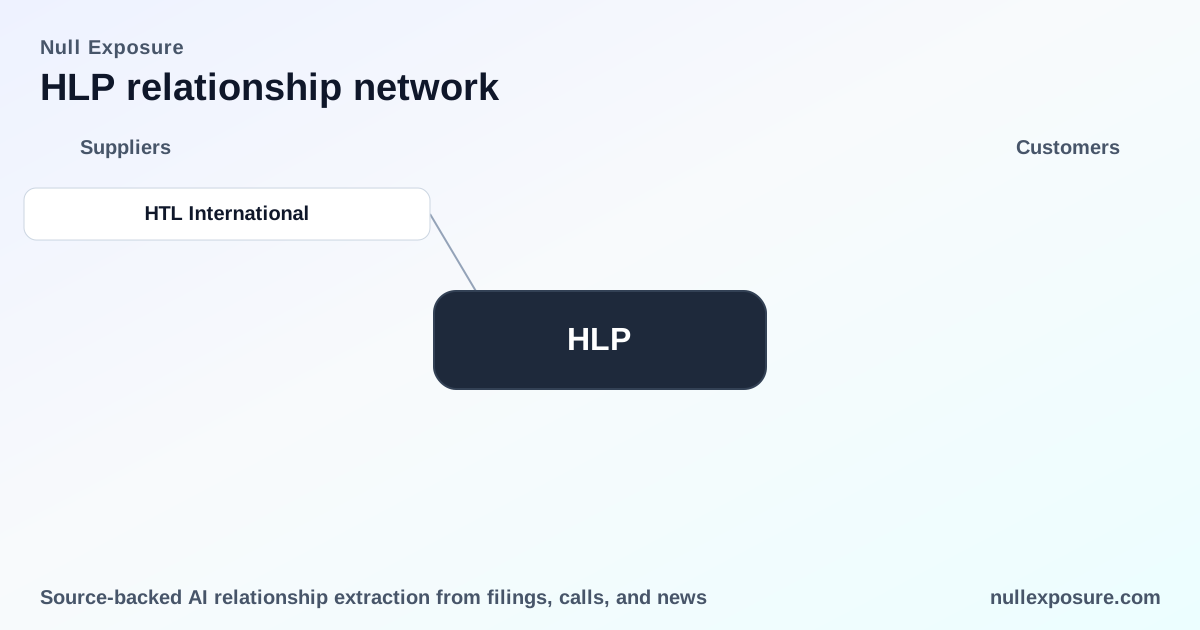
Hongli’s publicly surfaced supplier/service relationship in the collected results is with HTL International, disclosed as an appointment in early 2026. Below I summarize the relationship and its immediate implications.
HTL International — new independent auditor
Hongli appointed HTL International as its new independent auditor, according to a TipRanks note dated January 12, 2026, referenced on Hongli’s quote page on CNBC. This appointment reflects a change in the company’s external assurance provider and is a governance signal investors must assess alongside audit firm reputation and historical audit opinions.
Source: A TipRanks report published January 12, 2026, cited on Hongli’s CNBC quote page documenting the auditor appointment.
Why an auditor change matters for a supplier-stage company
An auditor appointment is not a routine back‑office footnote for a small-cap supplier of battery materials; it is a governance lever that affects investor confidence, reporting quality, and the firm’s ability to raise capital.
- Contracting posture: Auditor changes can reflect evolving contractual needs for capital markets or preparation for cross-border listings, or they can be tactical responses to prior audit findings.
- Criticality: For a company where insider ownership is high and institutional ownership is very low, the external auditor is one of the few independent checks on financial statements and internal controls.
- Maturity: Hongli’s financial profile — modest revenue base and limited analyst coverage — suggests the company is still in a scaling phase; an auditor change at this stage signals a potential shift in governance sophistication or external reporting requirements.
These are company-level signals; the available data does not specify reasons for the audit change or link the appointment to other service contracts.
Operational constraints and business-model implications
Even though no supplier-specific contractual constraints were captured in the available records, company-level indicators speak to how Hongli operates and the risks investors should weigh.
- Supplier-criticality: Hongli supplies inputs critical to lithium-ion battery manufacturing, creating natural demand from EV and energy storage OEMs that supports revenue growth potential.
- Concentration risk: The company’s small revenue base increases the operational impact of losing a single large buyer or a critical logistics partner; continuity of supply and quality assurance are disproportionately important.
- Contracting posture: Operating at small scale but serving a capital-intensive end market implies suppliers and logistics partners likely work on short- and medium-term contracts; flexibility is valuable but creates exposure to raw-material price swings.
- Governance maturity: High insider ownership and minimal institutional investors mean external governance mechanisms such as independent audits carry outsized weight for market confidence and future capital-raising.
These firm-level constraints make governance partners and reliable service suppliers essential to both operations and valuation.
Risk and opportunity for investors and operators
Hongli’s positioning creates a concentrated set of risks and opportunities:
- Upside drivers: Ongoing revenue growth (+37.7% quarterly) and gross-margin retention show operating leverage if the company scales with battery-market demand; high insider ownership aligns management incentives with shareholders.
- Key risks: Limited institutional coverage, potential liquidity constraints, and the operational impact of supplier disruption are core concerns. An audit firm change amplifies the need to evaluate disclosure quality and any historical restatements or qualifications.
- Operational focus for operators: Emphasize supplier diversification, contract standardization, and third‑party quality audits to reduce single-point failures and to support scalable margins.
How to act on this information
- Institutional investors should request the new auditor’s engagement letter and any communications with former auditors to assess the impetus behind the change and whether it affects prior periods’ disclosures.
- Operators and procurement teams should prioritize continuity plans for logistics and raw-material sourcing, given Hongli’s size and the critical nature of conductive agents to battery OEMs.
- For immediate monitoring and periodic updates, follow company filings and market commentary at NullExposure: https://nullexposure.com/.
Bottom line: governance and supplier reliability are value drivers
Hongli Group operates as a small-cap supplier of battery materials with solid gross margins but limited institutional oversight. The appointment of HTL International as independent auditor in January 2026 is a notable governance event that investors should scrutinize for implications on reporting quality and access to capital. For investors and operators, the primary focus should be on audit transparency, supplier continuity, and contract concentration — these factors will determine whether Hongli’s growth converts into sustainable value.
Explore ongoing supplier intelligence and governance signals at https://nullexposure.com/ to stay ahead of material relationship changes.