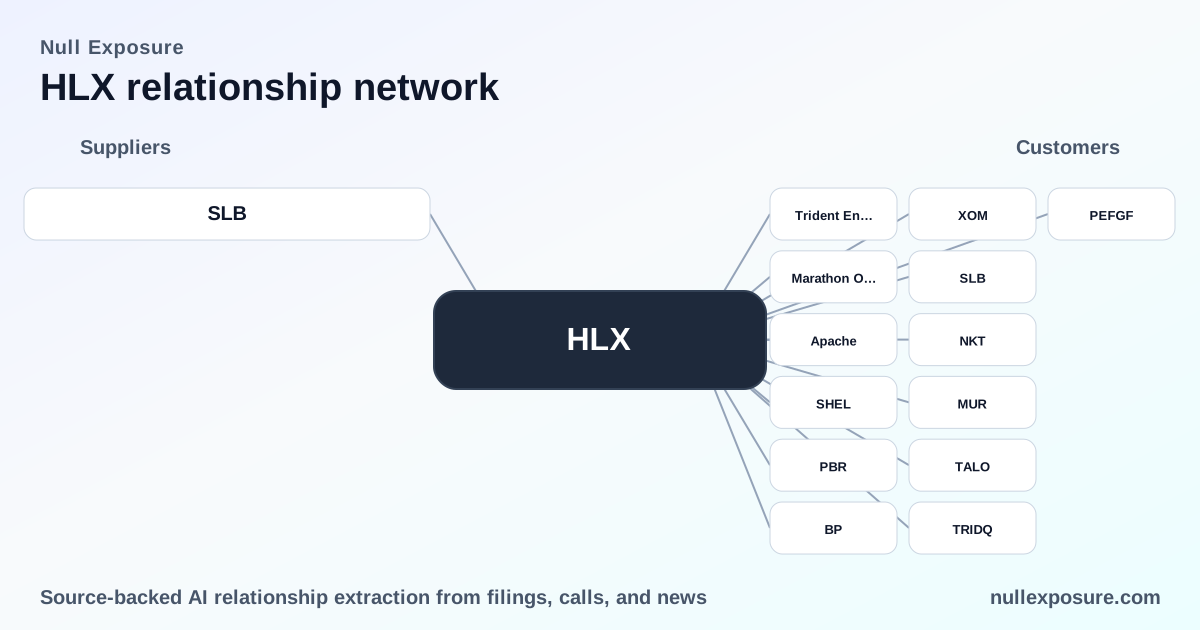
Helix Energy Solutions Group (HLX): Supplier Relationships and Strategic Exposures
Helix monetizes specialized offshore services — well intervention, robotics/ROV, trenching and project execution — by contracting vessel charters, long-term service agreements and spot work across Brazil, the Gulf of Mexico, the North Sea, Asia Pacific and West Africa. Revenue is driven by a mix of long-term charters and higher-margin intervention work supplemented by robotics and spot vessel activity; monetization comes from day-rates, service scopes and project fees tied to multi-year contracts and charters. For a consolidated view of counterparties and contract risk, visit https://nullexposure.com/.
Why supplier and charter relationships drive Helix’s economics
Helix’s operating model is inherently capital- and contract-intensive. The company books long-term vessel charters as a large fixed-cost base while also maintaining a capacity to pursue spot work and short-term engagements that increase utilization and margin. Key financial signals: revenue of roughly $1.29bn and EBITDA near $218m on a market cap of about $1.33bn (latest TTM figures). According to Helix’s Annual Report on Form 10‑K for the year ended December 31, 2024, long-term vessel charter commitments total approximately $835.5 million, with roughly $434.3 million categorized as non-lease service components — a structural cost element that underpins operational capability and cash-flow profile.
How Helix contracts and where concentration shows up
Helix’s public disclosures establish a clear contracting posture and counterparty mix:
- Contracting posture: blended long-term and short-term — the company separates long-term charters (multi-year, non-cancellable) from short-term and spot hires for robotics and trenching operations, and recognizes variable lease costs when incurred (Form 10‑K, 2024).
- Concentration and scale: meaningful fixed commitments — the $835.5 million in long-term vessel charters places supplier spend squarely in the >$100m band for core fleet commitments, while acquisitions and earnouts have produced sub‑$100m to low‑hundreds million cash flows (Form 10‑K disclosures).
- Criticality: suppliers are operationally material — failure of vessel or third-party systems (including classification societies, auditors, and SOCs) is treated as a critical operational risk (Form 10‑K).
- Maturity and stage: a mix of active and terminated obligations — Helix reports outstanding, active facilities (an Amended ABL facility) and several terminated notes and capped calls that were settled through 2023–2024 (Form 10‑K).
- Geographic footprint: multi‑regional exposure — the company operates across NA, EMEA and global markets with currency, regulatory and Jones Act implications noted in filings (Form 10‑K).
These traits make counterparties to charters and service alliances both high-dollar and high-impact for operational continuity.
All disclosed supplier relationships in our results
SLB — Subsea Services Alliance partner
Helix secured a well‑intervention contract in the U.S. Gulf that includes equipment and services delivered as part of the Subsea Services Alliance with SLB, indicating a strategic, collaborative delivery model rather than a pure subcontracting arrangement. (WorkBoat, March 10, 2026).
What the filings say about named counterparties and supplier roles
Helix’s filings name several counterparties in operational and financial contexts. When an excerpt explicitly names an entity, it signals a direct contractual tie:
- Sea1 Offshore (formerly Siem Offshore) is the counterparty for long‑term charters of the Siem Helix 1 and Siem Helix 2 vessels used in Brazil well intervention work, with charter terms running through 2030–2031, underscoring multi‑year dependence on vessel availability (Form 10‑K, 2024).
- MARAD / U.S. government involvement through Title XI guarantees illustrates government‑backed debt for certain vessels and creates both favourable finance terms and regulatory covenants (Form 10‑K, 2024).
- Bank of America functions as agent for the Loan, Guaranty and Security Agreement tied to revolving credit arrangements that support liquidity (Form 10‑K, 2024).
- KPMG LLP is the independent auditor with a long tenure, which is a signal of mature financial oversight (Form 10‑K, 2024).
These named ties reveal the split between operational counterparties (vessel owners, classification societies, alliance partners) and financial counterparties (lenders, guarantors, auditors), each with different risk and leverage implications.
Operational and financial implications for investors and operators
- Fixed-cost intensity drives leverage to utilization. Long-term charters represent committed cash flows; with operating lease liabilities and non‑lease service components exceeding several hundred million dollars, utilization shortfalls directly depress margins (Form 10‑K).
- Counterparty criticality is elevated. Strategic alliances like the Subsea Services Alliance with SLB and long-term time charters with Sea1 Offshore are essential to service delivery and therefore materially affect revenue delivery and execution risk (WorkBoat; Form 10‑K).
- Liquidity and covenant governance are active monitoring points. The Amended ABL facility ($120m capacity split U.S./U.K.) and outstanding notes create covenant structures and pricing mechanics (SOFR/SONIA margins) that investors must track for refinancing risk and potential springing covenants (Form 10‑K).
- Geopolitical and FX exposure is non-trivial. Operations across Brazil, the North Sea and other jurisdictions create currency and regulatory risk that feeds directly into cash conversion and local cost bases (Form 10‑K).
- Cybersecurity and third-party service dependencies are material. Helix identifies breaches of critical third‑party systems as a potential source of operational interruption, and it engages external SOCs and managed service providers for incident response — this elevates vendor oversight as a risk control priority (Form 10‑K).
For pragmatic monitoring of counterparties, operators should prioritize charter roll dates, alliance contract scopes, and lender covenant test dates.
Explore consolidated counterparty profiles at https://nullexposure.com/ for tailored exposure mapping.
Practical next steps for investors and commercial operators
- Monitor upcoming charter expirations (notably Siem Helix 1 & 2 through 2030–2031) and the Glomar Wave time charter expiries that influence replacement cost and renewal negotiations (Form 10‑K).
- Track covenant windows on the Amended ABL facility and MARAD‑backed debt and evaluate refinancing options relative to SOFR/SONIA movements (Form 10‑K).
- Watch alliance counterparties (SLB and other strategic partners) for contract extensions or escalations that change Helix’s share of high‑margin intervention work; these alliances are value‑accretive on utilization and capability (WorkBoat).
- Maintain supplier resilience checks on classification recertification cycles and cybersecurity third‑party arrangements; both are identified as material and critical in Helix’s disclosures (Form 10‑K).
For detailed counterparty scoring and ongoing monitoring, see how NullExposure synthesizes filings and news at https://nullexposure.com/.
Final read: the investor takeaway
Helix’s supplier landscape is defined by high-dollar, long-term vessel charters and strategically significant alliances that together determine utilization and margin capture. Investors should treat charter counterparties and alliance partners as primary drivers of execution risk and upside, and operators should prioritize contract renewal strategy and third‑party risk controls. For a consolidated view of supplier exposures and time‑series tracking, visit https://nullexposure.com/ and evaluate how counterparties like SLB and Sea1 Offshore influence HLX’s near‑term cash flow and long‑term operating leverage.