Helix Acquisition Corp. III (HLXC): Underwriters, Lock‑ups and the SPAC Playbook Investors Need to Read
Helix Acquisition Corp. III is a special purpose acquisition company that monetizes by raising capital from public markets, holding proceeds in trust and creating value through a negotiated business combination and sponsor economics. HLXC generates investor returns through deal sourcing and execution rather than operating revenues; its value depends on successful mergers, sponsor promote, and access to capital markets to underwrite transactions and provide distribution. For investors and counterparties evaluating supplier relationships, the focus is on the quality and contractual posture of capital‑markets partners and the operational reality of a blank‑check vehicle trading near IPO par.
Explore HLXC coverage on NullExposure
Where HLXC stands: a brief operating snapshot
HLXC trades on NASDAQ as a SPAC with a reported market capitalization of roughly $218.6 million and a quoted trading range concentrated tightly around the IPO price (52‑week high $10.36; low $10.00; moving averages near $10.23). The company reports zero operating revenue, no EBITDA and no conventional valuation multiples — a profile consistent with a pre‑combination SPAC that earns returns from transaction fees, sponsor economics and the outcome of its merger effort. This is a financing and execution business, not a product or services business, so the counterparty ecosystem (bankers, legal advisors, placement agents) functions as the core operating infrastructure.
What the banker relationships reveal about capital strategy
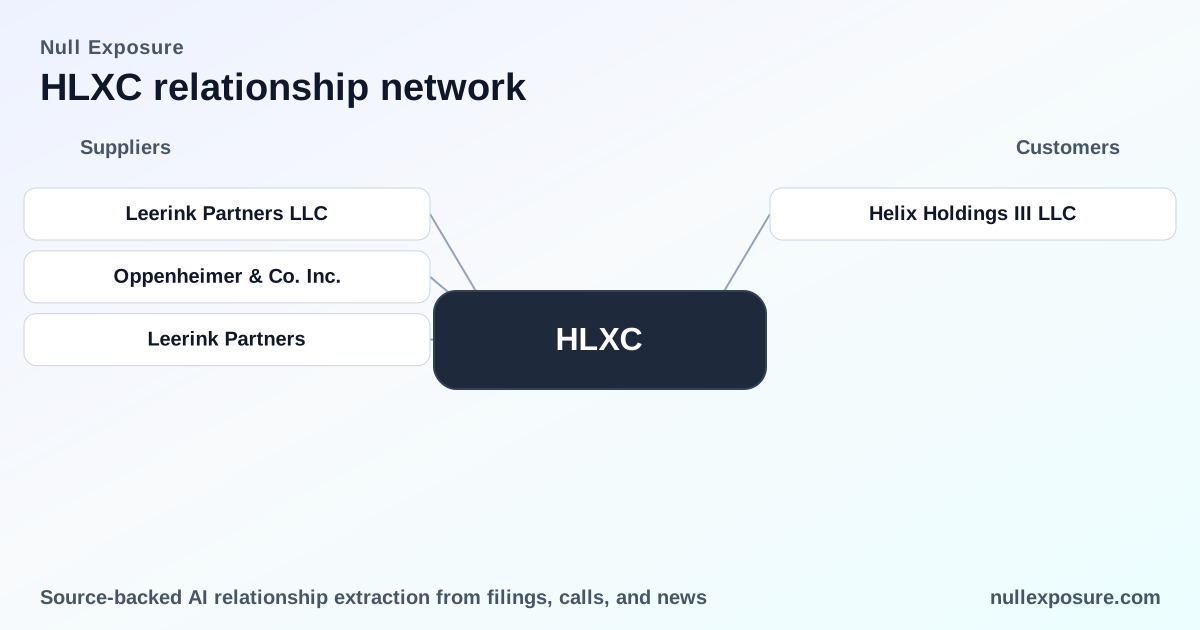
HLXC’s public disclosures identify bank partners executing capital markets functions for the vehicle. Each relationship below is included in the record and summarized for investor diligence.
Leerink Partners LLC — bookrunning and lock‑up language
Leerink is named among the joint bookrunning managers for HLXC’s offering; that role places Leerink at the center of underwriting and distribution mechanics for the SPAC raise (press release, March 10, 2026 — https://finance.yahoo.com/news/helix-acquisition-corp-iii-announces-123000675.html). Separately, a prospectus excerpt reported by MarketScreener notes that initial shareholders and officers agreed not to dispose of shares without prior written consent of Leerink Partners for 180 days after the prospectus date, indicating a lock‑up enforcement role (MarketScreener, March 10, 2026 — https://www.marketscreener.com/news/3-125-000-class-b-ordinary-shares-of-helix-acquisition-corp-iii-are-subject-to-a-lock-up-agreement-ce7e5dd2db81fe23).
Oppenheimer & Co. Inc. — joint bookrunner
Oppenheimer is disclosed alongside Leerink as a joint bookrunning manager, sharing primary responsibility for syndication and price discovery in the offering (press release, March 10, 2026 — https://finance.yahoo.com/news/helix-acquisition-corp-iii-announces-123000675.html). For investors, Oppenheimer’s inclusion signals a standard underwriting structure and distribution reach necessary to place institutional and retail shares of a SPAC.
How these supplier relationships shape HLXC’s operating profile
HLXC’s supplier set — dominated in the public record by underwriters — defines its contracting posture and business maturity in clear terms:
-
Contracting posture: HLXC operates under customary capital markets contracts (underwriter agreements, prospectus lock‑ups) that transfer execution and distribution risk to bookrunners while preserving sponsor control over deal selection and timing. This structure concentrates transactional risk in execution windows rather than ongoing vendor obligations.
-
Concentration: The disclosed supplier footprint is small and highly concentrated: a handful of capital markets partners perform essential functions. Concentration increases operational leverage — a single failed syndication or a breakdown in bookrunner coordination can materially delay or derail a SPAC combination.
-
Criticality: Underwriters and lock‑up mechanisms are critically important to HLXC’s near‑term value realization because capital access and shareholder discipline determine redemption rates and post‑combination capital structure.
-
Maturity: HLXC is in a pre‑combination, financing‑centric phase with no operating revenue or operating assets, reflecting low business maturity beyond capital markets capabilities. Execution and sponsor track record therefore substitute for product traction in valuation judgments.
Risk and opportunity framework for investors and operators
HLXC’s profile presents a succinct list of credit and commercial considerations:
-
Execution risk is the primary near‑term driver. The quality and alignment of bookrunning managers directly influence underwriting success, aftermarket stability and the effectiveness of lock‑ups.
-
Redemption pressure is latent but central. With no operating cash flows, the SPAC’s ability to consummate a deal and limit redemptions governs whether sponsor economics and investor returns are achievable.
-
Supplier concentration creates single‑point dependencies. Failure of underwriting syndication or a dispute over lock‑up enforcement would be highly consequential.
-
Market timing governs optionality. The vehicle’s finite life and public trading at near‑par mean windows for favorable deal economics are narrow; bank relationships are the mechanism that opens those windows.
Explore HLXC coverage on NullExposure
Practical next steps for counterparties and investors
For investors and operators evaluating HLXC supplier relationships, adopt the following playbook:
-
Request the full underwriting agreement and lock‑up language to quantify transfer of execution risk and any consent thresholds tied to underwriters. Public press releases show role allocation but not contractual triggers.
-
Evaluate underwriter track records on SPAC placements and post‑combination aftermarket performance; the names disclosed — Leerink and Oppenheimer — imply distribution capability that should be validated against recent SPAC deals.
-
Model redemption sensitivity around various deal structures and sponsor incentives; capital markets execution quality will determine realized equity value more than headline market cap today.
Closing synthesis and recommended actions
HLXC is a classic SPAC: capital‑markets infrastructure and sponsor execution are the product. The disclosed supplier relationships — joint bookrunners Leerink Partners and Oppenheimer, plus a lock‑up provision enforced through Leerink — confirm a standard underwriting and shareholder‑discipline approach that investors should treat as mission‑critical. With no operating revenues and a market capitalization tied to trust assets and market confidence, due diligence on underwriting agreements and lock‑up enforcement is the decisive diligence item.
For a deeper dossier on HLXC counterparties and how to underwrite SPAC counterparty risk, visit NullExposure for structured coverage and transaction‑level intelligence.