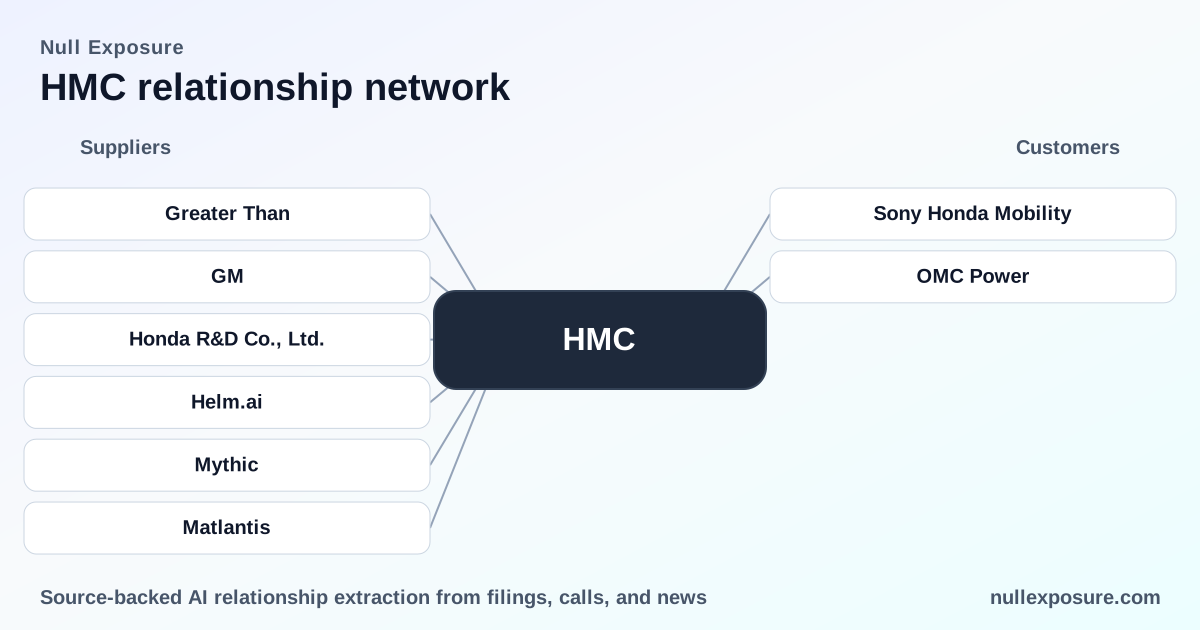
Honda (HMC) — Supplier relationships and strategic signals investors need now
Honda Motor Co., Ltd. operates as a global automotive and powersports manufacturer that monetizes through vehicle and parts sales, licensing of mobility technologies, and strategic investments in software and AI. For investors evaluating supplier exposures, the company combines in-house R&D consolidation with selective external partnerships and joint developments to accelerate electric vehicle (EV) and software-defined vehicle (SDV) programs while preserving its distribution and marketing responsibilities in key markets.
For a concise view of how we collect and present these supplier signals, visit https://nullexposure.com/.
What the recent supplier mentions reveal — a compact walk-through
This section covers every relationship flagged in the supplier feed and summarizes the commercial fact pattern and source for each mention.
-
Greater Than — Honda has executed a licensing arrangement where Honda handles sales and marketing while Greater Than supplies the core technology for a solution tied to vehicle analytics; the announcement was published in March 2026. (Greater Than press release, Cision, March 10, 2026: https://news.cision.com/greater-than/r/greater-than-announces-licensing-agreement-with-world-leading-automotive-manufacturer-honda-to-power,c4311732)
-
General Motors — Honda will owe GM money because it is sourcing fewer Honda Prologue units and discontinued the Acura ZDX EV after one year; these platforms were jointly developed and assembled by GM. This highlights a financial settlement exposure tied to a joint development and manufacturing agreement (MotorTrend, reporting on FY2026 developments; March 2026: https://www.motortrend.com/news/honda-ev-losses-earnings).
-
General Motors (platform relationship) — The Honda Prologue and Acura ZDX are built on GM’s Ultium battery platform, confirming platform dependence for at least some North American EV models (Motor1 coverage, FY2026; March 2026: https://www.motor1.com/news/789231/honda-prologue-acura-zdx-recalled-black-screens/).
-
Honda R&D Co., Ltd. — Honda announced a structural change in FY2026: R&D functions from Automobile Development Operations and the SDV Business Development Unit will be transferred into Honda R&D Co., Ltd., the firm’s R&D subsidiary, centralizing development work (Honda global newsroom, February 2026: https://global.honda/en/newsroom/news/2026/c260210beng.html).
-
Helm.ai — Honda has invested in and is integrating Helm.ai’s autonomous-driving AI into its self-driving system, where Honda’s domain expertise combines with Helm.ai’s AI technology (Star-Advertiser reporting on FY2026 partnerships; January 2026: https://www.staradvertiser.com/2026/01/01/news/honda-to-sell-ai-equipped-autonomous-hybrids-evs/).
-
Mythic — Honda has invested in Mythic to co-develop an AI system-on-chip aimed at improving compute and energy efficiency for automated driving and other SDV features, indicating strategic investment in specialized chip vendors for onboard AI performance (BISInfotech reporting on FY2026 collaboration; 2026: https://www.bisinfotech.com/honda-to-co-develop-ai-system-on-a-chip-for-software-defined-vehicles-with-mythic/).
-
Matlantis — Coverage ties Honda R&D activity to Matlantis materials research and the relaunch of the Prelude product line, flagging materials and component research partnerships in support of product relaunches (Simply Wall St. commentary on FY2026 R&D context; 2026: https://simplywall.st/stocks/jp/automobiles/tse-7267/honda-motor-shares/news/assessing-honda-motor-tse7267-valuation-after-prelude-relaun).
Each citation above points to a public report or company communication from FY2026 that documents the commercial linkage described.
The operational picture: what these relationships imply about Honda’s supplier posture
Taken together, the relationship slate shows a hybrid operating model: Honda is consolidating core R&D under a central subsidiary while selectively outsourcing specialized technology and platform work to external partners. That dual strategy produces several company-level signals investors should weigh:
-
Contracting posture: Honda retains commercial control of sales and marketing (as with the Greater Than license) but accepts external technology and platform dependence where scale or specialization is decisive (Ultium platform, AI silicon). This reflects a pragmatic approach of in-house product control with outsourced technical pieces.
-
Concentration and criticality: Platform dependencies (e.g., GM Ultium) and specialized chip partners are highly critical to EV and SDV roadmaps; any disruption or renegotiation in those arrangements can create material operational and cash-flow consequences, as the GM settlement language indicates.
-
Maturity and transition: The transfer of auto R&D into Honda R&D signals a maturing internal capability aimed at faster software and EV development cycles, while investments in startups like Helm.ai and Mythic show a willingness to accelerate capabilities via minority investments rather than full vertical builds.
-
Disclosure signal: There are no supplier constraint excerpts recorded in the public supplier feed for FY2026, which is a company-level signal that public constraints (contractual limitations, supplier-imposed caps) were not published in this capture window.
Key investor takeaways and risk items
- Revenue and strategic risk are linked to partner platforms: Exposure to GM’s Ultium platform and the financial settlement language creates direct earnings volatility tied to joint-development outcomes.
- Software and AI are material to value creation: Investments in Helm.ai and Mythic show Honda is placing strategic bets on compute and perception stacks that will determine SDV competitiveness.
- R&D centralization reduces duplication: Moving R&D into Honda R&D suggests potential efficiency gains and faster integration between software and vehicle hardware roadmaps.
- Limited public constraint signals: The capture window did not surface supplier constraints, but platform dependence and joint-development agreements themselves are structural constraints investors must model.
For a consolidated supplier-risk dashboard and deeper signals, see https://nullexposure.com/.
Practical implications for portfolio and operations teams
- For investors: stress-test models for potential cash settlements or revenue shortfalls from platform partners, and apply scenario analysis to R&D expense efficiency gains from centralization.
- For operators: accelerate supplier governance where platform or silicon vendors are single points of failure and negotiate clearer IP and production contingency terms.
Conclusion and next steps
Honda’s FY2026 supplier signals show a deliberate mix of centralizing R&D while outsourcing specialized hardware and AI capabilities—a set-up that can accelerate SDV and EV progress but also increases dependence on third-party platforms and chipmakers. Monitor joint-development settlements and disclosures around platform contracts closely; these are the most immediate levers that will move near-term earnings and cash flow.
If you want ongoing supplier signal coverage and supplier-risk scoring for portfolio monitoring, visit https://nullexposure.com/ for subscription and product details. For a tailored review of Honda’s supplier exposures relative to your portfolio, contact the team via https://nullexposure.com/.