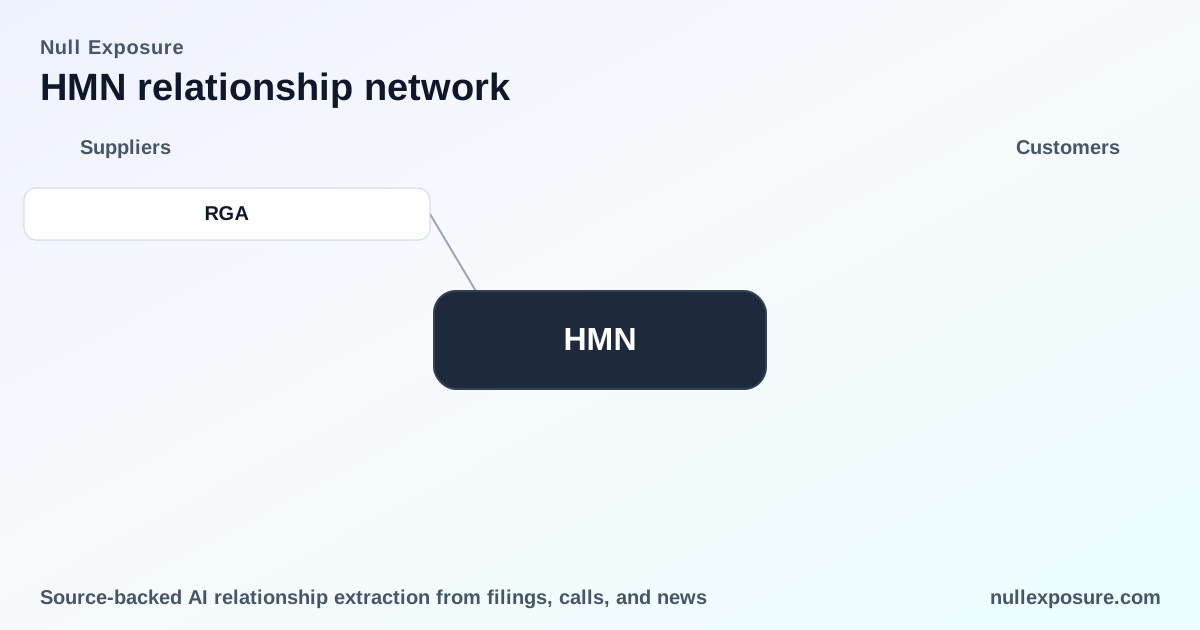
Horace Mann (HMN) — supplier map, contracting posture, and what matters to investors
Horace Mann Educators Corporation is a teacher-focused multi-line insurance group that earns through underwriting margins, investment income, and fee-based distribution services to education-sector clients. The company pairs traditional life, annuity and P&C products with indexed hedges and reinsurance programs to manage liability risk; it monetizes by collecting premiums, investing float in fixed-income portfolios, and retaining spread income after hedging and reinsurance. Investors should treat HMN as a balance-sheet centric insurer where capital structure, reinsurance counterparties and short-term derivatives vendors collectively determine volatility and capital returns.
For a deeper supplier-risk view visit https://nullexposure.com/.
The single named supplier relationship in the records: RGA reinsurance of annuities
RGA (Reinsurance Group of America) is reported as a reinsurer that assumed a substantial annuity block from Horace Mann. A ThinkAdvisor article noted RGA reinsured a $2.9 billion Horace Mann annuity block, and HMN filings describe annuity reinsurance arrangements that are recognized under the deposit method because the agreement does not transfer meaningful insurance risk to the reinsurer. According to HMN’s filings, the annuity arrangements transfer large blocks of fixed and variable annuity liabilities to third-party reinsurers and are presented as deposit assets on the balance sheet (ThinkAdvisor, June 2019; HMN Form 10‑K, 2024).
How HMN structures supplier relationships and why that matters
HMN’s vendor footprint is a layered mix of long-term capital commitments and short-term hedging and service contracts:
- Long-term capital and funding: HMN funds operations through senior notes, FHLB funding agreements and a revolving credit facility; senior paper and multi-year facilities create durable counterparty ties and raise refinancing considerations as maturities approach. HMN’s 2023 and 2015 senior notes, and an amended revolving facility (expiring mid‑2026), illustrate a capital-heavy contracting posture that locks in counterparties over multi-year horizons (HMN Form 10‑K, 2024).
- Short-term, tactical counterparties: The company purchases one‑year call options monthly to hedge Indexed Universal Life (IUL) and FIA liabilities, and it maintains short-term money market and option counterparties that are transactional by nature. These relationships are active and operationally essential because hedging funds index credits to policyholders.
- Framework and treaty arrangements: HMN relies on quota‑share and retrocession treaties (some dated decades), master netting arrangements for derivatives, and longstanding reinsurance frameworks that govern multiple product lines; these create institutionalized, multi-year supplier relationships that shape capital flows and contingent exposures.
Taken together, HMN operates a hybrid contracting model: strategic, long-dated financial linkages (debt and reinsurance treaties) underpin balance-sheet stability while short-term derivative counterparties drive near-term earnings volatility.
Where concentration, criticality and counterparty type show up in practice
HMN’s disclosures emphasize concentration and criticality rather than a large roster of small vendors:
- Reinsurance concentration is high and material: The company reports that a small set of reinsurers account for roughly 98% of ceded premium, making reinsurer performance critical to solvency and earnings (HMN Form 10‑K, 2024). A large reinsurance recoverable—$173.5 million from National Guardian Life—exceeded 10% of consolidated equity at year-end and flagged single-counterparty credit exposure in filings.
- Government‑type counterparties anchor the investment book: Large holdings of U.S. government and federally sponsored agency securities, and collateral held with FHLB, show HMN’s reliance on government-backed instruments to support regulatory collateral needs and funding agreements.
- Vendor roles are predominantly service provider and buyer: HMN buys hedging options and reinsurance, outsources investment management and policy administration, and depends on third‑party valuation and catastrophe modeling services, making these vendors operationally essential.
Key implication: a reinsurer default, a trading-counterparty failure on options, or a prolonged disruption in third‑party admin systems would transmit quickly into both regulatory and earnings stress.
Active vs. mature relationships — the lifecycle that shapes risk
HMN lists many active relationships (options providers, reinsurance treaties, FHLB funding) and a few clearly mature, longstanding ties (external auditor relationships and some retrocession treaties dating to the 1970s). The maturity profile matters because longstanding treaties carry legacy exposures (large in-force annuity blocks), while active hedging counterparties drive quarter-to-quarter earnings. For investors, this combination means monitoring both credit risk across reinsurers and counterparty operational resilience for short-term trading partners.
Practical investor takeaways and operational signals
- Capital and counterparty mix drives return volatility. HMN’s underwriting returns are amplified or compressed by the terms and creditworthiness of reinsurers and by the pricing of one‑year options used to hedge indexed products (HMN Form 10‑K, 2024).
- Reinsurance is a systemically critical supplier function. The annuity blocks that HMN cedes (reporting ranges discussed in filings and in press coverage) are economically large; deposit‑accounting treatment for some agreements signals limited risk transfer and continuing balance-sheet linkage to reinsurers.
- Liquidity and funding cadence require attention. FHLB advances, revolving credit capacity and soon‑maturing notes create a schedule-sensitive funding profile; investors should map these maturities against asset liquidity and market conditions.
- Operational dependency on third‑party tech and services is material. Policy administration, valuation services and cybersecurity vendors, while not individually named in the relationship file, are repeatedly cited in HMN disclosures as essential to day‑to‑day operations.
For a structured supplier-risk scorecard and ongoing monitoring, see https://nullexposure.com/.
Relationship-by-relationship (complete list from the supplied results)
RGA — Reinsurance Group of America: RGA reinsured a large Horace Mann annuity block; HMN’s disclosure and press coverage characterize the deal as a significant annuity transfer that is accounted for using the deposit method rather than traditional reinsurance accounting. (ThinkAdvisor report, June 24, 2019; HMN Form 10‑K, 2024).
Final assessment and investor actions
HMN’s economics are a function of underwriting discipline plus the credit and operational performance of a small set of large counterparties. Reinsurance counterparties (including RGA in press reports) and short-term options counterparties are the two supplier categories most likely to drive capital outcomes. Investors and operators should prioritize three actions:
- Monitor reinsurer financial strength and concentrations tied to ceded premium and recoverables.
- Map funding maturities and FHLB exposure against market liquidity and interest-rate scenarios.
- Audit vendor resiliency for derivatives clearing, policy administration and valuation services—these are operational failure points with immediate financial consequences.
For investigative support and continuous monitoring tools for supplier and counterparty risk, visit https://nullexposure.com/.