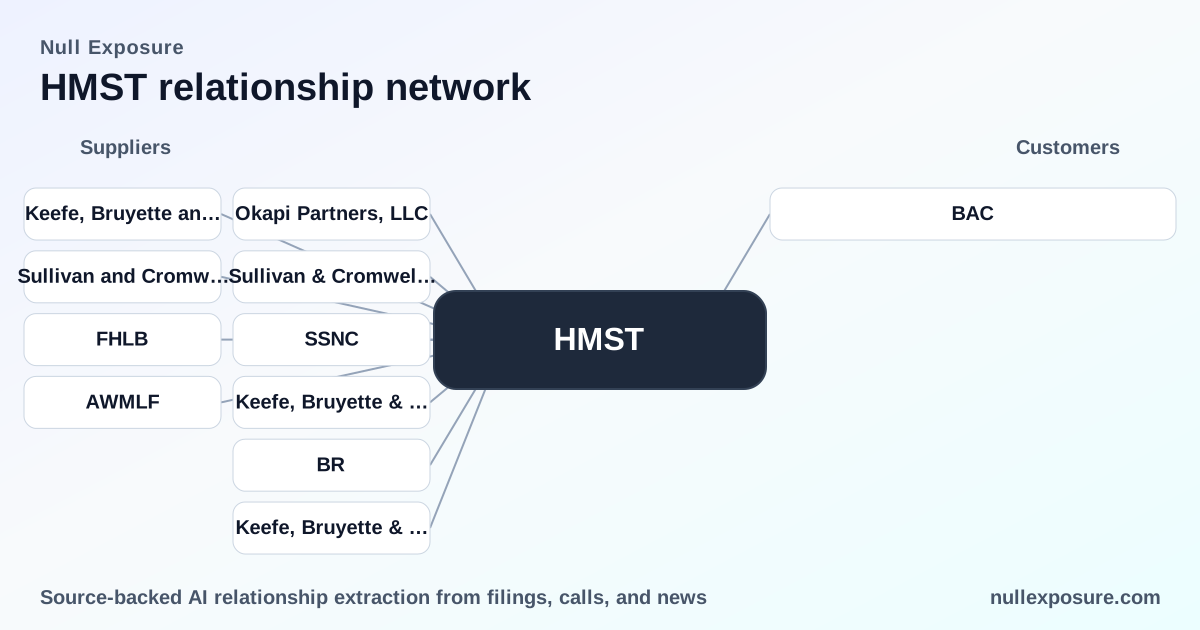
HomeStreet (HMST) — supplier map and what it means for investors
HomeStreet operates as a regional bank that monetizes through core lending and deposit spread, supplemented by fee income from capital markets and servicing activities; the FY2025 reverse merger with Mechanics Bank reconfigures both its balance-sheet profile and its supplier footprint, concentrating transaction-driven advisory and legal engagements while leaving operational back-office and transfer services intact. For investors assessing counterparty and execution risk, the supplier list shows a mix of short-duration, high-impact advisors and longer-term operations partners that together determine execution risk, continuity, and cost structure. Learn more about supplier risk profiles at https://nullexposure.com/.
Why the suppliers tell the story of the transaction — and the ongoing business
HomeStreet’s recent activity reads like a bank in transformation. The roster is dominated by financial and legal advisers engaged for a discrete corporate action, while critical processing and custody functions remain with established vendors, implying a hybrid contracting posture: project-heavy for corporate finance, steady-state for operations.
- Contracting posture: Transactional advisers (investment bank, fairness opinion, proxy solicitor, legal counsel) are engaged on a fee and milestone basis tied to the FY2025 merger, which concentrates execution risk into a short timeframe.
- Concentration: A small set of specialist firms handle the merger and shareholder processes, increasing counterparty importance during the deal window.
- Criticality: Broadridge and SS&C occupy infrastructure roles that are operationally critical; disruption here would affect securities processing and loan servicing respectively.
- Maturity: Relationships span long-standing operations partnerships (SS&C relationship dated to FY2020) and one-off or finite engagements (KBW, Sullivan & Cromwell, Okapi).
For a focused supplier-risk review and comparative counterparty intelligence, visit https://nullexposure.com/.
Supplier roster — entries and what they do
Below are every relationship pulled from public reporting, each summarized in plain English with the cited source.
Okapi Partners, LLC
Okapi acted as the proxy solicitor for HomeStreet in the FY2025 reverse-merger process and was paid a fee of $25,000 for proxy solicitation services. According to MarketScreener coverage of the Mechanics Bank acquisition (FY2025), Okapi provided shareholder solicitation support as part of the transaction execution.
Sullivan & Cromwell LLP
Sullivan & Cromwell served as legal counsel to HomeStreet for the FY2025 transaction, with named partners handling the matter. MarketScreener and American Banker reporting both list S. Eric Wang, Mitchell S. Eitel and Mehdi Ansari of Sullivan & Cromwell as HomeStreet’s legal advisers in the merger process (FY2025).
SS&C Technologies Holdings, Inc. (SSNC)
HomeStreet selected SS&C’s Precision LM to support its commercial real estate lending operations, including Fannie Mae DUS loan servicing, a relationship noted in FY2020. SS&C’s role is operational and recurring, supporting loan lifecycle and servicing functions, per MarketScreener’s FY2020 announcement.
Keefe, Bruyette & Woods, A Stifel Company
Keefe, Bruyette & Woods (KBW) was engaged as HomeStreet’s financial advisor for the FY2025 strategic merger and provided a fairness opinion; the firm received a cash fee structure tied to the aggregate merger consideration. Latham/Winston & Strawn reporting and MarketScreener reference KBW’s advisory role and fee arrangement in the FY2025 transaction.
Broadridge Financial Solutions, Inc. (BR)
Broadridge acted as transfer agent to HomeStreet in connection with the FY2025 merger and related shareholder services, per MarketScreener’s transaction coverage; this is an ongoing operational function that handles shareholder recordkeeping and transfer activity.
Keefe, Bruyette & Woods, Inc.
In the FY2025 filing for the merger, KBW’s engagement is described with explicit fee terms: HomeStreet agreed to pay the greater of $10 million or 1.25% of the aggregate merger consideration, with $500,000 payable upon delivery of the fairness opinion. MarketScreener’s FY2025 reporting provides the fee mechanics tied to KBW’s fairness opinion and advisory mandate.
Keefe, Bruyette and Woods (alternate citation)
American Banker also reported Keefe, Bruyette and Woods as HomeStreet’s financial advisor in the merger announcement (FY2025), reinforcing KBW’s central advisory position in the transaction.
Sullivan and Cromwell LLP (alternate citation)
American Banker’s FY2025 coverage reiterates that HomeStreet retained Sullivan and Cromwell for legal counsel during the merger process, underscoring the firm’s role across multiple public notices.
FHLB (Federal Home Loan Bank advances)
A KBRA ratings commentary referenced the runoff of HomeStreet’s higher-cost FHLB advances and certificates of deposit, noting additional runoff expected over the following quarters (FY2025). That funding runoff is a balance-sheet dynamic investors should track as it influences funding cost and liquidity metrics.
American West (AWMLF)
Historical reporting from FY2014 shows HomeStreet purchased branches from American West as it shifted small-business support strategies, indicating HomeStreet has executed prior branch acquisitions and local market consolidation; Westside Seattle’s 2014 coverage documents the branch transfers.
What this supplier map implies for operators and investors
- Execution risk is concentrated around the FY2025 merger window. A handful of advisers (KBW, Sullivan & Cromwell, Okapi) drive the deal mechanics and costs, so transactional counterparty performance and fee structure materially affect near-term cash flows and disclosure risk.
- Operational continuity is anchored by Broadridge and SS&C. These relationships are critical to ongoing shareholder servicing and commercial loan operations, respectively; they are structural rather than discretionary.
- Funding dynamics are shifting. Public commentary on FHLB advance runoff signals a deliberate funding strategy change that will reduce higher-cost liabilities and alter liquidity composition over the subsequent quarters (FY2025).
- Maturity mix reduces takeover operational risk but raises short-term concentration risk. Long-standing service relationships limit the chance of sudden operational failure, but the transaction-driven supplier set concentrates price and execution risk in the short run.
Investment takeaways and next steps
- Assess counterparty dependence during the merger: KBW and Sullivan & Cromwell are fee-intensive and central to deal completion; monitor disclosures for additional adviser fees or litigation risk.
- Monitor operational vendors for continuity: Broadridge and SS&C represent non-substitutable services in the near term; confirm service-level expectations during integration with Mechanics Bank.
- Track funding migration: FHLB runoff will change funding cost dynamics and should be modeled into near-term margin forecasts.
For a deeper supplier-level risk profile and comparative benchmarks, visit https://nullexposure.com/. If you need tailored analysis or a counterparty consolidation plan tied to the HMST–Mechanics integration, see https://nullexposure.com/ for advisory options.
Final note: the public record compiled here spans FY2014 (branch activity) through FY2025 (merger and associated advisers) and FY2020 (SS&C engagement), providing a chronological view of HomeStreet’s supplier evolution. For investors, the key signal is a firm in transition: operational partnerships remain stable while transactional suppliers drive immediate execution and cost risk.