HNI Corp: supplier relationships, financing counterparties and what investors should price in
HNI Corporation manufactures workplace furniture and residential construction products and monetizes primarily through product sales, aftermarket services, and strategic M&A that expand its distribution and manufacturing scale. The company leverages a mix of commercial financing, a committed revolving credit facility, and supply-chain finance programs to fund working capital and acquisitions — creating supplier and lender relationships that are both operationally important and financially material. For investors evaluating HNI as a supplier counterparty, the central calculus is how financing partners and legal advisors enable M&A-driven growth while the company manages a global manufacturing footprint and commodity cost exposure.
Explore deeper profiles and counterparty maps at https://nullexposure.com/.
The short thesis for operators and buyers
HNI runs a capital-intensive manufacturing and distribution business with mixed contract tenors (short and long), significant procurement exposure to commodities (steel, plastics, textiles), and reliance on committed bank financing for daily liquidity and strategic moves. That combination produces a supplier posture that is simultaneously transactional (purchase orders, SCF programs) and structural (long-term leases, term loans, hedges), which drives counterparty selection toward large banks, law firms for deal execution, and logistics/IT service providers to support scale.
What the relationships reveal about HNI’s operating model
HNI’s disclosed constraints show an operating model with several clear features:
- Contracting posture: a hybrid mix of short-term supplier arrangements and multi-year commitments — leases, long-dated term loans, and purchase obligations coexist with short vendor payment cycles and supply-chain finance options. This structure supports flexibility while locking in some fixed-cost commitments.
- Concentration and geography: manufacturing is global but operationally concentrated in North America with a notable cluster in eastern Iowa; that geography concentration creates localized operational tail risk (floods, power outages).
- Financial criticality: the revolving credit facility is the primary daily liquidity source and is treated as a critical counterparty-dependent funding line; long-term debt maturities extend to 2027–2028 and include hedges. Bank relationships therefore underwrite both working capital and acquisition capacity.
- Maturity and spend scale: the company carries multi-year lease and loan obligations and reports purchase obligations and borrowing levels consistent with >$100M spend bands — this signals large counterparty exposures and the need for counterparties able to support sizable commitments.
- Supplier service mix: HNI relies on third-party logistics, IT/security consults, and third-party financing programs (SCF) to manage payables — creating a dependency on external service providers for both operations and risk management.
These are company-level signals drawn from HNI’s disclosures and do not tie an individual constraint to a counterparty unless HNI’s own text explicitly names that firm.
If you want a mapped view of HNI’s counterparty roles and relative criticality, start here: https://nullexposure.com/.
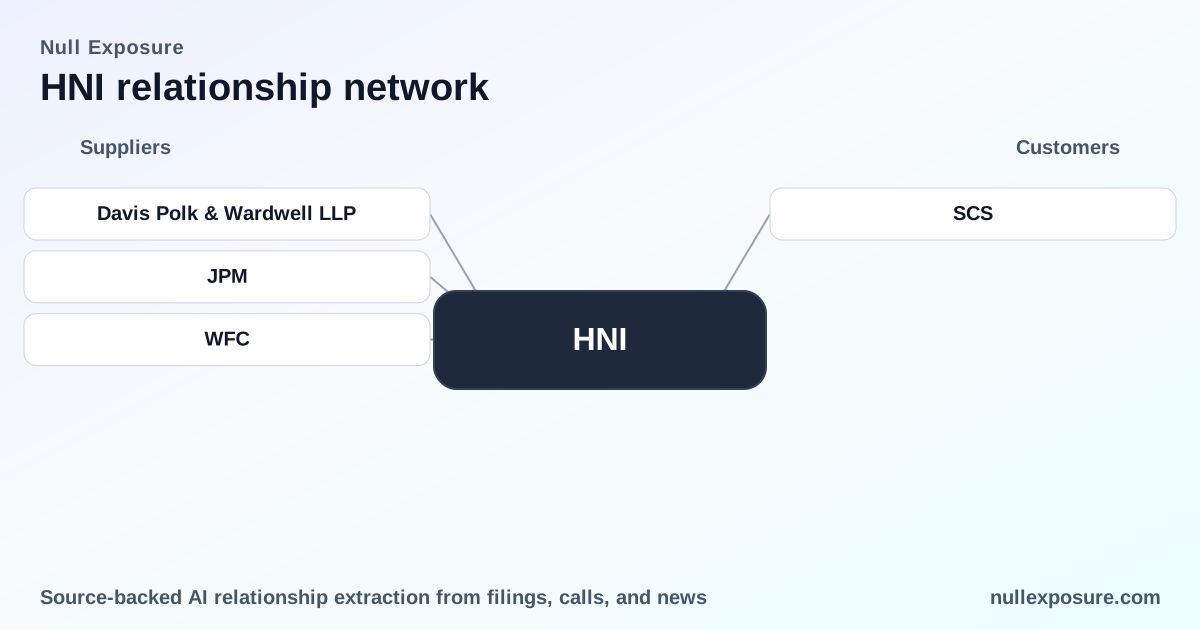
Counterparties tied to the Steelcase acquisition and financing
The recent transaction activity around Steelcase highlights the interplay between legal advisers, banks and HNI’s strategic agenda. Below are the relationships surfaced in public reporting and the role each counterparty plays.
Davis Polk & Wardwell LLP
Davis Polk served as HNI’s legal counsel on the Steelcase acquisition, advising on transaction structure and execution — a standard engagement for a strategic, transformational deal. According to a USA Herald report (March 10, 2026), Davis Polk steered the legal work for HNI in the transaction (FY2026 reporting context).
JPMorgan Chase Bank, N.A. (JPM)
JPMorgan is reported as a financing participant, providing a commitment letter that underwrites HNI’s acquisition financing for the Steelcase transaction. WZZM13 reported that JPMorgan, along with Wells Fargo, shared a commitment letter to provide financing to HNI (news coverage dated March 10, 2026; fiscal references in the disclosure point to FY2025 activity).
Wells Fargo Bank, N.A. (WFC)
Wells Fargo joined the acquisition financing commitment and is also named in HNI’s long-term credit documentation as an administrative agent on lending facilities, anchoring the company’s credit structure. WZZM13 reported the financing commitment to HNI (March 10, 2026), and HNI’s filings reference term loan and revolving credit arrangements with Wells Fargo as administrative agent (company filings, reference to 2023–2024 credit agreements).
How these relationships change supplier risk and procurement strategy
The combination of a law firm, two major banks, and ongoing third‑party service providers produces several actionable implications for investors and operators:
- Acquisition financing increases counterparty concentration risk. The commitment letters from large banks enable M&A but also centralize credit exposure; the revolving credit facility is the primary liquidity backstop and therefore a single-point financial dependency.
- Operational risk remains material. HNI’s supplier base is global and commodity-sensitive; prolonged shortages or price shocks for steel, plastics or textiles would be material to margins and put stress on SCF programs and trade payables.
- Contract mix supports both flexibility and lock-in. Short-term leases and SCF support working capital flexibility, while long-term lease and debt maturities create predictable fixed charges that lenders and service providers underwrite.
- Third‑party services are indispensable. HNI depends on external IT/security vendors, logistics carriers, and stop-loss insurers; failures or security incidents at those vendors translate directly into operational and reputational risk.
Investors should price in the dual nature of HNI’s exposure: strategic upside from bolt-on acquisitions and distribution scale balanced against concentrated credit reliance and commodity-driven cost volatility.
Practical checklist for counterparty diligence
When assessing HNI for supplier, partner, or lender exposure, focus on:
- Funding lines and covenant headroom on the revolving credit facility.
- The counterparty role in SCF programs and how receivables are confirmed and paid.
- Geographic concentration of manufacturing and contingency plans for the eastern Iowa cluster.
- Hedging program scale (interest rate swaps, commodity hedges) and their maturities.
- Insurance and third‑party cyber/security assessment practices.
For a quick vendor-risk map and access to HNI counterparty profiles, visit https://nullexposure.com/.
Closing recommendation
HNI’s recent deal activity and its reliance on large-bank financing create a clear institutional profile: capable of executing material acquisitions, but dependent on a small set of major financial and legal counterparties and exposed to commodity and localized operational risks. For investors and procurement operators, the relevant trade-off is between growth financed by large syndicated bank relationships and the operational volatility inherent in global sourcing and manufacturing concentration.
To explore the counterparty network or commission a tailored supplier-risk report for HNI, start at https://nullexposure.com/ — our platform indexes counterparties, contractual tenors, and materiality signals for decision-makers.