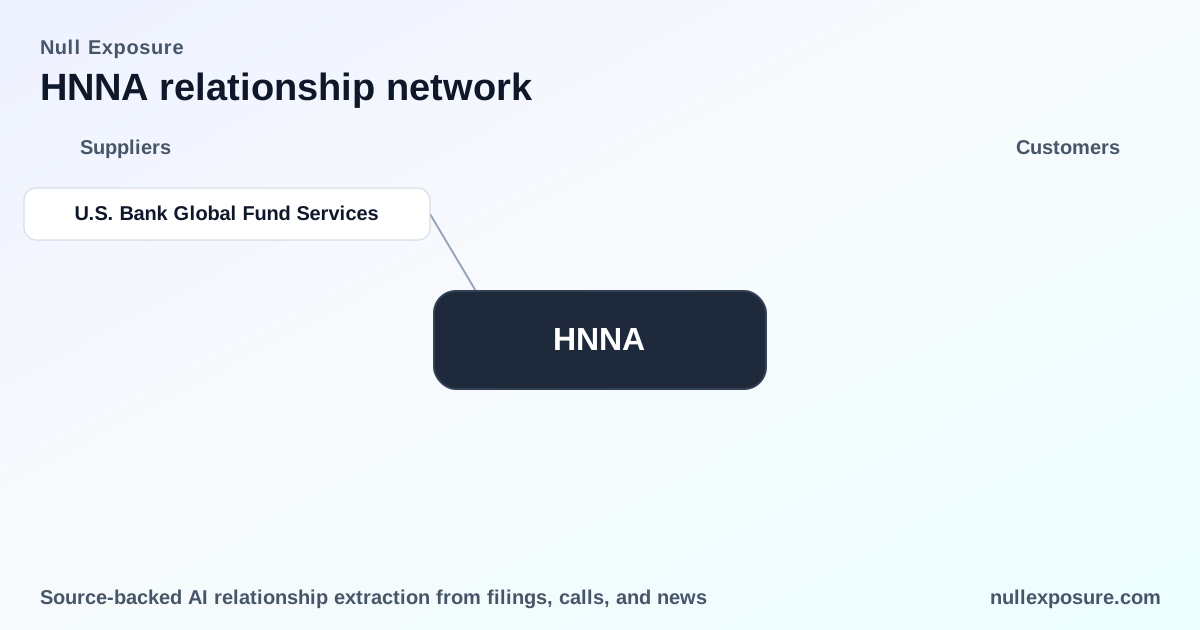
HNNA supplier relationships: what investors need to know
Hennessy Advisors (HNNA) operates as an asset manager that monetizes through management and distribution fees on mutual funds and ETFs, plus the purchase and capitalization of management contracts that it converts into ongoing fee revenue. The firm runs a manager‑of‑managers model: it directly manages several funds while contracting unaffiliated sub‑advisors for others, paying asset‑based sub‑advisory fees and using third‑party administrators for fund accounting, custody, and distribution. For a concise supplier-risk dashboard and ongoing tracking, visit the NullExposure homepage: https://nullexposure.com/.
A compact map of Hennessy’s supplier footprint
HNNA’s operating model is built around outsourced fund operations and occasional strategic acquisitions of management contracts. Key structural signals from filings:
- Contracting posture: a mix of short‑term renewable sub‑advisory agreements and long‑term investments (capitalized management contract assets and notes payable). The company explicitly requires annual renewal of sub‑advisory agreements, which creates recurring governance touchpoints.
- Pricing model: usage‑based, asset‑based fees dominate. Sub‑advisory payments, 12b‑1 fees, and distributor fees are calculated as percentages of average daily net assets or set minimums.
- Concentration and spend: Hennessy executes both small operating spends (~$0.3–$1.1M lease and transaction costs) and large strategic purchases (multiple asset purchases in the $35M–$435M range), producing a two‑tiered supplier profile.
- Criticality and maturity: fund administrators, custodians, auditors, and sub‑advisors are critical to revenue generation; several relationships are active and require frequent oversight, while capitalized management contracts represent an indefinite‑life asset requiring impairment monitoring.
- Geography and regulatory posture: operations and most counterparties are North America‑centric, with product exposure to APAC through Japan‑focused funds; the firm is subject to U.S. federal and state tax and securities regulation.
These signals frame supplier risk as operational and governance heavy, not commodity procurement. If you want the supplier intelligence product that generated this view, see NullExposure: https://nullexposure.com/.
Relationship detail: U.S. Bank Global Fund Services
U.S. Bank Global Fund Services — fund accounting and shareholder services
- Hennessy discloses that shareholder service fee revenues are earned and calculated daily by the Hennessy Funds accountants at U.S. Bank Global Fund Services and are subsequently reviewed by management, indicating U.S. Bank performs daily NAV and shareholder servicing for the funds. This is documented in Hennessy’s 2025 Form 10‑K. (Source: Hennessy Advisors, Inc., 2025 Form 10‑K)
Other named supplier signals from HNNA’s disclosures
HNNA’s filings name multiple counterparties and contractual constructs that shape supplier strategy. These are company‑level signals drawn from the same regulatory disclosure set.
- Netfolio licensing: Netfolio granted Hennessy a perpetual, paid‑up, royalty‑free, exclusive license to use certain trademarks and formulaic strategies (e.g., Cornerstone Growth/Value), evidencing a long‑dated intellectual‑property arrangement that underpins product branding. (Source: Hennessy 2025 Form 10‑K)
- Index and data licensing: The firm uses third‑party indices and servicemarks (Russell, Alerian) under license, creating recurring vendor obligations and restrictions on redistribution. (Source: 2025 Form 10‑K)
- Audit and accounting services: Marcum LLP resigned and CBIZ CPAs P.C. was engaged as the company’s independent registered public accounting firm for fiscal 2025, reflecting a recent auditor transition and the need to validate prior-year audit continuity. (Source: 2025 Form 10‑K)
- Third‑party administrators and custodians: Hennessy uses independent third parties for custody and distribution; fund accounting and transfer agency are delegated to service providers that Hennessy oversees as part of its compliance program. (Source: 2025 Form 10‑K)
- Sub‑advisor ecosystem: The firm has active sub‑advisory agreements with multiple named managers (e.g., Vident Advisory, Stance Capital, Broad Run, FCI Advisors) and discloses accrued sub‑advisor fees and sub‑advisory expense line items, confirming material ongoing payments to external portfolio managers. (Source: 2025 Form 10‑K)
- Asset purchases and management contract asset: Hennessy has repeatedly purchased fund management assets (transactions ranging from ~$12M to ~$435M) and capitalizes acquisition costs into an $82.6M management contract asset, creating balance‑sheet exposure to the success of those acquired revenue streams. (Source: 2025 Form 10‑K)
What the constraints imply for supplier counterparty risk
Translate the disclosure dimensions into investment‑grade operational judgments:
- Short‑term contracting for core fund management duties (annual renewal of sub‑advisory agreements) increases governance workload but preserves flexibility to replace underperforming managers. This creates recurring re‑approval risk that must be monitored via board and shareholder action.
- Usage‑based fee structures align vendor economics with AUM, which reduces fixed cost leverage but links Hennessy’s vendor spend volatility directly to fund flows and market cycles.
- Materiality is binary: several disclosures flag supplier risks as potentially material — interruptions to sub‑advisory relationships or product development failures can have outsized revenue consequences, while certain cash and deposit exposures are labeled immaterial by management.
- Maturity mix: Hennessy runs short‑term operational contracts alongside indefinite‑life intangible assets (management contracts) and medium‑term debt (2026 Notes), producing a mixed maturity profile that demands different oversight disciplines.
- Spend profile requires dual sourcing capability: operating spends are modest but acquisitions are capital intensive, implying the company needs reliable legal, accounting, and M&A advisory relationships capable of scaling from $0.3M to $400M transactions.
If you want a checklist to stress‑test these supplier dependencies against peer asset managers, NullExposure provides templates and continuous monitoring at https://nullexposure.com/.
Risks that deserve active monitoring
- Concentration of fee revenue on AUM: vendor costs and distribution expenses are asset‑sensitive; a sustained AUM decline compresses margins and reduces the ability to cover minimum sub‑advisor guarantees. (Source: 2025 Form 10‑K)
- Transition risk for auditors and critical service providers: auditor changes and sub‑advisor terminations require careful disclosure and control testing. (Source: 2025 Form 10‑K)
- Valuation and impairment of management contract asset: the $82.6M indefinite‑life asset requires ongoing impairment testing tied to acquired fund performance. (Source: 2025 Form 10‑K)
- Regulatory and geopolitical exposure: funds with Japan and other APAC exposure introduce FX and regulatory complexity into third‑party arrangements. (Source: 2025 Form 10‑K)
Bottom line and suggested investor actions
HNNA’s supplier model is operationally concentrated and revenue‑linked: the firm converts acquisitions of management contracts into fee streams while relying on a stable set of administrators, custodians, and sub‑advisors to execute daily operations. Key investor actions: review sub‑advisory renewal timelines, monitor accrued sub‑advisory fee trends, and insist on transparency around the performance of capitalized management contracts.
For curated supplier risk intelligence and ongoing alerts on Hennessy and its counterparties, visit NullExposure: https://nullexposure.com/.
This profile synthesizes Hennessy’s FY2025 public disclosures and offers an operationally focused lens for investors assessing supplier dependence, contractual posture, and balance‑sheet exposures.