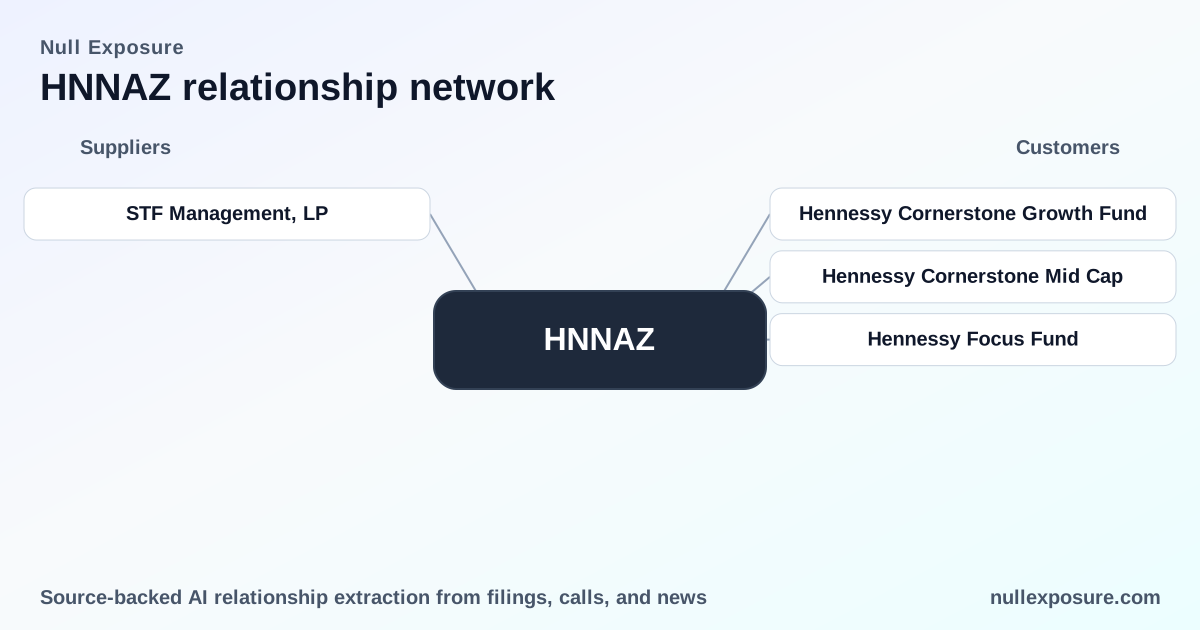
HNNAZ — Hennessy Advisors’ Notes and the supplier map that drives fee income
Hennessy Advisors operates as an active asset manager that monetizes through two clear channels: unitary advisory and asset-based fees on mutual funds and ETFs, and periodic acquisitions of fund management assets that are capitalized as an intangible “management contract” and amortized through returns on assets under management. The company offsets operating expenses by collecting advisory fees and using 12b‑1/distribution mechanics through financial institutions, while supplementing growth through targeted purchases of other managers’ fund assets. For a consolidated view of supplier exposures and contracts, visit https://nullexposure.com/ for partner-level detail.
How the business actually makes money and what that implies for suppliers
Hennessy generates recurring revenue from asset‑based fees and a smaller but strategic stream from one‑time asset purchases. Advisory and sub‑advisory fees are calculated as a percentage of average daily net assets, which creates direct revenue sensitivity to flows and market performance. The company also pursues an acquisition strategy—buying management contracts and integrating fund assets into Hennessy Funds—which creates a capitalized intangible on the balance sheet that links M&A activity directly to future fee generation.
- Fee model: Asset‑based, therefore revenue scales with AUM and distribution channels. FY2025 filings show sub‑advisory and 12b‑1 mechanics drive costs and transfers between parties.
- Buy strategy: Hennessy acts as an active buyer of fund management assets; the company has completed multiple asset purchases and capitalizes related costs into a management contract asset.
- Balance sheet signal: The management contract asset stood at $82.6 million at the end of fiscal 2025, with a $0.3 million increase tied to the STF Management agreement, which is an explicit linkage between supplier transactions and reported intangible assets (FY2025 disclosures).
Operating model constraints and what they tell investors
The company disclosures provide a set of consistent operating constraints that define contracting posture, counterparty mix, and geographic footprint.
- Contracting posture — usage‑based and annual renewals. Sub‑advisory and distribution economics are asset‑based (fees as a percent of average daily net assets) and sub‑advisory agreements require annual renewal by fund boards or shareholder vote, creating recurring counterparty negotiation points rather than multi‑year lockups.
- Duration mix — short and long elements. Most advisory arrangements renew annually, but the company carries long‑term liabilities such as the 4.875% notes due 2026 and certain capitalized leases; this creates a hybrid maturity profile: recurring commercial relationships alongside multi‑year financing instruments.
- Licensing posture — some perpetual IP rights. Hennessy holds at least one perpetual, paid‑up license (Netfolio) for strategic formulaic strategies, reducing ongoing royalties on those products while exposing value to the underlying strategy’s shelf life.
- Counterparty spread and concentration signals. Filings reference sub‑advisors across the spectrum — small businesses (e.g., Japan small‑cap specialists), mid‑market managers, and large enterprises for larger mandates — which reduces single‑counterparty concentration but increases oversight complexity.
- Geographic footprint — North America primary, APAC exposure in product set. The firm’s operations are U.S.‑centric (principal office in Novato, CA; offices across the U.S.), while product exposure includes Japan‑focused funds, exposing AUM to foreign exchange and APAC market risk.
- Materiality and criticality. The management contract asset is a material balance sheet item whose movement is explicitly tied to asset purchases; filings warn that interruption of sub‑advisory relationships could meaningfully affect AUM and revenue.
- Spend and deal scale. Recent purchases range from tens of millions to hundreds of millions in acquired assets (multiple transactions in FY2024–FY2025 reporting hundreds of millions collectively), highlighting that Hennessy executes both tuck‑ins and larger portfolio acquisitions.
These constraints position Hennessy as an asset‑centric manager that leverages asset‑based contracts and occasional larger M&A to grow fee income, while operating under the annual renewal and oversight dynamics common to fund managers.
The supplier relationship set — complete, explicit coverage
Below is the complete set of supplier relationships surfaced in the results and what each relationship means for counterparties and investors.
STF Management, LP
Hennessy signed a definitive agreement to purchase the assets related to the management of two ETFs — the STF Tactical Growth & Income ETF (TUGN) and the STF Tactical Growth ETF (TUG) — with completion expected in December 2025, and the assets will be reorganized as series of Hennessy Funds. A TradingView news post reported the agreement on March 10, 2026, and the company’s FY2025 disclosures record a $0.3 million increase in the management contract asset attributable to costs associated with the STF agreement (TradingView, March 10, 2026; FY2025 filings).
What the STF transaction signals to buyers, partners, and underwriters
- Strategic acquisition behavior. Hennessy continues to execute its documented strategy of buying management assets to scale AUM and fee revenue; the STF deal is another example of using acquisitions to acquire scale quickly.
- Integration and capital accounting impact. The $0.3 million capitalization tied to STF demonstrates that transaction costs are recorded to the management contract asset and will be evaluated for impairment under intangible asset guidance.
- Sponsor and board approvals required. The definitive agreement is conditional on ETF shareholder approvals and customary representations, suggesting transitional execution risk concentrated around meeting those governance requirements.
For deeper supplier mapping and risk scoring of Hennessy counterparties, see https://nullexposure.com/.
Risk checklist — what to watch in due diligence
- Board renewal and annual contracts: Annual renewal cycles create regular decision points for sub‑advisors and potential revenue volatility if relationships change.
- Asset‑based revenue sensitivity: Fee income will move with AUM flows and market performance; distribution channels that rely on 12b‑1 fees create variable expense/reimbursement dynamics.
- Concentration in management contract asset: The $82.6 million management contract asset is material; monitor write‑downs or impairment tests after integration of purchased assets.
- Operational delegation: Extensive use of unaffiliated sub‑advisors and third‑party administrators spreads execution risk and demands robust vendor oversight.
- Cross‑border product exposures: Japan funds introduce currency and APAC market risk into the product mix; this affects AUM volatility and fee receipts.
If you are evaluating Hennessy as a counterparty or supplier, prioritize operational integration plans, the governance timeline for ETF reorganizations, and the contingent costs capitalized in the management contract asset. For a supplier risk scorecard and partner documents, visit https://nullexposure.com/.
Final takeaways for investors and operators
Hennessy’s commercial model is straightforward and replicable: grow advisory fee revenue through AUM and accelerate scale through selective asset purchases. The material management contract balance and the company’s history of acquisitions make the firm a hybrid of organic active management and opportunistic consolidator in the mutual fund/ETF space. Active monitoring of annual sub‑advisory renewals, AUM flows, and integration milestones for purchased funds will indicate the trajectory of fee growth and the health of supplier relationships.
To map counterparties, review contracts, or commission a supplier risk brief on Hennessy Advisors and peers, start at https://nullexposure.com/ and request the tailored report.