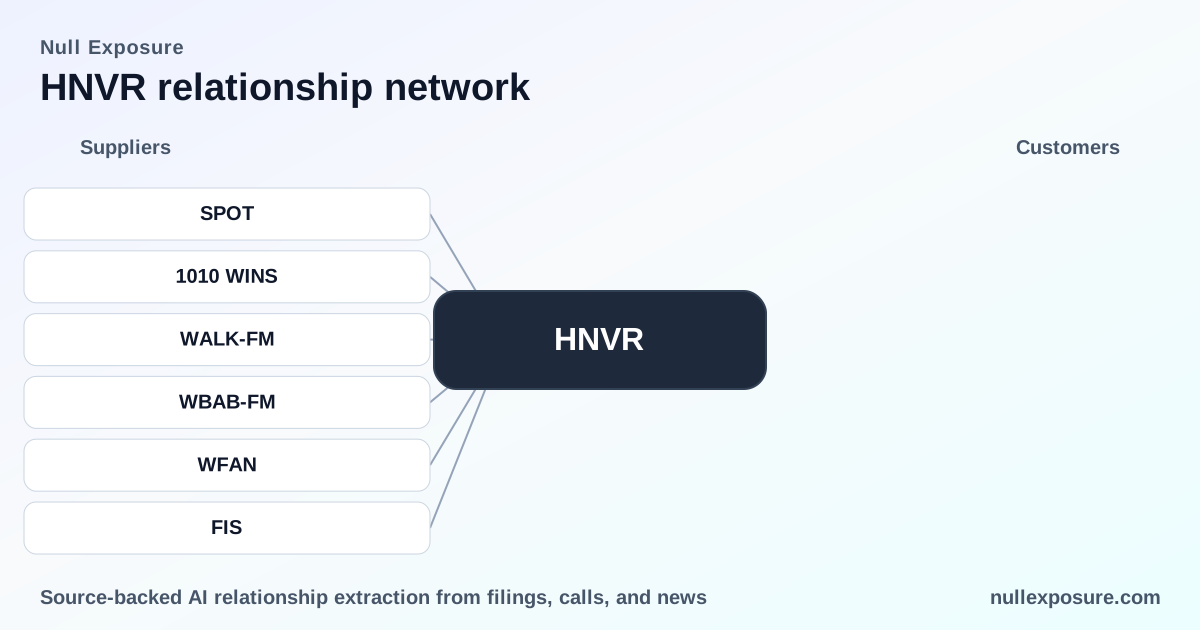
Hanover Bancorp (HNVR) — supplier map and what it means for operators and investors
Hanover Bancorp operates as the bank holding company for Hanover Community Bank, monetizing primarily through net interest income on commercial, municipal and consumer lending, supplemented by fee income and SBA loan servicing activity in the New York metropolitan area. Recent public disclosures show the bank is actively investing in customer acquisition through localized audio advertising and executing an enterprise systems migration to a new core processor — both moves that shift expense mix and operational risk profiles in measurable ways. For a concise supplier-risk frontier and opportunity read, review Hanover’s supplier footprint below and how it informs credit, operational and strategic assessment.
Discover deeper supplier intelligence at https://nullexposure.com/.
Why supplier relationships materially shape Hanover’s economics
Hanover’s supplier profile is a classic mix for a regional bank: short- and long-term funding commitments, heavy reliance on third‑party service providers for core processing and IT, and meaningful interactions with government counterparties for liquidity and credit guarantees. These characteristics drive four operating-model signals investors should track:
- Contracting posture: Hanover runs both long-term instruments (term FHLB borrowings, subordinated notes, interest-rate swaps) and routine short-term funding lines and deposit management. This hybrid posture lowers headline refinancing risk but raises complexity in ALM execution.
- Concentration and counterparty mix: The bank has exposure to government-backed funding and securities (FHLB, Federal Reserve facilities, U.S. GSE MBS) that are central to liquidity management and mortgage holdings, increasing systemic resilience while concentrating dependence on agency funding and regulation.
- Criticality of service providers: Third-party providers are integral to operations — core banking, web hosting, data processing and security testing — making vendor continuity and cybersecurity oversight operationally critical.
- Maturity and spend scale: Supplier spend ranges from modest branch leases and marketing to high‑value financing and core processing relationships; lease liabilities and FHLB advances indicate mid-to-high spend bands that matter to cash flow and capital planning.
These company-level signals set the context for individual supplier relationships below.
Detailed supplier relationships — who Hanover is working with
Spotify: targeted digital audio for local customer acquisition
Hanover launched geo-targeted audio ads to run on Spotify within a 10‑mile radius of its branches as part of an inaugural radio/digital audio campaign, signaling a modernized, locality-focused marketing push to drive deposit and loan growth. According to a company press release published on The Globe and Mail (March 2026), the Spotify placements were explicitly geo-fenced to branch trade areas.
1010 WINS: regional radio reach for brand and product messaging
Hanover’s campaign includes spots on top regional radio station 1010 WINS, broadening awareness among metropolitan listeners for Hanover’s community-first positioning and product referrals. The Globe and Mail press release (March 2026) lists 1010 WINS among the regional stations used in the campaign.
WALK-FM: local broadcast to capture suburban audiences
Local station WALK-FM is part of the radio mix, intended to capture suburban audiences around Hanover branches and support localized acquisition and cross-sell efforts. This placement is described in the same Globe and Mail press release (March 2026).
WBAB-FM: reaching adjacent listener cohorts with traditional radio
WBAB-FM is included in Hanover’s audio plan to reach adjacent commuter and suburban cohorts, representing a diversified radio buy across both local and regional channels. The campaign details were disclosed in the Globe and Mail press release (March 2026).
WFAN: sports and commuter audience exposure
Hanover’s media buy extends to WFAN to target sports and high-frequency commuter listeners, a tactical choice for brand frequency in high-engagement time slots. The Globe and Mail press release (March 2026) lists WFAN as a channel in the campaign.
FIS: core processing conversion to FIS Horizon
Hanover publicly announced a core processing system conversion to FIS Horizon, expected to complete by mid‑February 2025, reflecting a strategic modernization of transaction processing and customer servicing infrastructure. TradingView reported on the conversion in March 2026, noting the upgrade’s purpose to enhance operational efficiency and customer experience.
How these relationships link to Hanover’s constraint profile
Hanover’s disclosed constraints and vendor signals provide context for the relationships above without tying every constraint to a particular supplier:
- Long-term vs short-term contracts: The company operates with both long-term borrowings and leases (FHLB term advances, subordinated debentures, multi-year swaps) and short-term liquidity facilities (unsecured lines from correspondent banks, FHLB short-term advances). This blended contract tenure reduces refinancing cliff risk but demands active ALM execution.
- Licensing and software risk: Hanover acknowledges dependence on third‑party software licenses and service agreements; therefore, software licensing continuity is a company-level risk that affects any core processing conversion and hosted services.
- Government counterparty reliance: Hanover uses government-sponsored mortgage securities and Federal Reserve/FHLB facilities extensively; government counterparty relationships are core to liquidity and mortgage asset strategies, reducing credit risk but increasing regulatory sensitivity.
- Service-provider criticality and maturity: Disclosures classify third-party servicers as central to daily operations and flagged the risk that service interruptions or cyber events could materially affect operations. Hanover’s FIS core conversion underscores this criticality: the bank’s operations will depend heavily on the successful integration and ongoing management of a third-party core platform.
- Spend profile: Reported lease liabilities and FHLB advances place supplier spend across 1m–10m and 100m+ bands, indicating both modest recurring vendor costs (marketing, local leases) and large-scale financial relationships that materially affect capital and liquidity.
Investment implications — checklist for operators and credit analysts
- Operational execution risk: The FIS Horizon conversion is transformational; implementation risk is the primary near-term operational concern given claims that third-party servicers are essential to business continuity. (See TradingView, March 2026.)
- Marketing and deposit growth trade-off: The localized audio campaign on Spotify and top radio stations is a targeted, measurable acquisition cost; investors should monitor deposit growth and cost-per-acquisition against campaign spend. (See The Globe and Mail press release, March 2026.)
- Funding flexibility vs concentration: Heavy use of FHLB and agency MBS improves funding diversity, but concentration in government facilities increases regulatory dependency.
- Vendor oversight and cybersecurity: Hanover’s public filings emphasize the need for vendor due diligence and cyber testing; oversight intensity should increase during the core migration window.
For a full supplier-risk assessment and continual monitoring of vendor exposures, visit our portal at https://nullexposure.com/.
Bottom line: operational progress with concentrated dependencies
Hanover is executing two concurrent moves that define near-term investor focus: modernizing core operations via a high-impact vendor conversion to FIS Horizon and deploying targeted audio marketing to grow local balance sheet share. Both initiatives are strategically coherent but increase the bank’s dependence on third-party service continuity and execution. Investors and operators should prioritize monitoring implementation milestones, deposit response to marketing, and liquidity metrics tied to FHLB and correspondent lines.
Stay informed on supplier risk evolution and get ongoing monitoring at https://nullexposure.com/.