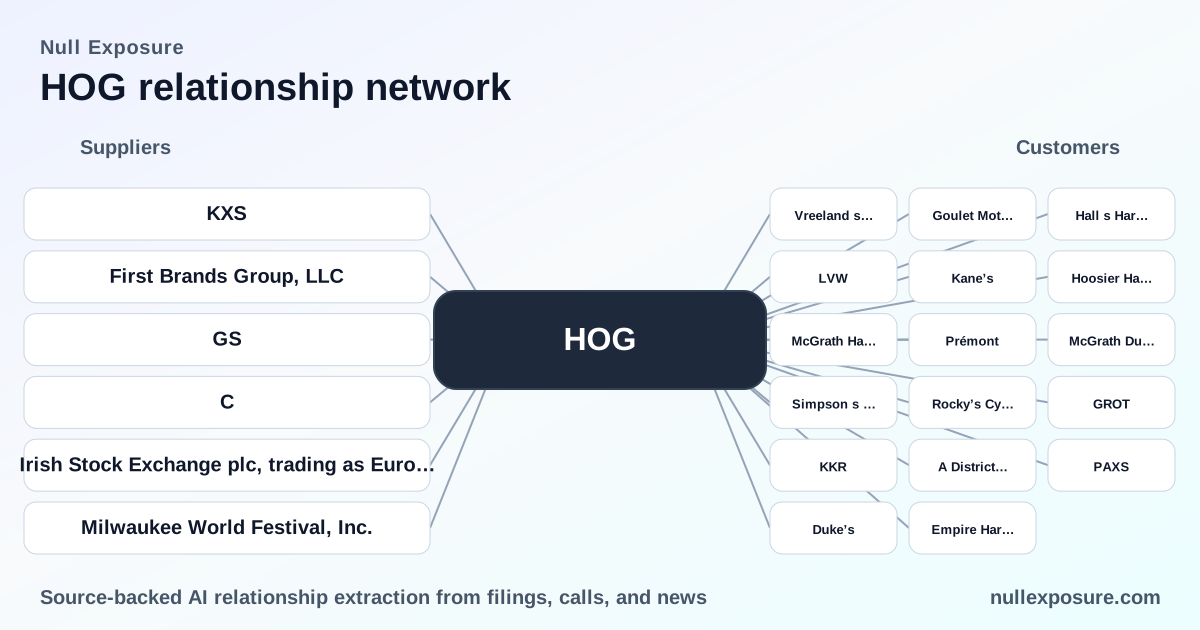
Harley-Davidson (HOG) supplier map — who moves production, parts and the balance sheet
Harley‑Davidson manufactures and sells motorcycles and related parts while monetizing through vehicle sales, parts & accessories, financing solutions and licensing. The company runs a capital‑intensive, vertically integrated manufacturing model with significant working‑capital and financing activity: revenues come from motorcycle and parts sales, recurring aftermarket revenue and interest and fee income from Harley‑Davidson Financial Services. Investors should view supplier relationships through both an operational lens (production continuity, part quality) and a balance‑sheet lens (asset‑backed conduits, commercial paper and short‑term funding). For deeper supplier profiles and counterparty risk signals, visit NullExposure.
Quick financial snapshot and what it means for vendor risk
Harley‑Davidson is a mid‑cap cyclical manufacturer: market cap roughly $2.1bn, revenue ~$4.47bn and EBITDA ~$621m (latest TTM). Valuation multiples are compressed (trailing P/E ~6.4, EV/EBITDA ~2.9), reflecting a capital structure that uses both short‑term commercial paper and long‑dated notes. The company’s procurement and financing posture creates two simultaneous priorities for suppliers and partners: (1) they must support high‑volume manufacturing and component continuity; (2) they must integrate with frequent, short‑dated funding actions (commercial paper, conduit facilities) that influence liquidity and timing of payables. This hybrid of durable manufacturing relationships and active short‑term funding elevates counterparty and timing risk.
Explore more supplier intelligence on NullExposure.
Who’s on Harley‑Davidson’s supplier and partner list — what each relationship means
Below are every relationship referenced in the recent feed, with concise, investor‑grade takeaways and source context.
Kinaxis
Harley‑Davidson selected Kinaxis as its supply‑chain orchestration platform to accelerate transformation of its global supply chain, signaling a move to digitize planning and reduce disruption risk. According to Kinaxis’ announcement (InvestingNews, Mar 10, 2026), this is a strategic attempt to improve forecast accuracy and parts flow.
First Brands Group, LLC
The company cited the bankruptcy of key suppliers such as First Brands Group as an example of supply chain vulnerability, underscoring exposure to supplier insolvency and the operational consequences of supplier failures (TradingView summary of HOG 10‑K commentary, Mar 2026).
Goldman Sachs
Harley‑Davidson entered a $200 million accelerated share repurchase agreement with Goldman Sachs as part of capital allocation in Q4, a clear signal that the company is deploying free cash to support shareholder returns while simultaneously managing leverage (earnings call transcript and coverage, Q4 2025 & press, Mar 2026).
Citibank, N.A., London Branch
Citibank’s London Branch acted as Fiscal Agent/Transfer Agent in the process of notice and redemption for Harley‑Davidson Financial Services’ $700m guaranteed notes due 2026, reflecting the mechanics of debt retirement and trustee‑level coordination (PR Newswire release on note redemption, Mar 2026).
Irish Stock Exchange plc (Euronext Dublin)
Harley‑Davidson will request cancellation of listing and trading admission for the redeemed notes on Euronext Dublin in connection with the full redemption, a procedural consequence of the debt paydown (PR Newswire release, Mar 2026).
Milwaukee World Festival, Inc.
Harley‑Davidson entered a multi‑year partnership with Milwaukee World Festival, the operator of Summerfest, reinforcing brand marketing and local partnership investments that support dealer and experiential marketing strategies (SpectrumNews1 coverage, Feb 24, 2026).
Operating model constraints investors should weigh
Harley‑Davidson’s supplier profile is shaped by several company‑level characteristics drawn from recent disclosures and filings. These are company signals, not tied to a specific partner unless explicitly named.
- Contracting posture: Harley runs a mix of short‑term and long‑term contracts. The company relies on short‑dated instruments — commercial paper, derivatives under 12 months and short‑term leases — alongside multi‑year credit facilities and long‑dated notes. This creates frequent rollover and liquidity management needs.
- Concentration and spend: The firm’s procurement includes large spend bands (several relationships and facilities exceed $100m), and certain parts come from single or limited suppliers; that concentration elevates operational risk.
- Criticality: Suppliers are critical to production continuity—raw materials, brake assemblies and battery cells are material inputs. Past production suspensions demonstrate supplier issues can immediately throttle output.
- Maturity and renewal: The company maintains mature supplier relationships (longstanding auditor engagement since 1982 and renewed conduit facilities in 2024) but also actively renews revolving facilities and conduits — an operational mix that balances stability with financing flexibility.
- Geography: Sourcing is North‑America centric with meaningful exposure to APAC manufacturing for certain subassemblies, creating geopolitical and logistics risk vectors.
- Role mix: Suppliers act as manufacturers, service providers and distribution partners; Harley is both buyer and seller across different segments (manufacturing, parts, finance).
Risk implications and near‑term watchlist
- Supplier insolvency and quality — the mention of First Brands’ bankruptcy and prior supplier quality issues (brake hose investigations) make supplier financial health and QA controls immediate monitoring points.
- Funding and liquidity cadence — frequent use of commercial paper and conduit facilities means payables timing and counterparty capacity will move with credit markets; redemptions of notes and ASR activity change leverage and cash availability.
- Tariffs, commodities and APAC tensions — raw materials and EV component exposures (battery cells, semiconductors) create margin pressure and potential supply interruptions.
- Digitalization upside — the Kinaxis deployment is a positive operational lever that will reduce forecast error and expedite parts allocation if implemented cleanly.
- Brand investments — partnerships like the Summerfest deal reflect continued marketing spend to protect retail demand and dealer economics.
See how this maps to supplier risk scores on NullExposure.
Actionable takeaways for investors and operators
- Monitor supplier financials and single‑source exposures for critical components; a bankrupt or suspended supplier can halt production quickly.
- Track Harley’s short‑term funding facilities and conduit renewals: commercial paper availability and conduit commitments materially affect cash conversion and supplier payments.
- Assess ASR and debt actions as they alter leverage and free cash; the $200m ASR with Goldman Sachs reshapes capital allocation in the near term.
- Follow the Kinaxis rollout as a leading indicator of improved inventory turns and fewer expedited freight costs.
- Account for geopolitical and tariff scenarios in margin modeling, particularly for LiveWire and EV component procurement.
For a deeper read and real‑time updates on counterparty exposure, visit NullExposure.
Harley‑Davidson blends legacy manufacturing scale with modern finance and service lines; the company’s supplier map is therefore both an operations play and a liquidity story. Investors should price in concentrated supplier criticality and active funding cadence while recognizing upside from supply‑chain digitization and disciplined capital deployment.