MicroCloud Hologram (HOLO): supply relationships, strategic posture, and investor implications
MicroCloud Hologram Inc. produces and monetizes holographic systems through a three-pronged model: hardware sales and resale, proprietary software and algorithm licensing, and service revenues (advertising, content and deployment). The company combines in-house manufacturing capabilities with outsourced PCBA suppliers and channel distributors, collects payments through third‑party platforms, and funds operations with a mix of operating cash flow and short-term borrowings — generating $321.2 million in trailing revenue and $77.8 million in gross profit (TTM). For investors evaluating supplier risk, the critical inputs are supplier concentration, the split between long‑ and short‑term contracting, and the company’s operational exposure to Chinese infrastructure and regulators. Learn more about supplier risk coverage at https://nullexposure.com/.
How HOLO’s supplier footprint links to revenue and margins
HOLO’s commercial model is intentionally hybrid: it designs and sells complete holographic systems while relying on third parties for specific components, content and distribution. Hardware is procured and resold, with an in‑house capability augmented by acquired PCBA expertise; software and algorithm work is both internally developed and supplemented by third‑party software; and service delivery — notably advertising and content provisioning — has been heavily outsourced, reflected in a dramatic increase in service costs.
Key financial and operational markers from company filings and public disclosures:
- Revenue and scale: $321.2M revenue (TTM) with $77.8M gross profit.
- Service cost ramp: service costs rose by roughly 481.6%, climbing from $4.1M to $24.0M year‑over‑year (company filing, FY2022), indicating rapid scaling of outsourced content and advertising services.
- Supplier concentration: the largest single supplier accounted for 13.8% of expenditures in FY2022 and the top ten suppliers accounted for 71.4% of product spend (FY2022 filing), signaling a materially concentrated vendor base.
- Leases and contracting posture: the company carries multi‑year operating leases and recognizes right‑of‑use assets and lease liabilities amortized through 2026, while also preserving a large universe of short‑term leases and short‑term bank borrowings (company financial disclosures, 2022–2023).
These signals establish a supplier posture that is partially locked in (long‑term leases and material vendor relationships) while maintaining flexibility through short‑term contracts and borrowings — a mixed contracting stance that influences both liquidity planning and supplier negotiation leverage.
The supplier relationships that surfaced in public signals
The universe of explicit named supplier relationships in our collection is limited but relevant for due diligence.
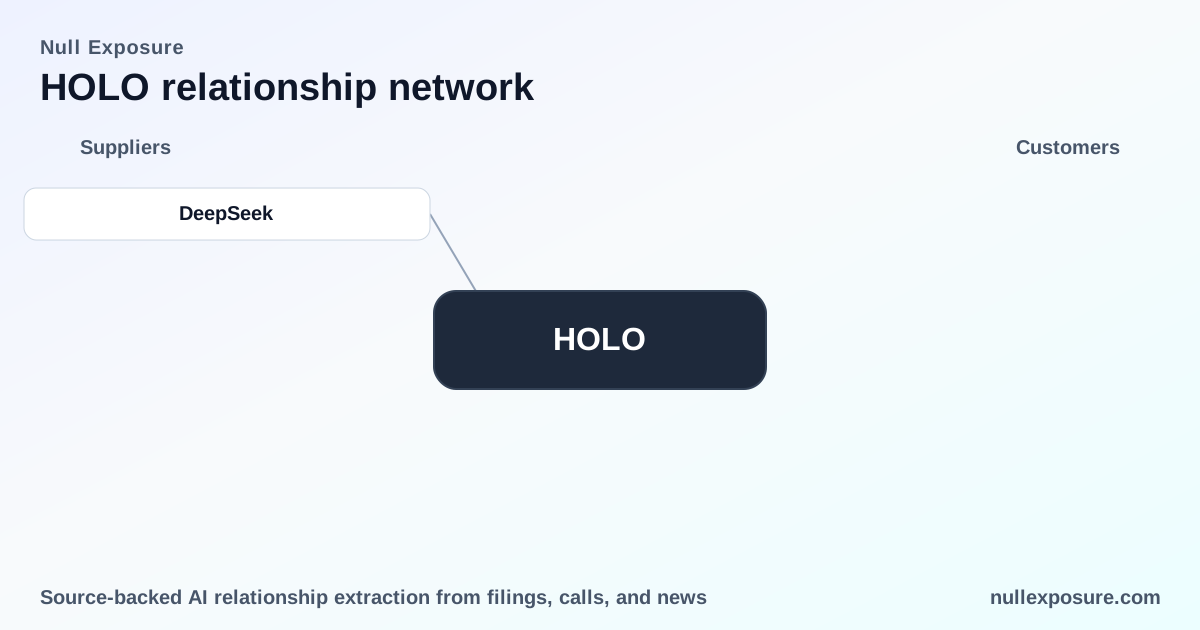
- DeepSeek — A TradingView post dated March 10, 2026, reports that HOLO will be using DeepSeek R1, indicating a supplier relationship for a specific product or component cited in market commentary; the post surfaced as news sentiment on TradingView. (TradingView discussion, March 10, 2026)
This is the complete list of relationships surfaced in the provided results.
What the constraints tell an investor about operational risk and supplier strategy
The constraints extracted from company disclosures point to distinct structural qualities of HOLO’s supplier base and operational model.
- Contracting posture — mixed maturity: HOLO runs both long‑term leases (ROU assets and liabilities amortized through future years) and short‑term contractual commitments (short‑term leases and short‑term bank borrowings). This indicates a strategy that balances capital commitment for facilities with tactical short‑term flexibility for services and working capital. (Company filings, FY2022–2023)
- Concentration risk is high and material: Top supplier concentration — 13.8% for the largest vendor and 71.4% for the top ten — is a company‑level signal of material dependency. Procurement disruption at a top supplier would have outsized P&L and operational impact. (FY2022 disclosure)
- Critical dependency on Chinese infrastructure and government touchpoints: HOLO’s operations are concentrated in APAC, rely on domestic telecommunications and data hosting, and interact with government programs (subsidies, social insurance) and evolving cybersecurity rules, establishing high criticality for certain infrastructure and regulatory counterparties. Limited insurance coverage for business interruptions in China raises recovery risk in the event of infrastructure failure. (Company filings, PRC regulatory excerpts)
- Supplier maturity and role mix: The company treats many third parties as service providers — auditors, content providers, channel distributors and outsourced software developers — and also functions as a buyer, distributor and manufacturer across its supply chain. The surge in outsourced service costs suggests services are still scaling and maturing operationally. (FY2022 service cost disclosures)
Commercial and operational risk: what to price into valuation
Investors should base vendor‑risk adjustments on these lead items:
- Vendor concentration haircut: high single‑vendor exposure and top‑ten concentration justify a discount for supply disruption and negotiation leverage.
- Lease and fixed‑cost leverage: multi‑year lease obligations increase fixed costs and reduce short‑term flexibility if demand stalls; plan cash flow sensitivities against the ROU amortization schedule. (Lease schedules in filings)
- Regulatory and infrastructure risk premium: operating predominantly in China exposes HOLO to data localization, cybersecurity review, and limited business interruption insurance — these are quantifiable downside risks to revenue continuity.
- Operational execution risk: the rapid rise in outsourced service costs implies integration and quality risks; investor due diligence should focus on SLAs, contingency suppliers and inventory buffers.
Practical recommendations for investors and operator negotiators
- Negotiate termination and performance clauses with major suppliers to lower concentrated counterparty risk. Use the company’s mixed contracting posture to push for better pricing on long‑lead hardware while retaining short‑term agility for services.
- Insist on SLAs and redundancy for network, data hosting and critical content providers given limited alternative networks in China. Maintain a contingency capex line to accelerate insourcing for the most critical components if supplier concentration persists.
- Model scenarios that stress working capital and short‑term bank borrowing needs; the company has historically used short‑term borrowings and bank guarantees in its capital stack. (Short‑term borrowing schedule in filings)
For a deeper commercial supplier map and scenario stress tests, visit https://nullexposure.com/ to commission custom supplier exposure analysis.
Bottom line and action items
MicroCloud Hologram’s business combines meaningful recurring service revenue with hardware resale and software intellectual property; supplier concentration and China‑centric infrastructure create the primary execution risk vectors. Investors should price a premium for continuity risk, require clear contingency plans for top vendors, and monitor contract maturities and short‑term borrowing levels closely. For hands‑on supplier due diligence and prioritization, start with a commissioned review at https://nullexposure.com/.
Bold final takeaway: HOLO grows through outsourced services and concentrated vendor relationships — that is a scalability advantage when suppliers perform, and a material downside when they do not.