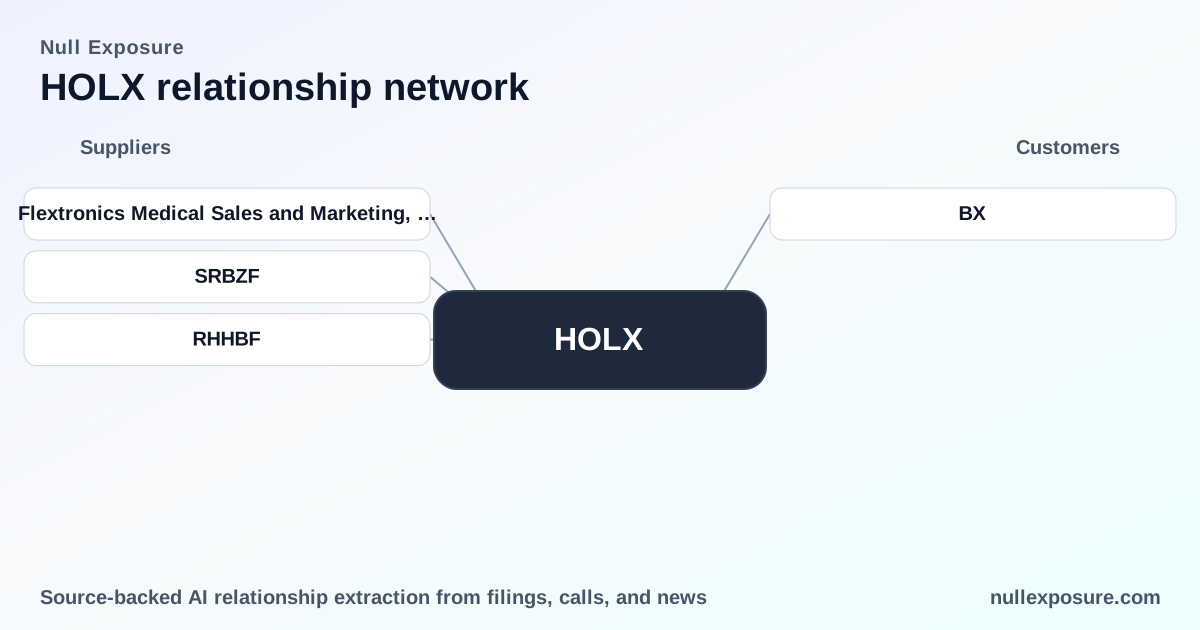
Hologic Inc (HOLX) — supplier relationships that drive margin and operational risk
Hologic is a vertically integrated medical technology company focused on women’s health, monetizing through the sale of diagnostic instruments, consumables, and imaging and surgical capital equipment, plus recurring reagent and service revenue tied to installed base utilization. Its economics depend on a small number of high-value, long-lived capital platforms and consumable streams, which creates both predictable recurring revenue and concentrated supplier exposure. For investors and operators evaluating HOLX as a counterparty or customer, the key questions are concentration, contract tenor, criticality to production, and geographic dispersion of manufacturing. Learn more at https://nullexposure.com/.
What you need to know in one paragraph
Hologic sells instruments (hardware) and consumables (high-margin recurring revenue) and relies on a mix of in-house manufacturing and third-party contract manufacturers for critical product lines. That operating model translates to stable aftermarket cash flows but creates concentrated supplier dependency for specific instruments and raw materials — a structural risk that influences contingency planning, inventory policy, and capital allocation.
- For a fast supplier-risk check, visit https://nullexposure.com/ for an expedited supplier relationship view.
The three named supplier relationships and what they mean for investors
Flextronics Medical Sales and Marketing, LTD — sole manufacturer for Skeletal Health finished goods
Flextronics is identified as the only manufacturer of Hologic’s Skeletal Health finished goods, meaning production of those disposables and finished products is single-sourced through Flextronics (FY2025 Form 10‑K, filed September 27, 2025). This creates concentration risk in the Skeletal Health line that can translate into revenue interruption if Flextronics experiences disruption. (Source: Hologic FY2025 10‑K).
Stratec SE — sole manufacturer of Panther and Panther Fusion instruments
Stratec SE is the only manufacturer of the Panther and Panther Fusion molecular diagnostics instruments, establishing a single-source dependency for Hologic’s Panther instrument platform (FY2025 Form 10‑K, filed September 27, 2025). The Panther platform drives substantial consumables revenue, so manufacturing interruption would have outsized top-line and aftermarket consequences. (Source: Hologic FY2025 10‑K).
Roche — key raw-material supplier for amplified NAT diagnostic assays
Roche supplies certain key raw materials for Hologic’s amplified NAT diagnostic assays, positioning Roche as a critical raw-material partner for specific assay lines (FY2025 Form 10‑K, filed September 27, 2025). Reliance on Roche for these inputs links assay production timelines and cost exposure to Roche’s supply continuity and pricing. (Source: Hologic FY2025 10‑K).
How Hologic’s contracts and operating posture shape supplier risk
Hologic’s public filings disclose several company-level operating characteristics that inform counterparty assessment:
-
Contract tenor and structure: The company documents long-term financial arrangements (secured term loans and revolver maturities into 2030 and beyond) and explicit long-term lease renewals, reflecting an operating posture that supports multi-year manufacturing commitments. The 10‑K also states the company has established long-term supply contracts with many suppliers and, in other cases, developed in-house capabilities to offset sole-source risks (FY2025 10‑K). This indicates strategic use of long tenors where possible to secure continuity.
-
Concentration and criticality: Hologic explicitly identifies sole-source manufacturers for critical product lines (Stratec for Panther instruments; Flextronics for Skeletal Health), a fact that raises high concentration risk for discrete revenue streams. The 10‑K frames these as material risks: inability to secure alternative suppliers could delay shipments and materially affect revenues.
-
Maturity and stage: Many relationships are active and long-duration, with non-cancelable purchase commitments reported across fiscal years (totaling hundreds of millions). Lease renewals and scheduled debt amortization further imply an entrenched capital structure that assumes persistence of supply and manufacturing capability.
-
Geographic footprint: Manufacturing and contract manufacturing exist in the U.S., Costa Rica, Mexico, the U.K., and other jurisdictions. Hologic’s supply chain is globally distributed but concentrated in a limited number of facilities, which increases the susceptibility to regional disruptions, tariffs, and regulatory audits (FY2025 disclosures).
-
Spend scale and financial magnitude: Public disclosures indicate significant capital and procurement scale — the company’s non-cancelable purchase commitments and debt structure sit in the $100M+ spend band, reflecting sizable counterparty exposure where supplier failure would have measurable financial impact.
Together, these characteristics create a predictable revenue engine with elevated supplier concentration risks requiring active mitigation.
Operational implications for buyers, investors and suppliers
For investors underwriting Hologic’s equity or debt, and for suppliers negotiating terms with Hologic, the practical implications are clear:
- Buy-and-hold investors should price in concentration risk around Panther and Skeletal Health lines while acknowledging the recurring-consumable economics that underpin margin stability.
- Suppliers and contract manufacturers should expect long-term, high-value commitments where quality, regulatory compliance, and capacity assurances are essential to retain or gain share.
- Operators and procurement teams should prioritize redundancy planning, inventory strategies, and contractual performance guarantees for the sole-source platforms.
A deeper supplier-risk profile and tailored exposure map are available at https://nullexposure.com/ for institutional users.
Key takeaways and action items
- Concentration is explicit: Stratec and Flextronics are sole manufacturers for major instrument platforms and product lines (FY2025 10‑K). That is a strategic choke point for revenue continuity.
- Contracts skew long-term: Hologic’s procurement posture includes long-term supply arrangements and material non-cancelable purchase commitments, aligning the company to multi‑year supply relationships.
- Global footprint increases operational complexity: Manufacturing across North America, Latin America, and EMEA is efficient for market access but raises geopolitical, tariff and regulatory vectors to monitor.
If you are evaluating HOLX as a supplier partner, customer, or investment, prioritize verification of contingency plans for Panther and Skeletal Health production lines and a supplier continuity review for assay raw materials from Roche. For a focused commercial due diligence package on Hologic’s supplier dependencies, visit https://nullexposure.com/.
Closing note
Hologic’s business model is a classic mix of capital equipment and recurring consumables that generates high margins and predictable cash flow, while simultaneously creating concentrated supplier dependencies that require active monitoring and contractual mitigation. Understand the single-source manufacturers and raw-material suppliers, and stress-test those nodes when assessing Hologic exposure.