Home BancShares (HOMB): Supplier relationships, acquisitions and funding posture investors should price in
Home BancShares operates as a regional bank holding company through Centennial Bank, monetizing primarily via net interest income from loans and securities, fees from consumer and commercial banking services, and deposit-driven funding advantages. The company grows both organically and by acquisition—buying loan portfolios, subordinated notes and whole banks—and leverages its securities portfolio and Federal Home Loan Bank access to maintain liquidity and margin. For a rapid gateway to counterparty risk and supplier intelligence on HOMB, visit https://nullexposure.com/.
How Home makes money and how that shapes supplier exposure
Home BancShares’ economics are straightforward: interest spread on earning assets is the principal profit engine, supplemented by service revenues and gains on securities. That operating model creates three supplier dynamics that determine risk and upside:
- Contracting posture: Home runs a mix of long-term and short-term contractual relationships — long-dated subordinated notes and operating leases sit alongside overnight repo, repurchase/resale activity and short-term advances. This dual posture supports liquidity flexibility while locking in some funding costs.
- Concentration toward government instruments: A large share of the securities portfolio is invested in U.S. government‑sponsored mortgage-backed securities and state/political subdivision obligations, which both underpin earnings and concentrate interest-rate and credit exposure in public-sector paper.
- Service-provider criticality and maturity: Home depends on third‑party core processors, cybersecurity specialists, auditors and the FHLB system. Some relationships are mature and embedded (auditor relationships since 2005), while others (repurchase counterparties and borrowed funds) are dynamic and actively managed.
These characteristics drive an operating profile where liquidity management and third-party operational resilience are strategic levers for investors evaluating supplier risk.
What every named relationship in public coverage says about HOMB
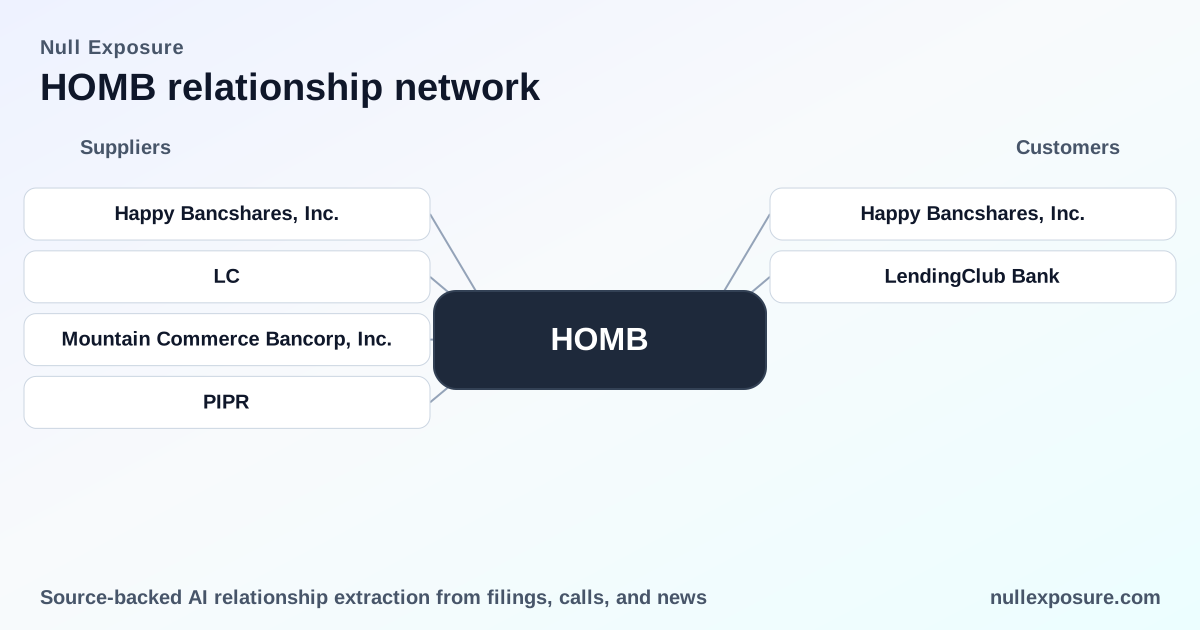
Happy Bancshares, Inc.
Home completed its largest acquisition with Happy, folding Happy State Bank into Centennial Bank and taking on significant assets, loans and deposits; it also acquired $140 million of Happy subordinated notes (5.5% fixed-to-floating due 2030) and recorded fair-value adjustments on that paper. According to TradingView’s summary of Home’s FY2026 disclosures, the Happy deal materially expanded Home’s Texas footprint and balance sheet (TradingView, March 10, 2026).
LendingClub Bank (LC)
Home purchased the performing marine loan portfolio from LendingClub in 2022—approximately $242.2 million of yacht loans—bolstering its marine lending specialty and integrating LH‑Finance into its specialty finance division. TradingView’s FY2026 coverage highlights the LendingClub portfolio acquisition as a targeted portfolio buy that deepened Home’s marine lending capabilities (TradingView, March 10, 2026).
Mountain Commerce Bancorp, Inc.
Home disclosed a proposed acquisition of Mountain Commerce Bancorp and explicitly cited integration risk and potential unknown liabilities as part of its acquisition strategy. The FY2026 commentary frames this as part of Home’s continued roll‑up approach with attendant execution risk (TradingView, March 10, 2026).
Piper Sandler
Piper Sandler provided valuation inputs and supplemental disclosure work tied to Home’s announced deals, with disclosed discount rates used in fairness analyses (Home 9.33% vs. MCBI 10.86% in one model). Market write-ups referencing Piper Sandler’s materials were published alongside the company’s acquisition disclosures (TradingView, March 10, 2026).
What constraints and filings reveal about supplier risk (company-level signals)
Home’s public filings and the FY2026 narrative highlight several cross-cutting constraints that determine supplier and counterparty risk:
- Long-term vs. short-term contracts: The company documents both long-dated obligations — such as subordinated debt maturing in 2030 and long-term operating leases — and routine short-term instruments like repurchase agreements and short-term advances. This mixed tenure profile gives the bank flexibility but creates reprofiling risk if short-term markets reprice sharply.
- Licensing and subscription expense line: Data processing and software licensing subscriptions increased post-acquisition activity, indicating recurring third-party systems spend on core processing and telecommunication services that is not negligible for operations.
- Government exposure concentration: Approximately large shares of the available‑for‑sale and held‑to‑maturity portfolios are in state and political subdivision obligations and U.S. government‑sponsored MBS, making Home’s interest income and capital sensitive to public‑sector spreads and prepayment behavior.
- Material operational dependency: Filings call out third‑party core processing, cybersecurity vendors and auditors as material service providers; management runs a third‑party risk program and uses external penetration testers, underlining that vendor resilience is a core operational risk.
- Spend profile skewed by M&A and securities: The company’s spend bands include very large items (hundreds of millions) tied to acquisitions and securities positions alongside mid‑sized operating spend, indicating capital allocation tilted toward growth-by-acquisition and large securities holdings.
- Relationship stages: Many third‑party relationships are active (FHLB borrowing, repurchase counterparties, ongoing vendor contracts) while some legacy emergency funding relationships are terminated — for example, Home repaid a $700 million BTFP advance during 2024, removing that temporary exposure.
A specific, relationship-level constraint: Home’s filings explicitly state that on April 1, 2022 the company acquired $140.0 million of 5.500% subordinated notes due 2030 from Happy and recorded approximately $144.4 million including fair-value adjustments, which creates a long-term liability alignment tied directly to that acquisition (company 10‑K summarised in FY2026 filings).
For deeper supplier intelligence and to see how these constraints map to counterparty networks, visit https://nullexposure.com/ for a structured view of counterparties and contractual tenure.
Investment implications — what investors and operators should act on
- Earnings resiliency depends on interest spread management and MBS performance. Given the heavy weighting to government‑sponsored MBS and state obligations, investors should price prepayment and duration risk into valuation models.
- Acquisition-driven growth increases integration and credit risk. Home’s roll‑up strategy (Happy, LendingClub portfolio, Mountain Commerce pursuit) drives book growth but elevates PCD (purchase credit deteriorated) loan and goodwill amortization risk, and investors should monitor incremental provisioning and charge-offs.
- Operational risks are supplier-dependent. Core processing, cybersecurity and third‑party liquidity providers are material to operations; vendor due diligence and continuity planning are strategic governance items for the company and its board.
- Balance-sheet flexibility exists but requires execution discipline. Available external liquidity (FHLB, repo, repurchase agreements) is substantial; call options on funding and execution of liability management will determine short-term stock performance.
For a tactical snapshot of counterparties, spend bands and contractual tenure that affect valuation and operational continuity, explore Null Exposure’s supplier profiles at https://nullexposure.com/.
Bottom line
Home BancShares is a regional bank with a hybrid model of spread income, strategic acquisitions and a concentrated securities book that together produce steady earnings but require active liquidity and vendor risk management. Investors should treat Home’s supplier landscape — from long-term subordinated paper acquired with Happy to short-term repo and core processors — as integral to the investment thesis: acquisition upside is real but comes with crystallizing integration and third‑party operational risk that affects both capital and earnings volatility.