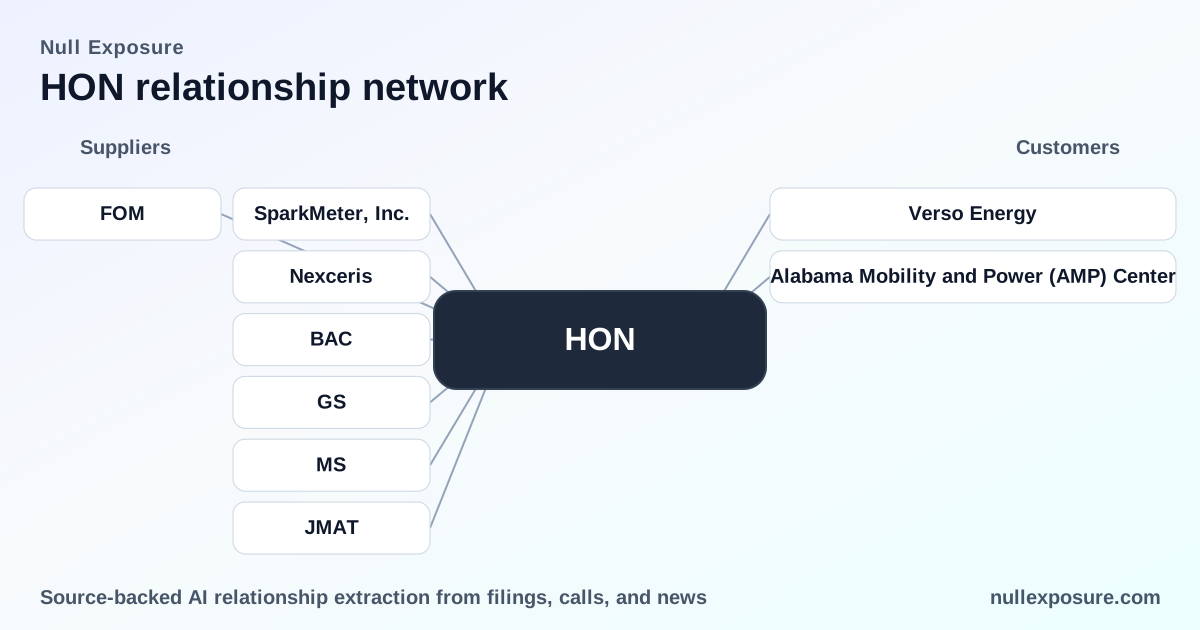
Honeywell (HON) as a Supplier Counterparty: What investors need to know now
Honeywell operates as a diversified industrial conglomerate that monetizes through four core platforms—Aerospace, Building Technologies, Performance Materials & Technologies, and Safety & Productivity Solutions—by selling hardware, software and long-running service contracts, and by pursuing targeted acquisitions to accelerate adjacent capabilities. The company finances this strategy through a mix of long-term debt, short-term credit facilities and active treasury management, while retaining broad geographic scale and supplier redundancy that support execution. For a deeper look at counterparty-level exposure and supplier momentum, visit https://nullexposure.com/.
How recent deals change the supplier map — pragmatic M&A, targeted technology buys
Honeywell’s deal-making in 2025 was tactical and portfolio-focused, with acquisitions that strengthen building and energy-related product lines and expand capabilities into battery manufacturing.
-
SparkMeter, Inc. — In August 2025 Honeywell acquired three utility platforms from SparkMeter, expanding its smart-grid and utility offerings. This was reported in coverage of Honeywell’s portfolio strategy in March 2026 by TradingView. (TradingView, March 10, 2026: https://www.tradingview.com/news/zacks:9f5e1670d094b:0-here-s-why-you-should-retain-honeywell-stock-in-your-portfolio/)
-
Nexceris — Honeywell purchased Nexceris’ Li‑ion Tamer business in July 2025 to bolster its fire and life safety product set and to expand into energy storage and data center markets. (TradingView, March 10, 2026; also syndicated on Finviz and Bitget reporting the same acquisition.)
-
Johnson Matthey (Catalyst Technologies) — Honeywell amended its acquisition agreement for Johnson Matthey’s Catalyst Technologies business, revising purchase price and timing as part of a portfolio re-pricing and schedule adjustment. (SimplyWallSt, March 10, 2026: https://simplywall.st/stocks/us/capital-goods/nasdaq-hon/honeywell-international/news/honeywell-portfolio-shake-up-and-catalyst-deal-repricing-tes)
-
FOM Technologies — FOM will integrate its high-precision slot-die coating technology into Honeywell’s AI-driven Battery Manufacturing Excellence Platform (Battery MXP), a strategic capability add to Honeywell’s battery manufacturing initiative. (Ritzau announcement, March 10, 2026: https://via.ritzau.dk/announcement/14801930?publisherId=13559885&lang=en)
Banking and liquidity counterparties — syndicate structure for new facilities
Honeywell restructured liquidity with new revolvers and term financing that name major banks as agents and arrangers, which affects counterparty credit and operational arrangements.
-
Bank of America — Identified as the administrative agent on Honeywell’s new facilities; Bank of America is the primary facility administrator in the syndicate. (TradingView, March 10, 2026: https://www.tradingview.com/news/tradingview:d6b99375211ca:0-honeywell-overhauls-liquidity-with-new-7b-revolvers-and-6b-term-loan-ends-prior-facilities/)
-
Goldman Sachs — Named as a syndication agent on the financing package that accompanies Honeywell’s updated revolving and term loan facilities. (TradingView, March 10, 2026)
-
Morgan Stanley — Named as a syndication agent alongside Goldman Sachs on the newly arranged credit facilities. (TradingView, March 10, 2026)
What those relationships collectively signal to investors
Honeywell’s supplier and counterparty footprint reflects a deliberate operating model: large-scale, capital-intensive industrial operations with a mix of long-term contracts, active M&A, and reliance on major financial counterparties to underpin liquidity. The company-level characteristics that matter for investors are:
-
Contracting posture: predominantly long-term with material short-term overlays. Honeywell maintains five-year credit facilities and fixed-term loans alongside 364‑day credit agreements and commercial paper capacity, indicating a blended maturity ladder that supports acquisitions and working capital without overconcentration in any single tenor.
-
Concentration and spend profile: skewed to high-dollar relationships. Public filings and disclosures show numerous >$100M exposures in acquisitions, lease portfolios, and credit arrangements—an institutional spend profile that drives reliance on a small set of large suppliers and global banks.
-
Criticality of third parties: dual character. Suppliers and third‑party service providers are simultaneously operationally critical (components, manufacturing support, IT/cloud services) and manageable via supplier redundancy; filings note active engagement with primary and secondary suppliers and contingency programs to mitigate disruptions.
-
Geographic footprint: global sourcing with North America and EMEA scale. Honeywell operates hundreds of locations worldwide with manufacturing sites across the U.S., Europe and other international regions, exposing operations to trade policy shifts and multi-currency hedging needs.
-
Relationship maturity and stage: active and transactional. Most supplier ties and credit facilities are active; acquisition activity in 2024–2025 produced new operating relationships that are currently being integrated.
-
Roles and segments: buyer, manufacturer, and service consumer. Honeywell behaves predominantly as a buyer (acquisitions, purchase obligations), a manufacturer (174 manufacturing sites), and as a large consumer of third‑party services (IT, valuations, hedging counterparties), creating multiple vectors of counterparty risk.
Mid-read action: for an enterprise-grade counterparty map and to track how these moves affect exposure, review our supplier intelligence hub at https://nullexposure.com/.
Relationship-level takeaways (one line each)
-
SparkMeter, Inc. — Honeywell acquired three utility platforms from SparkMeter in August 2025, expanding its smart‑grid capabilities (TradingView / Finviz syndicated coverage, March 10, 2026).
-
Nexceris — Acquisition of the Li‑ion Tamer business in July 2025 added battery-fire safety solutions and deepened Honeywell’s presence in energy storage and data centers (TradingView / Finviz / Bitget / Globe and Mail, March 10, 2026).
-
Bank of America — Serves as administrative agent on Honeywell’s new revolving and term facilities, anchoring the company’s syndicate-level liquidity (TradingView, March 10, 2026).
-
Goldman Sachs — Acts as a syndication agent on Honeywell’s new credit package, indicating an institutional distribution strategy for its debt (TradingView, March 10, 2026).
-
Morgan Stanley — Listed as a syndication agent alongside Goldman Sachs on the financing, providing underwriting and placement capacity for the facilities (TradingView, March 10, 2026).
-
Johnson Matthey — Honeywell amended purchase terms for Johnson Matthey’s Catalyst Technologies business, adjusting price and timing as part of a portfolio repricing move (SimplyWallSt coverage, March 10, 2026).
-
FOM Technologies — Agreed to integrate FOM’s slot‑die coating tech into Honeywell’s Battery MXP, strengthening Honeywell’s manufacturing technology stack for batteries (Ritzau announcement, March 10, 2026).
Investment implications and risks — clear-eyed, actionable
-
Operational resilience is high but not bulletproof. Honeywell’s global footprint, supplier redundancy, and diversified revenue mix reduce single‑counterparty shock risk, yet filings highlight that certain suppliers and third‑party providers remain critical and could materially disrupt operations if they fail.
-
Balance sheet flexibility supports strategic M&A. The combination of five‑year credit capacity, term loans and short‑dated credit lines funds both bolt‑on acquisitions (SparkMeter, Nexceris, Johnson Matthey carve‑outs) and working capital, while also increasing leverage sensitivity to interest rate cycles.
-
Technology integration raises execution risk. FOM and Nexceris add niche capabilities that require integration into manufacturing and product flows; successful integration materially improves margins and product stickiness, while delays would pressure near-term returns.
-
Banking counterparties matter for funding cost and execution. Administrative and syndication agents—Bank of America, Goldman Sachs, Morgan Stanley—underline institutional access but also expose Honeywell to market‑wide funding stress in stressed conditions.
Conclusion — position and next steps
Honeywell’s supplier relationships and counterparties reflect a strategically acquisitive, credit-enabled industrial company with concentrated high-dollar exposures but robust global scale and operational redundancy. Investors should monitor integration milestones for Nexceris, SparkMeter, FOM, and the amended Johnson Matthey terms as primary catalysts for margin expansion and revenue diversification.
Explore a granular counterparty map and ongoing relationship monitoring at https://nullexposure.com/ to convert these signals into investment and operational decisions. For tailored reports or to horizon-scan supplier risk for a portfolio, start at https://nullexposure.com/.