How Hope Bancorp (HOPE) Sources Short-Term Liquidity and What That Means for Investors
Hope Bancorp is a regional bank holding company that earns net interest margin and fee income by funding commercial and consumer loans with customer deposits and wholesale borrowings. The company supplements deposits with large, short-dated advances from the Federal Home Loan Bank (FHLB) and the Federal Reserve Bank (FRB) and realizes income from its mortgage-backed and agency securities portfolio, which it uses both as an earnings source and collateral for liquidity. For investors and counterparties, the takeaway is simple: HOPE operates with a liquidity-first, agency-heavy balance sheet and relies on short-term central‑bank and FHLB funding while maintaining some long-term contractual obligations. Learn more at https://nullexposure.com/.
Quick-read takeaways for an underwriter or investor
- Liquidity posture: Heavy reliance on short-duration advances — average FHLB/FRB borrowings were in the mid‑hundreds of millions in 2024 — signals active use of wholesale, short-dated funding as a routine liquidity tool.
- Counterparty concentration: A large share of investment securities (85.6%) are U.S. government agency or GSE‑issued, so credit risk on those holdings is treated as negligible in the company’s disclosures.
- Operational risk and vendor dependence: Third‑party service providers (IT, appraisal, foreign exchange counterparties) are integral to operations, and the company treats vendor management and cybersecurity as mission‑critical.
- Contract mix: Short-term funding for liquidity coexists with longer-term contractual commitments (leases with expirations through 2032 and convertible notes maturing in 2038), producing a blended maturity profile.
Supplier relationships reported in the FY2026 release
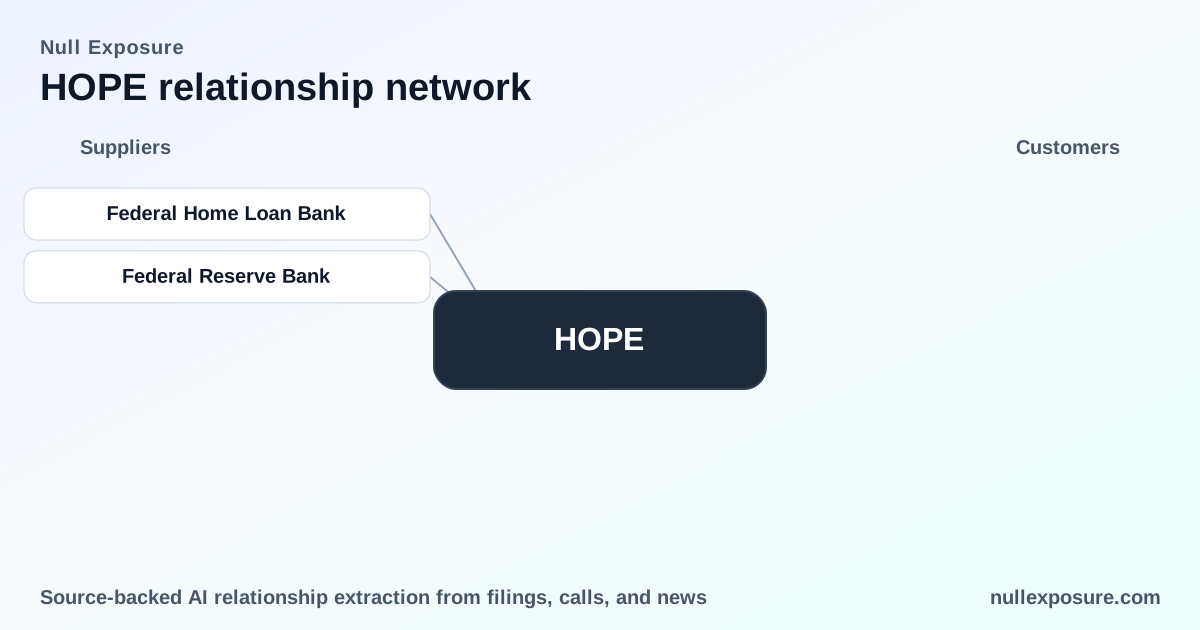
The dataset returned two explicit supplier/counterparty relationships in HOPE's FY2026 disclosures. Each is summarized below.
- Federal Home Loan Bank — Hope maintains an active line of credit with the FHLB of San Francisco and used FHLB advances as a routine source of wholesale funding; as of December 31, 2024 the company reported $100.0 million outstanding in FHLB borrowings, and FHLB advances are described as a primary supplemental funding source. According to Hope’s FY2026 financial results press release (Business Wire/FinancialContent, Jan 27, 2026) and related year‑end disclosures, the FHLB is a standing liquidity partner.
- Federal Reserve Bank — Hope used Federal Reserve Bank borrowings, including access to the Bank Term Funding Program (BTFP) in prior periods; as of December 31, 2024 the company reported $139.0 million outstanding from FRB borrowings, and average combined FHLB/FRB borrowings were roughly $532 million for 2024. The FY2026 press release notes these advances and documents the payoff of BTFP borrowings by year‑end (Business Wire/FinancialContent, Jan 27, 2026).
How the relationship details map to Hope’s operating model
The constraints extracted from Hope’s public materials explain the bank’s supplier posture as a set of corporate signals rather than isolated stats:
- Contracting posture — short-term dominant: The disclosures state that all borrowings at Dec. 31, 2024 had maturities under 12 months and the average remaining maturity of FHLB/FRB borrowings was measured in months (approximately two to three months). That indicates a deliberate operational choice to run liquidity via short-dated wholesale lines rather than long-term wholesale debt.
- Long-dated obligations nonetheless exist: The company also maintains longer-term lease commitments and issued convertible senior notes maturing in 2038, producing an important mismatch between short-term funding and some long-dated liabilities.
- Counterparty profile — government counterparties are central: 85.6% of the investment portfolio is in U.S. government agencies and GSE securities, and the company applies a zero credit‑loss assumption to those holdings; that creates high reliance on government-sponsored markets for both earnings and collateral.
- Criticality and maturity mix: Borrowings and the investment portfolio are material and in some cases labeled critical to operations — the firm explicitly links dividend capacity, capital planning, and routine operations to the Bank’s cash distributions and liquidity arrangements.
- Vendor role and operational concentration: The company treats third‑party service providers as service providers and implements vendor security and oversight programs; failures in those services are described as potentially material to operations.
- Lifecycle signals: Some relationships are active (ongoing FHLB/FRB lines), others are explicitly terminated or winding down — notably, the BTFP stopped extending new advances in March 2024 and outstanding BTFP borrowings were paid off by Dec. 31, 2024.
Where the risk and value converge
Hope’s structure creates a defined set of investment and counterparty considerations:
- Risk: Short-term wholesale funding raises rollover risk under stress, and a reliance on agency securities and regulatory capital flows places the company within a narrow spectrum of policy and market sensitivity. FDIC and state regulatory constraints on dividend flows further amplify the funding-coverage imperative.
- Value: The agency-heavy portfolio reduces expected credit losses and stabilizes NII (net interest income) modeling under base-case scenarios; institutional ownership (>90%) signals investor confidence in the strategy.
If you are assessing counterparty exposure or modeling HOPE’s funding stress scenarios, focus on three monitoring triggers: (1) changes in outstanding FHLB/FRB borrowings and their average maturity, (2) shifts in the proportion of agency securities in the investment portfolio, and (3) lease renewals or material changes in long-term contractual obligations.
Read more about portfolio and counterparty signals at https://nullexposure.com/.
Practical next steps for investors and vendors
- For risk teams: integrate short-term funding run‑rates and FHLB/FRB line availability into liquidity stress tests; track BTFP legacy exposures and any substitute facilities.
- For vendors and counterparties: prioritize contract terms that accommodate HOPE’s short funding cycles and periodic liquidity testing; maintain robust cybersecurity and operational readiness given the firm’s stated reliance on third-party providers.
- For M&A and credit analysts: monitor the pending merger with Territorial Bancorp for potential changes to branch leases, deposit composition, and wholesale funding needs (company disclosures cite merger-related professional fees in 2024).
Learn more about how to interpret counterparty relationships and balance sheet signals at https://nullexposure.com/.
Bottom line
Hope Bancorp runs a liquidity-first balance sheet that uses short-dated FHLB and FRB facilities alongside an agency-heavy securities portfolio to fund lending and dividend policy. That structure produces stable credit assumptions for the investment book but requires continued vigilance on wholesale funding rollovers, regulatory constraints on dividends, and third-party operational resilience. For investors and service providers evaluating HOPE as a partner, the firm’s public disclosures give a clear operating blueprint: short-term funding + agency collateral + targeted long-term obligations = a defined set of counterparty exposures to monitor.