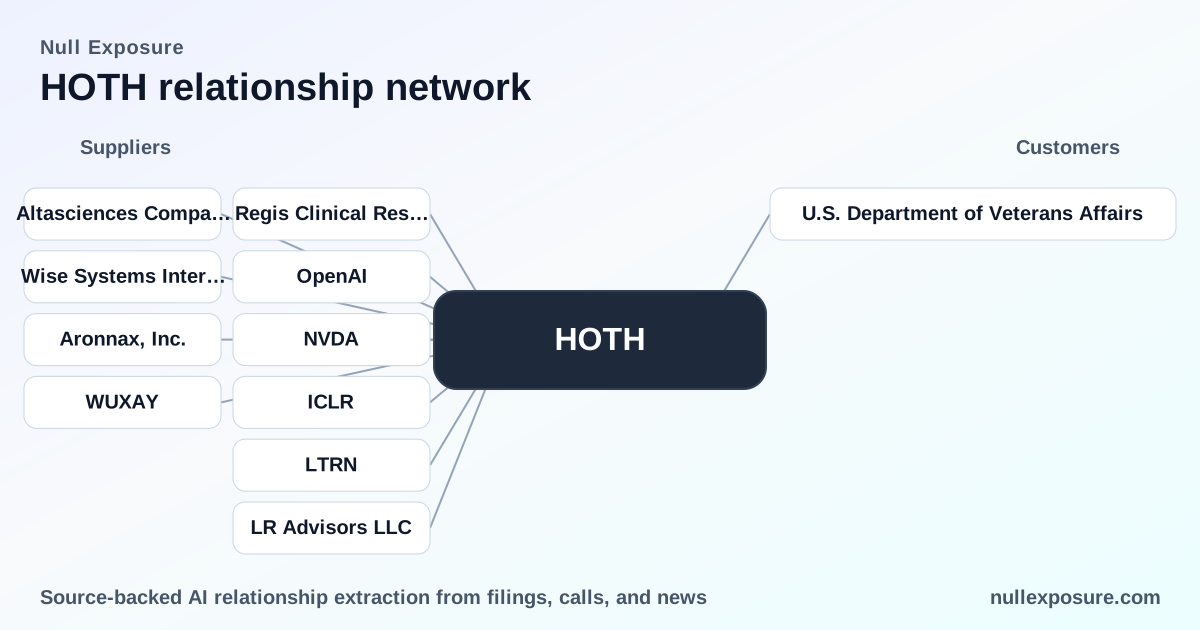
Hoth Therapeutics (HOTH) — supplier relationships and operational constraints that drive valuation
Hoth Therapeutics is a development-stage biopharma that advances dermatology and oncology programs through a licensing-and-collaboration model, outsourcing most R&D, clinical execution and manufacturing to third parties. The company monetizes future therapeutics via in‑licenses, milestone and royalty structures, and eventual commercialization partnerships, while today funding operations with equity raises and limited service agreements. For investors and operators, the key equity call is straightforward: value is driven by execution of outsourced development (CROs/CDMOs), patent licenses, and successful IND/clinical inflection points.
For a concise supplier-risk brief and ongoing signal tracking visit https://nullexposure.com/.
How Hoth runs the pipeline: contracting posture, concentration, and maturity
Hoth operates with a clear externalized operating model. The company consistently signs exclusive licenses (academic and government licensors) and master service agreements with CROs, CDMOs and AI partners rather than building internal scale. Financially the business is pre‑revenue with negative EBITDA and limited market capitalisation, so counterparty continuity and cost control are defining drivers of near‑term value.
- Contracting posture: an emphasis on licensing (royalty-bearing, exclusive) plus a mix of short-term operational leases and longer-term commercial instruments (e.g., warrants and ATM agreements).
- Concentration: single-sourced manufacturing is a material vulnerability; service delivery is heavily outsourced across clinical, regulatory, and analytics functions.
- Criticality and maturity: relationships with CROs/CDMOs and selected AI/computational partners are mission-critical for IND progression; the company is in active preclinical/early clinical stages where supplier performance directly controls timelines and cash burn.
These characteristics create a classic small‑cap biotech profile: high operational gearing to third parties and outsized sensitivity to supplier disruption or regulatory inspection.
What the regulatory and audit constraints say about counterparty risk
Hoth’s public filings and disclosures emphasize licensed IP positions (NC State, GW, VA) and explicit dependence on third parties for manufacturing and trial execution. The 2024 audited filing highlights material accounting issues tied to advance payments to CROs and the need to strengthen contract-review processes. Collectively this signals that counterparty governance and contract oversight are company-level priorities; investors should treat supplier oversight as a live risk factor rather than a background item.
For operational teams, prioritize contractual controls, audit rights, and continuity plans with CMOs/CROs given the company’s spend bands (frequent sub‑$100k engagements but material potential milestone exposure up to ~$30M if full development triggers occur).
Catalog of supplier relationships investors should track
- Regis Clinical Research — Hoth expanded its CLEER‑001 Phase 2a trial by adding Regis as a new enrolling site to address demand outpacing capacity at existing sites. Source: Bitget / Intellectia reporting on March 10, 2026.
- OpenAI — Hoth deployed the OpenAI API to support IND‑enabling development of HT‑KIT, using AI for preclinical data analysis, molecular modeling and regulatory document preparation to accelerate IND workflow. Source: Benzinga and PR Newswire, March 2026.
- NVIDIA (NVDA) — Acceptance into the NVIDIA Connect Program gives Hoth access to accelerated computing resources and technical guidance to strengthen AI research efforts; earlier, Hoth entered a joint development agreement leveraging Nvidia’s BioNeMo AI platform via Wise Systems. Sources: PR Newswire (NVIDIA Connect, FY2025) and PR Newswire (joint development with Wise Systems, FY2024).
- ICON Clinical Research (ICLR) — Hoth engaged ICON to expand HT‑001 enrollment into EU sites, intended to accelerate timelines and support future pivotal development. Source: Yahoo Finance coverage of Hoth shareholder communications, March 2026.
- Lantern Pharma (LTRN) — Hoth adopted Lantern’s PredictBBB.ai platform to accelerate blood–brain barrier permeability predictions, improving preclinical decision velocity across programs. Source: Yahoo Finance, March 2026.
- LR Advisors LLC — LR Advisors is listed repeatedly as Hoth’s investor relations contact for multiple clinical and preclinical announcements, supporting Hoth’s external communications. Source: PR Newswire press releases (FY2025–FY2026).
- Wise Systems International SRL — Hoth signed a joint development agreement with Wise Systems to leverage Nvidia’s BioNeMo for drug‑discovery efforts. Source: PR Newswire announcement, FY2024.
- Altasciences Company, Inc. — Altasciences conducted GLP‑standard studies for HT‑KIT that Hoth cites as meeting OECD/FDA/EMA bioanalytical benchmarks, a crucial preclinical validation step. Source: PR Newswire, FY2025.
- Aronnax, Inc. — Hoth entered a Master Services Agreement with Aronnax for support on HT‑KIT development, reflecting the company’s model of outsourcing specialized development tasks to niche service providers. Source: ContractPharma reporting (FY2026).
- WuXi AppTec (WUXAY) — Hoth discloses reliance on single‑sourced manufacturing with WuXi AppTec for HT‑KIT in its FY2024 10‑K, making this supplier a strategic manufacturing dependency. Source: Hoth 10‑K (filed for period ending December 31, 2024).
Investment implications — where supplier signals change the thesis
Hoth’s equity value is a function of timely clinical progress and intact supplier execution. Single‑sourced manufacturing with WuXi is an explicit concentration risk that can delay IND timing or force costly tech transfers. The company’s financial profile (negative EBITDA, market cap roughly $16M, no revenue TTM) means supplier interruptions would have immediate valuation impact. Conversely, the deployment of advanced computational partners (OpenAI, Nvidia, Lantern) is a positive optionality signal: it shortens analytical cycles and reduces time-to-IND if integrated effectively.
For active investors, track: trial enrollment velocity (sites like Regis and ICON), GLP/CMC validation (Altasciences), and contract terms with WuXi/Aronnax that affect delivery milestones. For operators, enforce audit rights, change‑control clauses, and contingency suppliers where possible.
Explore supplier risk dashboards and counterparty monitoring at https://nullexposure.com/ — structured tracking materially improves signal-to-noise for small caps.
Actionable next steps for investors and operators
- For investors: prioritize milestones tied to third‑party deliverables (GLP reports, IND filings, site activations) and monitor any public changes to WuXi, Aronnax, Altasciences, ICON and CRO performance.
- For operators: strengthen contract oversight, require explicit deliverable dates, and negotiate audit/inspection access with CDMOs/CROs to de‑risk the single‑source exposure.
- For strategic partners: evaluate where computational platforms (OpenAI, Nvidia, Lantern) can compress development timelines and reduce incremental spend.
For a tailored supplier risk briefing or to subscribe to ongoing counterparty monitoring, visit https://nullexposure.com/.