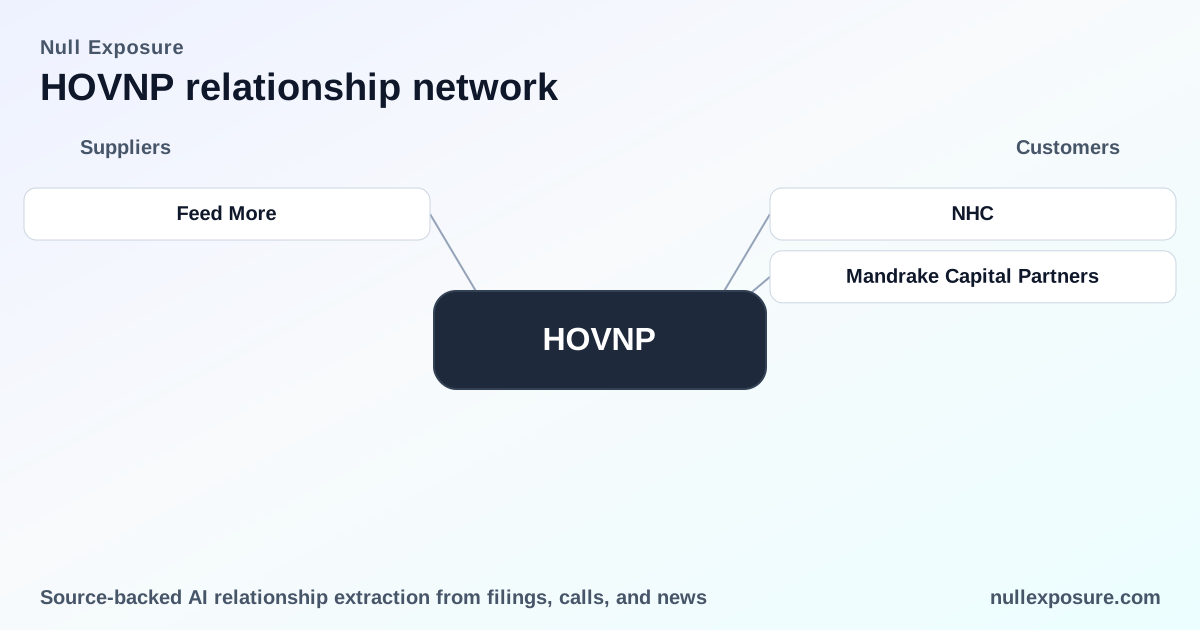
HOVNP supplier intelligence: how K. Hovnanian’s vendor posture shapes risk and opportunity
Hovnanian Enterprises (HOVNP) builds and sells residential homes across the United States and monetizes primarily through home sales, strategic land acquisitions and development, and financial services around mortgage origination and short-term warehousing. The company combines large, cyclical capital commitments (land and debt) with a predominantly subcontracted construction model—holding significant exposure to supplier performance, short-duration fixed-price trades, and concentrated construction cost lines that drive margin. For investors and operator partners, the key decision is whether Hovnanian’s procurement posture and liquidity profile reduce or amplify execution risk during a housing cycle.
Discover more supplier-level intelligence at https://nullexposure.com/.
How Hovnanian actually contracts and pays suppliers
Hovnanian runs a dual contracting model that shapes supplier relationships:
- Short-duration, fixed-price construction contracts with subcontractors and material suppliers (typically 3–12 months or defined by a number of homes). This structure enforces price discipline but transfers execution risk to subcontractors and upward cost pressure back to Hovnanian if availability or quality issues arise.
- Framework and national purchasing arrangements for selected vendors that lower unit costs and centralize procurement, increasing negotiating leverage with strategic suppliers.
- Large-scale, long-term financial commitments (senior notes and a secured credit facility) that create a required liquidity profile and influence payment flexibility.
These patterns are visible in the company filings through October 31, 2025, which document both significant long-term debt issuances and a parallel set of short-term mortgage warehouse and repurchase facilities used in its mortgage operations.
What that means in practice
- Contracting posture: Procurement relies on many short-term fixed-price agreements for construction work, while strategic vendors operate under national purchasing contracts—so supplier bargaining power is concentrated in standardized categories, but day-to-day build execution is outsourced. Company filings show fixed-price subcontract arrangements and national purchasing contracts as operational levers.
- Concentration and criticality: Construction costs represent a majority of homebuilding cost of sales—about 51% in fiscal 2025—making supplier performance and material price moves directly material to margins.
- Maturity profile: Hovnanian carries both maturing long-term debt (recent private placements for 2031 and 2033 notes) and numerous short-term borrowings (mortgage repurchase lines that reprice frequently), which together define liquidity rhythms that suppliers will feel through payment timing and contract renewals.
Operational constraints investors should model
Key company-level signals extracted from filings and disclosures:
- Long-term financial obligations are substantial. Hovnanian completed private placements in 2025 totaling $900 million of senior notes and has a secured revolving facility that matures mid-decade; debt service is a structural constraint on procurement flexibility (company filings, Sept–Oct 2025).
- Short-term financing and warehouse lines are operational levers. Multiple mortgage repurchase agreements and short-term borrowing facilities (maturities through 2026) create quickly changing liquidity needs that can compress vendor payment cycles (company filings, FY2025).
- Framework agreements exist for scale purchasing. The company reduced vendor counts and executed national purchasing contracts to lower construction and administrative costs, showing an intent to centralize strategic spend and reduce supplier fragmentation (company disclosures).
- Geography is U.S.-centric and exposed to regional events. The supply base and sales footprint are national across U.S. regions; natural disasters and local utility delays have historically impacted production in California, Texas and Florida (FY2025 filings).
- Supplier roles are primarily service providers. Hovnanian depends on subcontractors for core construction work and third-party actuaries and auditors for advisory and governance functions (company filings).
- Materiality is high. Construction cost exposure and insurance/warranty liabilities are material to the P&L and balance sheet, and the company flags potential material adverse outcomes from insurance gaps or subcontractor failures (FY2025 disclosures).
These constraints are company-level signals and should be used to assess counterparty risk and working-capital exposure across the supplier base.
Discover vendor-level risk scoring and peer comparisons at https://nullexposure.com/.
Counterparty snapshot — every relationship in the record
Feed More — The 6-acre former Feed More headquarters at 1415–1603 Rhoadmiller Street sold to developer K. Hovnanian for $13 million, reflecting a property acquisition within Hovnanian’s land/asset strategy. (Richmond BizSense, May 6, 2025 — https://richmondbizsense.com/2025/05/06/developer-drops-13m-for-former-feed-more-hq-near-the-diamond/)
Note: the provided record set contains a single news-sentiment entry (Feed More). Other supplier and financing relationships discussed in this analysis are drawn from Hovnanian’s public filings through October 31, 2025 and related disclosures.
Risk and value implications for investors and operator partners
- Execution risk is concentrated in subcontracted labor and materials. Short-term fixed-price contracts limit cost pass-through but increase the chance of schedule slippage and warranty exposure if subcontractors fail to deliver; the company carries owner-controlled insurance and third-party actuaries to manage these exposures (FY2025 filings).
- Liquidity management drives supplier negotiation power. Large land purchases ($859.4 million in fiscal 2025) and significant debt outstanding mean procurement decisions are constrained by the need to service debt and maintain covenant compliance; the company’s mix of long-term notes and short-term repurchase facilities creates a persistent funding cadence that influences payment timing and retention practices.
- Insurance and warranty exposure is a notable operational lever. Hovnanian’s owner-controlled insurance program shifts some underwriting and premium flows through the company, reducing supplier insurance availability issues but concentrating risk on the balance sheet.
- Geographic and regulatory shocks matter. Local utility delays, natural disasters and potential government scrutiny over subcontractor labor practices are explicitly cited as sources of operational disruption in company disclosures.
Bold takeaway: Hovnanian trades margin volatility for balance-sheet scale—investors should underwrite supplier performance risk and monitor liquidity windows that could compress vendor terms.
Tactical takeaways for sourcing and investment diligence
- Require evidence of subcontractor capacity and insurance when underwriting new communities; owner-controlled insurance helps but does not eliminate execution risk.
- Model covenant and cash-flow timing across both long-term debt maturities and short-term warehouse lines to understand when procurement flexibility will tighten.
- Prioritize counterparties within national purchasing frameworks that deliver price and service reliability; treat ad hoc local subcontractor panels as higher risk for warranty and completion exposure.
For prioritized supplier mapping and exposure modeling, visit https://nullexposure.com/.
Conclusion — Hovnanian’s supplier architecture is a two-speed system: strategic, centralized purchasing for cost control and high-frequency, short-term subcontracting for delivery. That combination supports scale but concentrates operational risk in subcontractor performance and in the company’s liquidity profile. For investors and operator partners, the opportunity is to exploit negotiated national contracts and land inventory upside while actively underwriting short-term execution and financing timing risk.