New Horizon Aircraft (HOVRW): supplier map and what it means for investors
New Horizon Aircraft builds the Cavorite X7 hybrid-electric VTOL and monetizes through aircraft sales, certification-driven services, and anticipated regional air mobility operations once type certification and manufacturing scale are achieved. The company sources critical propulsion, energy and certification capabilities from a mix of specialized manufacturers, university research programs and service providers; these relationships shape both its technical trajectory and near-term execution risk. For investors, the supplier picture is a direct proxy for technical readiness, certification pathway, and concentration risk. Learn more about supplier intelligence at https://nullexposure.com/.
Quick read: what the company does and how suppliers fit into monetization
New Horizon is a product-led aerospace developer: commercialization depends on converting engineering work into certified aircraft that can be sold or operated under regulated services. Revenue will come from aircraft deliveries and ancillary certification and operational services once regulatory approvals and manufacturing scale are in place. Suppliers supply the enabling hardware (motors, propellers, batteries, power electronics), testing and certification expertise, and coatings and sensors that determine whether Horizon hits performance, safety and noise targets required for commercial deployments.
The supplier relationships that matter today
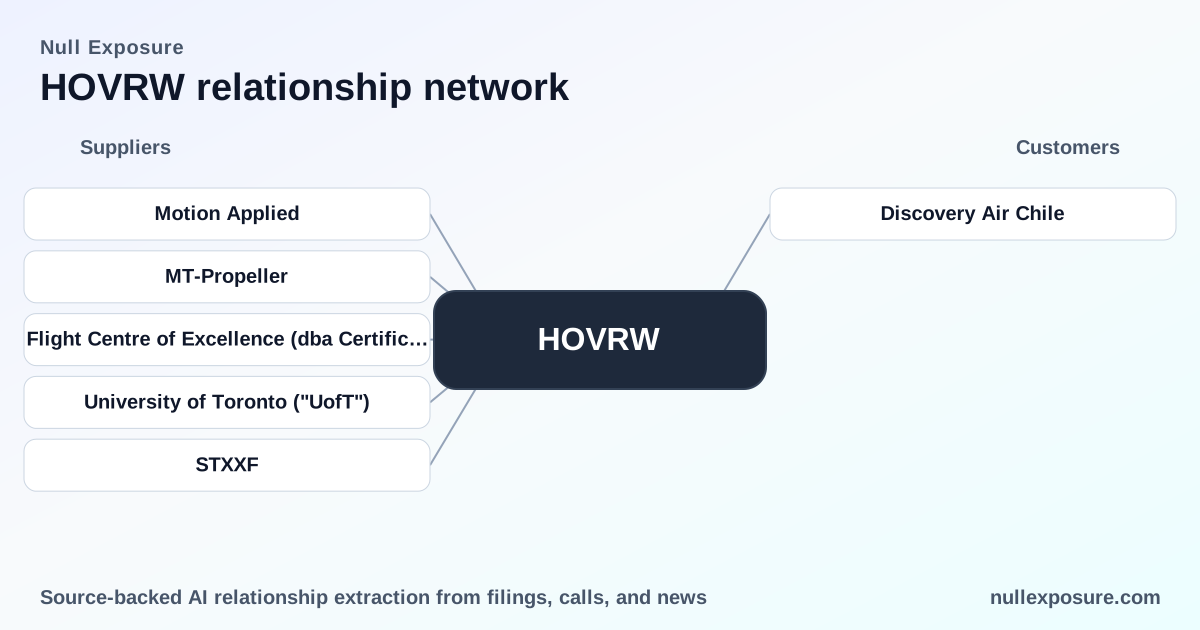
Below are the supplier and partner relationships surfaced in public reporting and press coverage. Each is summarized in plain English with a source citation.
Motion Applied — power electronics for lift
Motion Applied will design and manufacture a customized motor drive inverter for Horizon’s hybrid-electric VTOL, the Cavorite X7, to increase power efficiency and reduce weight for the aircraft’s vertical lift system. This is a supplier partnership focused on critical propulsion electronics. (Press release coverage, March 2026 — https://www.news-journalonline.com/press-release/story/15110/horizon-aircraft-partners-with-motion-applied-to-advance-hybrid-evtols-power-system/)
MT-Propeller — composite propeller integration
MT-Propeller will supply advanced composite propellers integrated into Horizon’s hybrid turbine system to improve speed, operational efficiency and reduce noise. This is a hardware integration relationship with direct performance and noise-abatement implications for the Cavorite X7. (Airport-Technology report, March 2026 — https://www.airport-technology.com/news/horizon-aircraft-mt-propeller-hybrid-evtol/)
Flight Centre of Excellence (Certification Center Canada / 3C) — certification and testing services
Horizon has engaged 3C to support a grant-backed program focused on all-weather eVTOL development; 3C will support testing and analysis in the project’s second phase. Horizon has paid 3C nominally to date (documented at $60), indicating an active, low-dollar certification services engagement to date. (Grant announcement coverage, March 2026 — https://www.naplesnews.com/press-release/story/66128/horizon-aircraft-awarded-insat-grant-to-help-fund-105-million-all-weather-evtol-project/; company filing evidence of $60 spend)
University of Toronto — ice detection and protective coatings R&D
The University of Toronto is responsible for early-phase characterization of advanced ice detection technologies and protective coatings such as ice-phobic and electrothermal solutions that will be evaluated on the Cavorite X7. This is an applied research collaboration that feeds the certification and safety case. (Grant announcement coverage, March 2026 — https://www.naplesnews.com/press-release/story/66128/horizon-aircraft-awarded-insat-grant-to-help-fund-105-million-all-weather-evtol-project/)
Strix (STXXF) — INSAT program funding partner
Strix, the non-profit administrator for the INSAT program in Canada, is an institutional backer of the grant program supporting Horizon’s all-weather eVTOL project; Strix’s CEO framed the funding as part of Canada’s competitiveness push. This is a program-level funding and ecosystem relationship rather than a component supplier. (Grant announcement coverage, March 2026 — https://www.naplesnews.com/press-release/story/66128/horizon-aircraft-awarded-insat-grant-to-help-fund-105-million-all-weather-evtol-project/)
What the constraint signals reveal about operating posture
The public disclosures surface a consistent set of operational characteristics that are impactful for counterparty risk and valuation.
- Contracting posture is mixed: Horizon uses both short-term instruments (one-year convertible promissory notes and short-term leases) and longer-term arrangements (contracts and operating leases that can extend), indicating a pragmatic, stage-dependent supplier contracting approach rather than a single long-term supplier lock-in.
- Concentration and single-source risk are embedded: Horizon explicitly relies on third parties for key enabling technologies (batteries, power electronics, electric motors), and states some supplier relationships could be single or limited source. That elevates supply concentration risk and execution exposure to supplier delivery timelines.
- Supplier roles straddle services and manufacturing: The company engages vendors as both service providers (testing, certification, professional services) and manufacturers (propulsion, propellers, hardware). This dual posture increases dependence on external partners for both R&D and production ramp.
- Materiality and criticality are both high: Multiple excerpts characterize supplier failures or certification delays as having a material adverse effect on business outcomes; supplier delivery and component performance are central to product viability.
- Geography and scale are Canada-centric today: Headquarters and primary operations are in Ontario with a small headcount outside Canada, meaning regulatory and supply chain decisions will be anchored in North American certification regimes and logistics.
- Maturity and stage are early but active: Relationships are predominantly active or in ramping/testing phases, with some short-term engagements and at least one documented termination. The company is still in the development and pre-commercialization window.
For deeper sourcing intelligence and to track these dynamics in real time, visit https://nullexposure.com/.
Investment implications — what investors should price in
- Execution risk dominates near-term valuation: The path to revenue is gated by certification, serial production and supplier scale-up. Hardware partners like Motion Applied and MT-Propeller directly influence performance metrics that regulators and customers will evaluate.
- Grant and government linkage reduces some cash burn pressure: Grant support and program participation (INSAT/Strix) provide non-dilutive funding and third-party validation of the technical program, but do not eliminate the need for capital to scale manufacturing.
- Supplier concentration creates event risk: Single-source components for batteries, power electronics or motors create binary outcomes—successful integration accelerates commercialization; supplier failure delays launch and increases capital needs.
- Small-dollar service engagements coexist with higher-cost manufacturing relationships: The company documents low-dollar certification engagements (3C at $60) alongside higher audit and professional fee bands; this indicates a cost structure that is a mix of modest professional services today and scaling capital requirements in manufacturing later.
Practical next steps for operators and investors
- Prioritize verification of supplier timelines for battery cells, power electronics, and motor drives; these are explicit gating items for range, payload and certification.
- Monitor certification milestones with 3C and Transport Canada filings to track regulatory progress that unlocks commercialization.
- Validate redundancy plans for single-source components and look for supplier diversification or captive manufacturing steps as maturity increases.
For ongoing supplier surveillance and bespoke counterparty risk reports, visit https://nullexposure.com/ to commission an exposure readout.
Bottom line
New Horizon’s supplier set combines specialized hardware suppliers (Motion Applied, MT-Propeller), academic R&D (University of Toronto) and certification partners (3C), backed at the program level by Strix/INSAT funding. These relationships collectively determine whether Cavorite X7 transitions from prototype to certified, manufacturable product, and they represent the primary execution levers investors must monitor. For tailored, transaction-ready supplier intelligence and monitoring for aerospace counterparties, start here: https://nullexposure.com/.