Helport AI (HPAI): Supplier relationships, operating posture, and what investors should price in
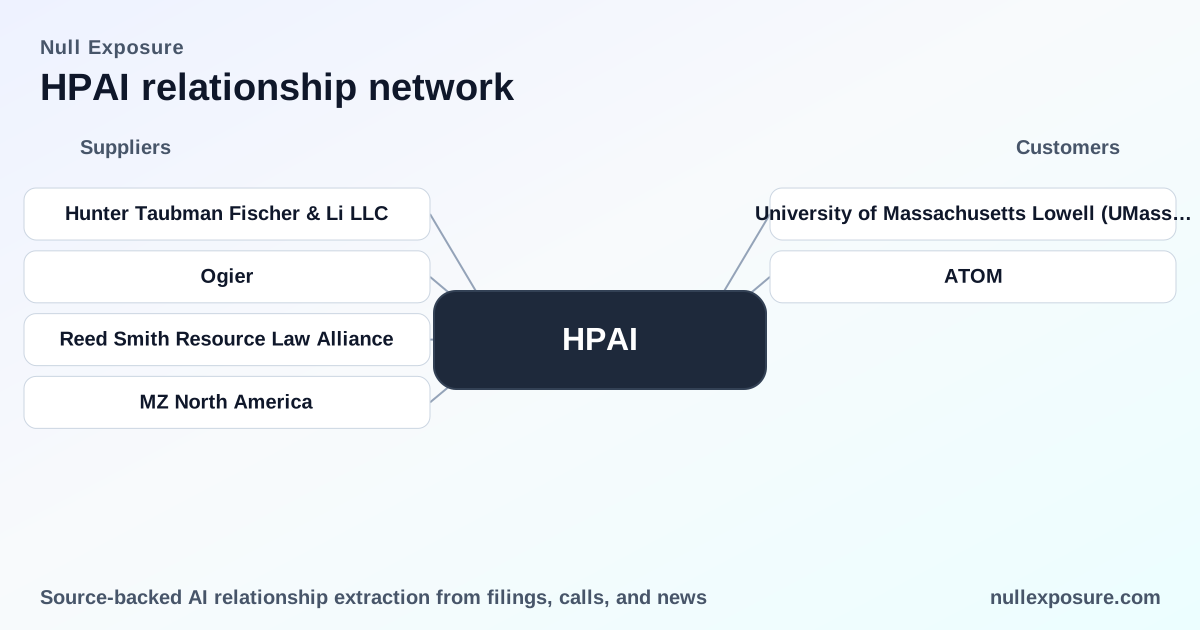
Helport AI monetizes by selling AI-driven logistics software and enterprise services that optimize supply-chain operations, collecting recurring revenue through platform licensing and professional services while leveraging capital markets access for growth. The company’s supplier footprint is concentrated around legal advisors and investor-relations support—relationships that were instrumental in its public listing and ongoing market communications—and these vendor linkages have direct governance and capital-raising implications for investors.
For an institutional primer on counterparty and supplier risk for small-cap technology issuers, see https://nullexposure.com/ for structured supplier intelligence.
Why these supplier relationships matter for valuation and governance
Helport operates as a technology-enabled logistics software firm with modest profitability (profit margin ~5.33%) and recurring revenue dynamics (Revenue TTM ≈ $34.9M). Its supplier relationships are not operational inputs like cloud compute or data feeds; they are service providers that influence legal compliance, transaction execution, and market access—functions that affect financing cost, regulatory exposure, and shareholder communications. The company’s public-market history shows active use of external counsel for transaction work and an outsourced investor-relations partner for market messaging, both of which are material for investors assessing execution risk ahead of scaling.
Visit https://nullexposure.com/ to read deeper supplier profiles and transactional flow analysis.
The supplier roster investors need on their checklist
Hunter Taubman Fischer & Li LLC
Hunter Taubman Fischer & Li LLC acted as a legal advisor to Helport in connection with its business combination and Nasdaq listing. A FinancialContent report covering the closing of the transaction (August 2024 / FY2024) lists the firm among Helport’s legal advisors.
Ogier
Ogier served as one of the law firms advising Helport on the business combination that concluded with the company’s Nasdaq listing. The same August 2024 FinancialContent coverage names Ogier in the legal advisory lineup for FY2024.
Reed Smith Resource Law Alliance
Reed Smith Resource Law Alliance is identified as a legal advisor on Helport’s transaction work tied to its public listing; the August 2024 FinancialContent announcement lists Reed Smith alongside the other counsel engaged for the closing in FY2024.
MZ North America
MZ North America is Helport’s external investor-relations contact and is quoted in company press releases during FY2025, including a GlobeNewswire release announcing a Thailand office (November 21, 2025) and a Yahoo Finance release regarding product launches in FY2025; these filings list MZ North America and an executive contact for investor relations.
What the supplier mix signals about operating constraints and posture
-
Contracting posture: Helport’s supplier mix for material public disclosures and transactional work is oriented toward specialized professional services rather than commodity suppliers. Engagement of multiple law firms for the business combination signals a structured, multi-jurisdictional contracting posture during the listing process. This is a company-level signal, not tied to any single ongoing operational provider.
-
Concentration and control: Insiders control ~79% of shares while institutions hold under 3%, which is a high insider concentration that influences bargaining power and vendor selection. High insider ownership reduces the effective pressure from institutional shareholders on supplier renewals and governance, making supplier relationships more a matter of executive decision than market discipline.
-
Criticality: The identified suppliers—legal advisors and investor-relations counsel—are highly critical for capital markets access and compliance but are not direct revenue-generating vendors. Loss or poor performance from these partners increases transaction, compliance, and reputational risk, which can translate into higher cost of capital or disclosures that depress valuation.
-
Maturity: Public listing activity in FY2024 and follow-on media/IR engagement in FY2025 indicate a company in the early public-maturity stage: revenue scale is moderate (TTM ~$34.9M) with growth signals (quarterly revenue growth YOY +22.4%) but uneven earnings (quarterly earnings growth YOY -38.9%). Vendor choices reflect that stage—outsourced IR and retained counsel as opposed to in-house investor relations or an established, diversified supplier base.
(Company-level figures cited from Helport AI public profile and FY2025/FY2024 disclosures.)
For targeted supplier risk maps and counterparty concentration modeling, check https://nullexposure.com/ for tailored reports.
Investment implications: risk checklist and what to validate in diligence
-
Governance and disclosure risk: Given the heavy insider ownership, investors must validate the independence and contractual terms of legal advisors used during the business combination and any ongoing retainer arrangements that could influence litigation risk or disclosure quality.
-
Market access dependence: Outsourced investor relations through MZ North America means Helport’s market messaging and capital-raising effectiveness are dependent on an external vendor; confirm engagement length, deliverables, and contingency plans if IR support changes.
-
Cost structure and margins: Helport’s operating margin (~1.93%) and EV/EBITDA (~14.7) reflect early-stage margin pressure; understand how much professional services (legal, advisory, IR) contribute to SG&A and how scalable those costs are as revenue grows.
-
Valuation sensitivity: Trading metrics (P/E ~53.8; Price-to-Sales ~2.89) price in growth—validate revenue recurrence, client concentration in the customer base, and that supplier arrangements do not inject hidden liabilities that would impair cash flow.
-
Transaction and compliance exposures: The multiple law firms engaged for the listing indicate cross-border work and regulatory complexity; investors should confirm there are no outstanding contingent liabilities tied to the transaction counsel’s scope.
Bottom line and recommended next steps
Helport AI is a small-cap, publicly traded logistics-AI company that relies on specialist legal counsel and outsourced investor relations to manage its capital-market lifecycle and public messaging. The supplier set is concentrated and governance-critical rather than operationally diverse, which elevates counterparty risk in the areas that matter most to investors: compliance, disclosure, and capital access.
For operational due diligence, secure copies of the engagement letters for the listed legal advisors and the MZ North America IR agreement, quantify the annual spend against SG&A, and validate any change-of-control or success-fee provisions tied to past transactions.
If you want supplier-level evidence, contractual signals, and a prioritized risk remediation plan for HPAI, start with a supplier-risk briefing at https://nullexposure.com/.
Final action: review legal engagement terms, confirm IR contract duration, and map professional-services spend to cash runway—then reassess valuation assumptions in light of these supplier risks. Explore bespoke counterparty assessments at https://nullexposure.com/ for next-step reporting and monitoring.