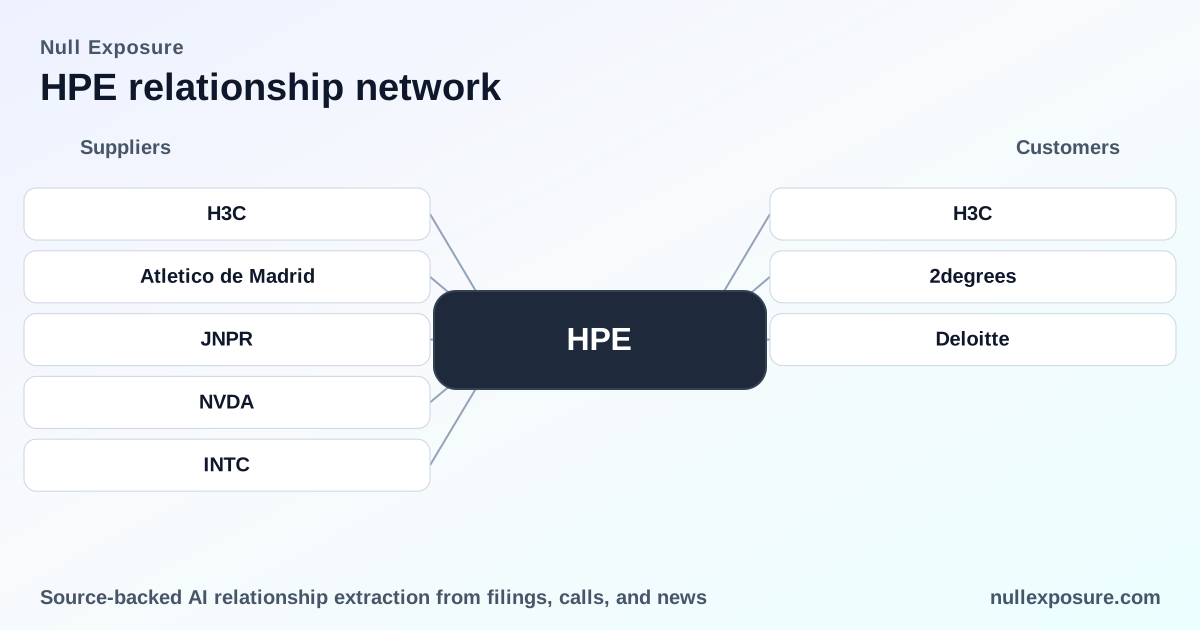
Hewlett Packard Enterprise (HPE) — supplier relationships, risks, and strategic implications
Hewlett Packard Enterprise operates as an enterprise IT vendor that monetizes through a mix of hardware sales (servers, storage, networking), software and subscription services, and managed/consulting services; large enterprise deals and strategic OEM and component supplier relationships drive both topline and gross-margin variability (Revenue TTM: $35.7B; Market Cap: $29.0B). This note unpacks the supplier and partner mentions visible in public filings and news through FY2025–FY2026 and explains the practical implications for investors and operators evaluating HPE as a counterparty or a customer. For a consolidated view of supplier intelligence, visit https://nullexposure.com/.
How HPE buys, contracts, and manages supplier risk — the operating model in plain terms
HPE’s supply posture mixes long-term strategic commitments and short-term tactical arrangements. The company publicly discloses multi-year credit and term loan facilities, multi-year purchase and lease commitments, and routine 90–120 day procurement cycles. The result is a dual exposure:
- Contracting posture: a blend of long-term binding purchase commitments and shorter, rolling procurement (blanket/scheduled orders), which supports inventory buffering but limits nimbleness in falling-cost environments.
- Concentration and criticality: HPE depends on single-source industry suppliers for key components (notably x86 CPUs and GPUs), which creates systemic exposure shared across peers; HPE classifies many suppliers as critical to operations.
- Geographic and operational footprint: sourcing and manufacturing are global, increasing currency, trade, and geopolitical risk, while also providing diversified manufacturing capacity.
- Maturity and scale of commitments: large unconditional purchase obligations and lease liabilities reflect institutionalized supplier relationships and sizable spend bands, including multiple >$100M relationships.
These company-level characteristics shape counterparty negotiation leverage, inventory practices, and the operational resilience investors should model. Learn more about supplier risk mapping at https://nullexposure.com/.
Supplier relationships and recent public mentions (each entry from filings and news)
H3C — FY2025 (10‑K)
HPE disclosed $65 million of purchases from H3C in FY2025, reflecting a bilateral commercial arrangement where HPE both buys from and sells to H3C in material but not dominant volumes. This figure is taken from HPE’s FY2025 Form 10‑K filing (filed 2026).
Atletico de Madrid — FY2026 (news)
A SimplyWall.St piece (Mar 2026) reported that HPE is supplying AI‑driven networking solutions for Atlético de Madrid’s Riyadh Air Metropolitano Stadium digital transformation, highlighting HPE’s go‑to‑market push into venue and enterprise digitalization.
Juniper Networks — FY2026 (SahmCapital article)
SahmCapital (Mar 3, 2026) covered HPE’s expanded integration of Juniper Networks technology across HPE’s networking portfolio, signaling deeper product-level coupling following HPE’s strategic moves in networking.
Juniper Networks Inc. — FY2026 (SiliconANGLE, Feb 24, 2026)
SiliconANGLE reported (Feb 24, 2026) that HPE’s service‑provider strategy builds on Juniper integration to help operators virtualize and modernize networks for AI services, positioning HPE as a single-vendor proposition for telcos.
Juniper Networks — FY2026 (SahmCapital analysis, Feb 25, 2026)
An additional SahmCapital article (Feb 25, 2026) emphasized HPE’s unveiling of AI‑native networking and compute solutions that extend Juniper integration from core to edge, underlining product bundling with Intel Xeon 6 servers and Cloud Ops automation.
Nvidia — FY2026 (FinancialContent analysis)
A FinancialContent report (Mar 2026) identified backlog conversion tied to accelerated AI server shipments as GPU supply constraints from Nvidia eased, meaning HPE’s near-term server revenue is sensitive to GPU availability shifts.
Intel — FY2026 (SiliconANGLE, Feb 24, 2026)
SiliconANGLE (Feb 24, 2026) noted HPE’s systems are powered by Intel Xeon 6 processors for virtualized RAN boosts and built-in security, reflecting Intel’s role as a core CPU supplier in HPE’s AI and telco offers.
Juniper Networks — FY2026 (SimplyWall.St)
A SimplyWall.St article (Mar 2026) reiterated the extension of Juniper technology across HPE’s networking portfolio, reaffirming market commentary about tighter product-level integration.
NVIDIA — FY2026 (CFO.com)
CFO.com (Mar 2026) quoted HPE executives on working with NVIDIA to build internal models and Private Cloud AI, signaling co‑development and validation of NVIDIA‑powered AI offerings inside HPE’s finance and operations functions.
NVIDIA — FY2026 (InsiderMonkey / Wells Fargo note)
Coverage relayed by InsiderMonkey (Mar 2026) described HPE Private Cloud AI co‑developed with NVIDIA and its application to operator automation (example: 2degrees), illustrating sales references and joint solution positioning.
Juniper Networks — FY2026 (SimplyWall.St separate mention)
A further SimplyWall.St note (Mar 2026) discussed HPE’s Juniper‑powered AI networking push aimed at telcos and enterprises seeking consolidation and lower operating costs.
Intel — FY2026 (SimplyWall.St)
SimplyWall.St (Mar 2026) again flagged HPE’s use of Intel Xeon 6‑based servers in its AI‑native networking and compute portfolio, reinforcing Intel’s supplier role.
Intel — FY2026 (SahmCapital)
SahmCapital (Feb 25, 2026) covered the same product launch and Intel integration, underscoring multi‑source corroboration of Intel’s role in HPE’s new offers.
NVIDIA — FY2026 (Finviz / Wells Fargo reporting)
Finviz (Mar 2026) and related coverage cited Wells Fargo commentary that HPE’s Private Cloud AI with NVIDIA is enabling operator automation use cases, reinforcing the NVIDIA co‑development narrative.
What this collection of relationships means for investors and operators
- Spend scale and concentration: HPE’s public disclosures and news coverage show multiple supplier relationships in the >$100M band (M&A and large purchase commitments) and meaningful dependencies on Intel and NVIDIA for processors and accelerators; this is a structural concentration investors must model into scenario analysis.
- Strategic integration vs. supplier risk: The Juniper integration illustrates HPE consolidating stacks into a single‑vendor pitch for service providers, which increases solution stickiness but also raises supplier/partner execution risk if integration or supply fails.
- Contracting tradeoffs: HPE’s mix of long‑term purchase commitments and short rolling orders preserves supply priority but can lock in prices and inventory in volatile component markets.
- Operational criticality: HPE classifies several suppliers as critical, and single‑source components create industry‑wide vulnerability that impacts HPE in line with competitors (e.g., GPU shortages).
Key takeaway: HPE’s supplier landscape supports an aggressive AI and networking go‑to‑market strategy with important operational levers and counterparty exposures tied to Intel, NVIDIA, and Juniper integration. Risk is manageable but concentrated; investors should stress‑test GPU/CPU supply scenarios and contract rollover timelines.
For a structured supplier risk scorecard and monitoring playbook, explore https://nullexposure.com/. If you want a bespoke brief that maps HPE’s supplier exposures to your investment thesis, contact us through https://nullexposure.com/ for a tailored report.
Actionable recommendation: model at least two downside scenarios (GPU constraint and a material Intel CPU pricing shock) and one upside scenario driven by accelerated Juniper‑powered telco adoption; allocate probability weight accordingly when valuing HPE enterprise deals and backlog conversion assumptions.