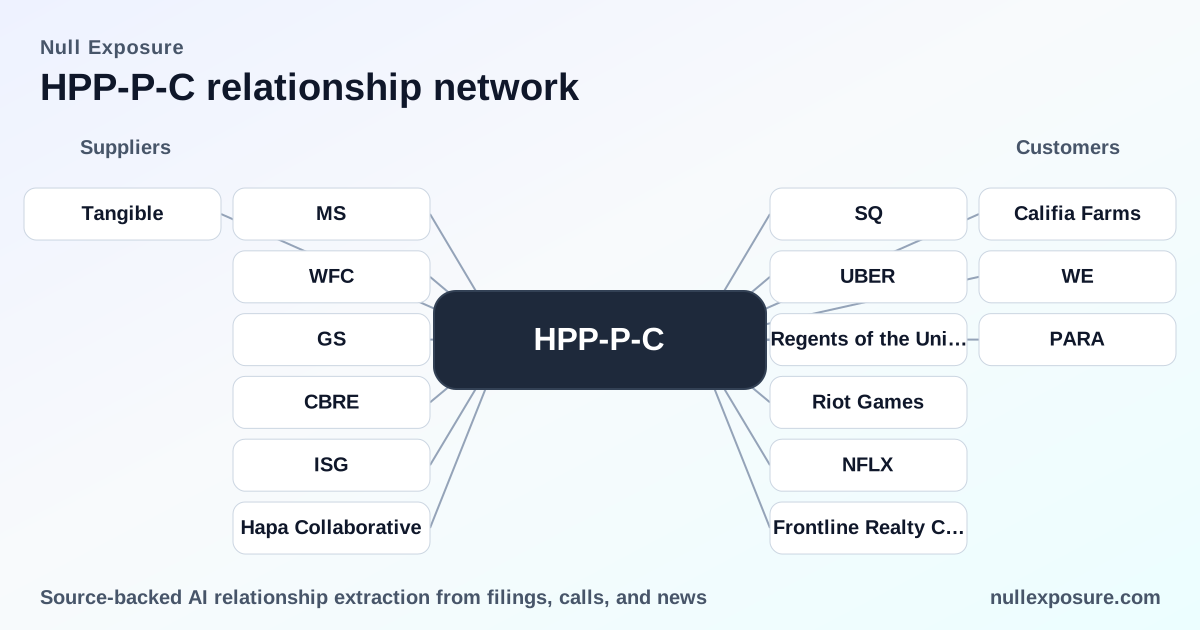
Hudson Pacific Properties (HPP-P-C): Supplier relationships that shape capital and operations
Hudson Pacific Properties (HPP-P-C) operates as a REIT concentrated on high-quality West Coast office and studio real estate, monetizing through long-term leasing, development fees, and property management revenues tied to tech and media tenants in San Francisco and Los Angeles. The preferred stock ticker represents capital claims on a portfolio driven by lease stability and studio demand, while supplier relationships — lenders, construction contractors, professional services and local designers — directly influence execution, cost of capital, and tenant experience.
Explore how these supplier links affect underwriting and counterparty risk at scale: https://nullexposure.com/
What the supplier map tells an investor about HPP-P-C’s operating posture
Hudson Pacific’s supplier footprint in the reporting set shows a dual focus on capital markets relationships and outsourced real estate services. Large banks (Goldman Sachs, Morgan Stanley, Wells Fargo) serve as financing and underwriting partners for major asset-level financings, which implies institutional access to capital and reliance on syndicated credit structures. CBRE is presented as a strategic, exclusive provider for certain services, indicating outsourcing of critical property-level functions to a single global servicer, which concentrates operational dependency but leverages CBRE’s scale and capabilities.
Construction and local design relationships (ISG; Hapa Collaborative; Tangible) reveal project-level execution exposure: large development contractors and boutique designers both influence delivery risk, capex timing, and tenant-facing amenities. No supplier constraints were flagged in the available relationship records, which at the company level signals no documented supplier governance restrictions in the reviewed sources, but investors should still model counterparty concentration and execution friction into downside scenarios.
Explore supplier risk and counterparty profiles for underwriting decisions: https://nullexposure.com/
Who HPP-P-C is working with (concise, relationship-by-relationship)
Goldman Sachs
Goldman Sachs led a five-year financing for a Hudson Pacific office CMB issuance, acting as lead underwriter and bookrunner alongside other banks; this transaction highlights Goldman’s role as a primary capital markets counterparty for significant financings. — Commercial Observer, March 2025 (https://commercialobserver.com/2025/03/hudson-pacific-cmbs-riot-games-office-financing/)
Morgan Stanley
Morgan Stanley participated as a co-lead and joint bookrunner on the same five-year financing, reflecting syndication use and shared underwriting risk across major investment banks. — Commercial Observer, March 2025 (https://commercialobserver.com/2025/03/hudson-pacific-cmbs-riot-games-office-financing/)
Wells Fargo
Wells Fargo also served as a co-lead and joint bookrunner on the financing, indicating that Hudson Pacific taps a mix of global and commercial bank capacity when structuring multi‑party debt placements. — Commercial Observer, March 2025 (https://commercialobserver.com/2025/03/hudson-pacific-cmbs-riot-games-office-financing/)
CBRE
CBRE will work with Hudson Pacific as a strategic partner and exclusive provider of certain real estate services, establishing a primary outsourcing relationship for leasing, property management or transaction services that are critical to tenant retention and operational efficiency. — REIT.com (Hudson Pacific launches DEI-focused impact fund, FY2022) (https://www.reit.com/news/articles/-hudson-pacific-launches-dei-focused-impact-fund)
ISG
ISG was appointed to deliver the large Sunset Waltham Cross Studios project in the U.K., a development originally announced with Blackstone and Hudson Pacific before the project was officially scrapped; this shows Hudson Pacific’s use of major contractors for sizable studio developments and the execution risk inherent in large-scale builds. — Construction News, March 20, 2025 (https://www.constructionnews.co.uk/buildings/ex-isg-film-studio-project-officially-scrapped-20-03-2025/)
Hapa Collaborative
Hapa Collaborative is credited for landscaping and seating design around the Bentall Centre plaza, demonstrating Hudson Pacific’s engagement of local design firms to enhance public and tenant-facing spaces in its properties. — UrbanYVR (Bentall Centre parasols light up new Dunsmuir St plaza, FY2021) (https://www.urbanyvr.com/bentall-centre-parasols-light-up-new-dunsmuir-st-plaza/)
Tangible
Tangible, a local design studio, supplied the nine-foot parasols for the Bentall Centre plaza installation, representing small-scale vendor relationships that contribute to amenity quality and local place-making at Hudson Pacific-managed assets. — UrbanYVR (Bentall Centre parasols light up new Dunsmuir St plaza, FY2021) (https://www.urbanyvr.com/bentall-centre-parasols-light-up-new-dunsmuir-st-plaza/)
How these relationships change the underwriting checklist
- Capital access and syndication: Multiple investment banks syndicating financings reduces single‑bank dependency and supports liquidity pathways for refinancing, but increases the importance of covenant terms across syndicated documentation. The presence of Goldman Sachs, Morgan Stanley and Wells Fargo signals institutional market access and typical REIT capital structures.
- Operational outsourcing concentration: An exclusive relationship with CBRE creates operational leverage and counterparty concentration; CBRE’s scale reduces execution risk but raises single‑vendor exposure that should be stress‑tested in vendor continuity and performance scenarios.
- Execution and development risk: Using large contractors like ISG for studio projects underscores project execution exposure—delays or cancellations (as with the scrapped Sunset Waltham Cross Studios) directly affect capital deployment and revenue ramp assumptions.
- Local amenity suppliers: Engagement with boutique designers such as Hapa Collaborative and Tangible illustrates an investor-relevant focus on tenant experience and placemaking, which supports leasing but requires diligence on procurement, costs, and maintenance cycles.
Key investment takeaways and risk checklist
- Banks as strategic partners: The mix of Goldman Sachs, Morgan Stanley and Wells Fargo across financings is a strength for market access and pricing discipline; investors should review recent financing covenants and amortization schedules to assess preferred-stock protection.
- CBRE concentration is material: Outsourcing core services to CBRE concentrates operational risk; verify service-level commitments and transition plans in vendor agreements.
- Development execution is a frontier risk: The ISG-linked scrapped project is a reminder that large studio builds carry cancelation and permitting risk; stress-test development timelines and capital commitments against a conservative occupancy ramp.
- Amenity spend supports leasing economics: Local designers are small-ticket but signal a deliberate amenity strategy that enhances tenant retention and pricing power in core markets.
For a deeper counterparty exposure report and supplier risk scoring, visit https://nullexposure.com/
Final recommendation
For investors evaluating HPP-P-C, prioritize review of recent financing terms, CBRE service agreements, and development pipeline status because these supplier relationships are the immediate levers that alter cash flow durability and execution risk. Capital partners demonstrate market access; service partners concentrate operational dependency; contractors and designers translate strategy into tenant demand. Confirm these relationships in the company’s next investor filing and model downside scenarios where a major vendor transition or development disruption affects distributions.
If you want structured counterparty intelligence and a prioritized list of supplier risks for Hudson Pacific, start here: https://nullexposure.com/