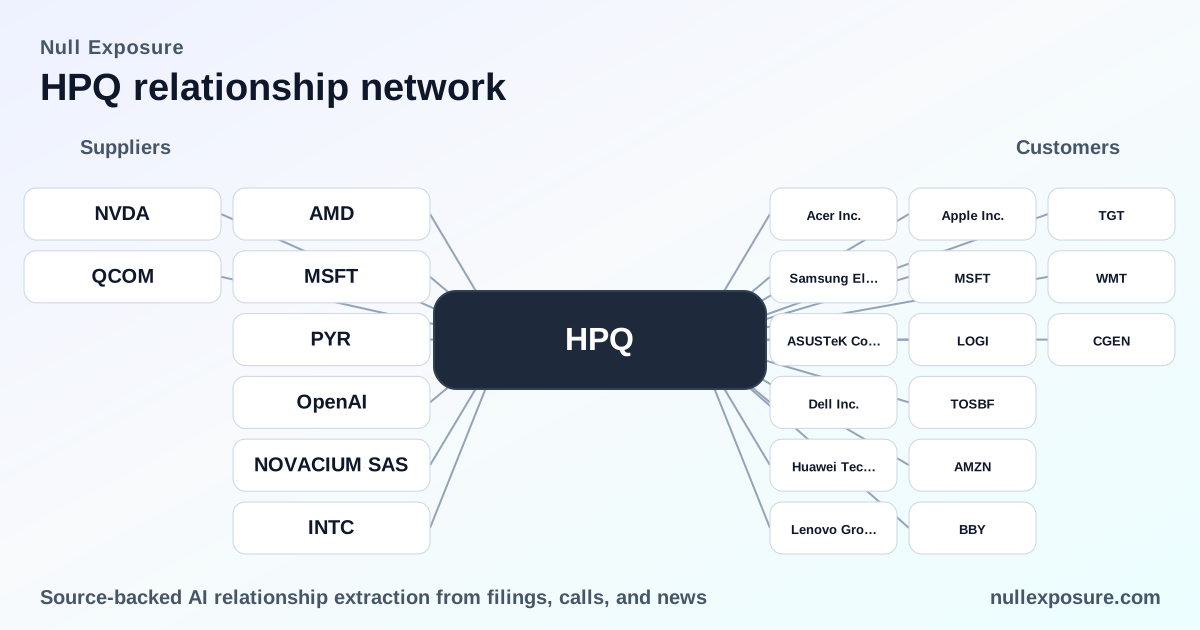
HP Inc (HPQ) — supplier relationships investors and operators need to know
HP Inc. designs and sells personal computers, printers and related supplies, and monetizes through hardware sales, consumables (printers/toner), services and software subscriptions; the company leverages large OEM/outsourced manufacturing arrangements and strategic technology partnerships to accelerate product cycles and embed AI and software value into its hardware platforms. HP generates cash from high-volume hardware sales and recurring consumables and services, while its supplier posture concentrates risk around a small set of critical component and manufacturing partners.
If you are benchmarking supplier risk or sourcing opportunities, start your research at https://nullexposure.com/.
Quick read: what the supplier map says about HP’s operating model
HP operates as a high-volume buyer and systems integrator. The company routinely executes a mixture of long-term purchase commitments and short-term, single-source agreements, outsources manufacturing globally, and uses supplier finance programs to manage working capital. That combination produces cost leverage at scale but also concentration and operational dependency on a handful of suppliers and contract manufacturers.
The relationships that matter — plain-English summaries with sourcing
Below are the partner relationships surfaced in public reporting and press items tied to HP’s FY2026 reporting window. Each entry is a concise, investor-oriented description with a source pointer.
-
AMD (Advanced Micro Devices, Inc.) — HP engages in deep co‑engineering with AMD to push neural processing unit performance in its AI PCs and to adopt AMD Ryzen AI silicon across OEM SKUs; this is central to HP’s next‑generation PC strategy. Source: CRN coverage of HP’s AI PC launch (reporting on the collaboration; referenced in FY2026 tracking) — https://www.crn.com/news/computing/2024/hp-intros-world-s-highest-performance-ai-pc-pushing-amd-chip-to-new-heights.
Additional AMD supply context: AMD’s March 2026 product release notes OEM availability including HP (GlobeNewswire, 2026) — https://www.globenewswire.com/news-release/2026/03/02/3247061/0/en/AMD-Gives-Consumers-and-Businesses-More-AI-PC-Options-with-Expanded-Ryzen-AI-400-Series-Portfolio.html -
Microsoft — HP expanded its enterprise integration with Microsoft by embedding Microsoft 365 Copilot into printers and by positioning devices to support Copilot+ PC experiences, strengthening software‑driven differentiation for HP’s printing and PC offerings. Source: Q1 FY2026 earnings call transcript coverage (InsiderMonkey / NationalCIOReview; Q1 FY2026) — https://insidermonkey.com/blog/hp-inc-nysehpq-q1-2026-earnings-call-transcript-1704014/ and https://nationalcioreview.com/articles-insights/cio-field-notes/hp-aligns-enterprise-growth-with-cost-discipline-in-q1/
-
OpenAI — HP established an exploratory partnership to pilot OpenAI Frontier for enterprise AI agent deployment on HP EliteBook platforms, signaling a move to tightly integrate third‑party AI platforms into device-level workflows. Source: InsiderMonkey earnings call transcript and FinancialContent market commentary (January–February 2026 reporting) — https://insidermonkey.com/blog/hp-inc-nysehpq-q1-2026-earnings-call-transcript-1704014/ and https://markets.financialcontent.com/stocks/article/marketminute-2026-2-26-the-ai-pc-paradox-hp-inc-navigates-a-high-stakes-refresh-cycle-amidst-component-crises
-
PyroGenesis Canada Inc. (PyroGenesis / PYR) — HP’s HPQ Silica Polvere subsidiary is collaborating with PyroGenesis on a 50 tonnes/year fumed‑silica reactor pilot; PyroGenesis reported pre‑commissioning activities targeting a Q3 FSR start. Source: HPQ Silica press releases hosted on hpqsilicon.com (press release, FY2026) — https://hpqsilicon.com/press-release/pre-commissioning-of-fumed-silica-reactor-pilot-plant-underway/ and https://hpqsilicon.com/press-release/fumed-silica-reactor-slashes-co2-emissions-in-fumed-silica-production/
-
NOVACIUM SAS — NOVACIUM is identified as a technology partner supporting HPQ’s development of lower‑carbon processes for critical materials used in fumed silica production, indicating HP’s supply‑chain investments in decarbonization technology. Source: HPQ Silica press release (FY2026) — https://hpqsilicon.com/press-release/fumed-silica-reactor-slashes-co2-emissions-in-fumed-silica-production/
-
Nvidia — HP partnered with Nvidia on an AI training and channel enablement program (AI MasterClass) to upskill partners and accelerate uptake of Nvidia-powered AI solutions across HP’s channel. Source: CRN coverage of HP channel initiatives (March 2024) — https://www.crn.com/news/ai/2024/hp-s-kobi-elbaz-hybrid-ai-is-a-massive-opportunity-for-partners
-
Intel — Intel remains a core processor supplier for HP’s AI PC refreshes and broader PC lineup; reporting highlights HP’s alignment with Intel for next‑gen AI laptops alongside AMD and Qualcomm. Source: Industry reporting aggregated into FY2026 coverage (CRN/Ad‑hoc news, referenced in FY2026 tracking) — https://www.crn.com/news/computing/2024/insight-s-megan-amdahl-on-windows-10-end-of-life-and-4-other-ai-pc-tailwinds and https://www.ad-hoc-news.de/boerse/news/ueberblick/hp-inc-why-this-boring-stock-just-got-seriously-interesting-for-you/68635553
-
Qualcomm — Qualcomm’s Snapdragon X processors power certain HP OmniBook X and EliteBook Ultra laptops; HP benchmarks NPU performance across Qualcomm, AMD and other silicon partners. Source: CRN product coverage (2024 reporting referenced in FY2026 collection) — https://www.crn.com/news/computing/2024/hp-intros-world-s-highest-performance-ai-pc-pushing-amd-chip-to-new-heights
Constraints and what they signal about HP’s supplier posture
HP’s public filings and operational disclosures reveal an explicit supplier and contracting posture that shapes both risk and opportunity:
-
Mixed contract horizon: HP maintains both substantial long‑term commitments (multi‑year purchase obligations, a $5.0 billion sustainability‑linked revolving facility) and short‑term, single‑source agreements. This structure delivers supply security for critical lines while preserving tactical flexibility for others. (Company 10‑K obligations, FY2025–FY2026 disclosures.)
-
Buyer with scale and concentration: HP is a large buyer with supplier spend bands concentrated well above $100m; outsourcers and three large contract manufacturers accounted for the vast majority of supplier receivables. This gives HP pricing leverage but creates dependency and counterparty concentration risk. (Purchase obligations and outsourced manufacturer receivable disclosures, FY2025.)
-
Global manufacturing footprint and geopolitical exposure: HP uses outsourced manufacturers globally (including Taiwan and broader APAC) and flags tariff, export, and tax audit exposures across ~60 jurisdictions — a native global supply chain with attendant trade and regulatory risk. (Operational and tax audit disclosures, FY2025.)
-
Criticality of suppliers: HP classifies supplier dependency for certain components as critical; for some parts, single‑source suppliers are necessary due to technology or capacity constraints (printer engines, ASICs, specialized NPUs). That elevates operational concentration risk for key SKUs. (10‑K supplier risk disclosures.)
-
Active supplier finance and working capital programs: Confirmed obligations under supplier finance programs ran to multiple billions, indicating HP actively manages payables and supplier liquidity as part of supply continuum management. (Supplier finance rollforward, FY2025 disclosures.)
Investment implications and operational actions for partners and operators
-
For investors: HP’s business model benefits from recurring consumables and embedded software, but investor returns are sensitive to component costs, tariff shocks and supplier disruptions. The stock’s valuation metrics (trailing P/E ~7.1, EV/EBITDA ~6.1) reflect cyclical and margin pressure dynamics while offering durable cash flows from consumables and services.
-
For procurement and operations teams: Prioritize resilience in single‑source categories, build contingency for high‑criticality components, and structure supplier finance programs to protect OEM and contract manufacturer cash flow while avoiding overconcentration of receivables. HP’s public disclosures make it clear that diversifying manufacturing and securing long‑term price stability on key inputs are core levers.
If you want deeper supplier exposure analytics and rolling alerts on HP relationships, visit https://nullexposure.com/ to get started.
Final takeaways and next steps
- HP’s supplier strategy is deliberate: scale buys leverage, but concentrated sourcing imposes material operational risk.
- Technology partnerships (AMD, Intel, Qualcomm, Nvidia, Microsoft, OpenAI) are being leveraged to turn hardware into a software‑anchored, AI‑enabled revenue stream.
- Critical materials initiatives (PyroGenesis, NOVACIUM) signal HP’s push to control niche inputs and reduce carbon intensity in supply chains.
For a practitioner-ready supplier risk scorecard and ongoing monitoring of HP’s partner roster, sign in or explore services at https://nullexposure.com/.